
Community listing page, reviews may not be monitored by the author.
HoloBuilder - Schematic loader


No reviews yet
Client-side schematic hologram builder with Fabric and NeoForge support.

Community voices
Reviews
No reviews yet. Be the first to review this project!
Get it on
Available Platforms
Compatibility
Supported Environments
Runs entirely on the client. Works on vanilla servers.
About
Project Details
For authors
Embed Badge
If you're the author of this project, you can embed a live badge anywhere that supports HTML or Markdown. It updates automatically whenever ratings change.
Use HTML for any page that supports it, or Markdown for README files and Markdown-based descriptions.
Identifiers
Platform IDs
Resources
External Links
About
Description

HoloBuilder
HoloBuilder is a client-side schematic hologram builder for Minecraft. It loads local schematic files and renders them as a translucent in-world guide, so you can line up a build, inspect missing or incorrect blocks, prepare materials, and work layer by layer without installing anything on the server.
What It Does
HoloBuilder focuses on planning and visual building:
- Load schematic files from
holobuilder/schematics/. - Preview the structure as an in-world hologram.
- Compare expected blocks with the current world.
- Highlight incorrect blocks in red.
- Optionally show already-correct blocks with subtle outlines.
- Move the placement relative to the direction you are looking.
- Rotate the schematic horizontally or vertically by 90 degrees around its center.
- Mirror the schematic directly in game.
- Work with one Y layer at a time.
- Preview required materials from the schematic selection screen.
- Compare required materials with your current inventory, hotbar, offhand, shulker boxes, and readable bundles/pouches.
- Export selected areas into supported schematic formats.
- Show, hide, or clear
/holoposselections with configurable shortcuts.
The mod is client-side only. It does not need to be installed on the server.
Performance Warning
Very large schematics can still cause significant FPS drops or stutters while the hologram is visible, especially with high render-distance settings or complex block states. For the smoothest experience, lower HoloBuilder's render distance, use layer view, hide already-correct blocks, or split very large builds into smaller schematics.
Supported Files
The schematic selector currently accepts:
.holo.litematic.schem.schematicNBT
The .schem, .schematic, and .litematic formats are NBT-based. HoloBuilder accepts compressed and uncompressed NBT imports. The native .holo format is recommended for the most reliable workflow, while unusual external files may still expose edge cases depending on their metadata and block states.
Basic Usage
- Put schematic files in:
<game directory>/holobuilder/schematics/- Press
Hin game. - Select a schematic.
- Click
Load. - Move, rotate, mirror, or switch layers until the hologram is aligned.
No schematic is loaded automatically when joining a world.
Controls
Default keybinds :
H: open schematic selector.G: toggle schematic rendering.Numpad 8 / 2: move forward/backward relative to your horizontal view direction.Numpad 4 / 6: move left/right relative to your horizontal view direction.Numpad 9 / 3: move up/down.Numpad + / -: rotate by 90 degrees.Numpad /: rotate vertically by 90 degrees.Numpad *: toggle mirror mode.Numpad 7 / 1: show higher/lower layer.X: show all layers.Numpad .: show or hide the/holoposselection without clearing it.Delete: clear both/holoposselection points.Numpad 5: reload the active schematic.
Selection And Export
HoloBuilder includes simple client commands for selecting and exporting a cuboid area:
/holopos 1/holopos 2/holopos info/holopos clear/holo save <format> [name]/holo undo
Supported export formats:
holoschematicschemlitematicNBT
Exports are written to holobuilder/schematics/.
Creative Build Tools
HoloBuilder includes optional build assist tools for creative mode:
B: direct-build all missing/incorrect blocks.V: toggle auto placer for the aimed hologram block.C: toggle full auto build for the aimed hologram block.
These tools are only available in creative mode and use normal Minecraft /setblock commands. On multiplayer servers, they still depend on server permissions and rules. HoloBuilder suppresses its own vanilla /setblock feedback spam locally, but it does not change world gamerules.
Survival gameplay remains visual-only: no automatic block placement is available there.
Compatibility
- Minecraft 1.21.1, 1.21.5, and 1.21.11
- Minecraft 26.1, 26.1.1, 26.1.2, and 26.2
- Fabric build available
- NeoForge build available
- Fabric API required for the Fabric build
- Server-side installation not required
Fabric and NeoForge are distributed as separate jar files. One shared 26.1.x file supports Minecraft 26.1 through 26.1.2. Use the file that matches your Minecraft version and mod loader.
Release Notes
The main schematic workflow is visual and client-side. It does not place blocks, modify the world, or require a server-side installation.
Creative build tools are optional and creative-mode only. They use normal Minecraft /setblock commands, so back up important worlds before using them on saves you care about.
Areas where reports are especially useful:
- unusual
.litematic,.schem, and.schematicfiles - complex block states
- large schematics
- multiplayer permission behavior
- loader-specific UI/rendering differences
Independent Project
HoloBuilder is an original independent project. It is not based on Litematica, does not reuse Litematica source code, does not copy its internal architecture, and does not depend on MaLiLib.
Join the official Discord:
HoloBuilder
HoloBuilder is a client-side schematic hologram builder for Minecraft. It loads local schematic files and renders them as a translucent in-world guide, so you can line up a build, inspect missing or incorrect blocks, prepare materials, and work layer by layer without installing anything on the server.
What It Does
HoloBuilder focuses on planning and visual building:
- Load schematic files from
holobuilder/schematics/. - Preview the structure as an in-world hologram.
- Compare expected blocks with the current world.
- Highlight incorrect blocks in red.
- Optionally show already-correct blocks with subtle outlines.
- Move the placement relative to the direction you are looking.
- Rotate the schematic horizontally or vertically by 90 degrees around its center.
- Mirror the schematic directly in game.
- Work with one Y layer at a time.
- Preview required materials from the schematic selection screen.
- Compare required materials with your current inventory, hotbar, offhand, shulker boxes, and readable bundles/pouches.
- Export selected areas into supported schematic formats.
- Show, hide, or clear
/holoposselections with configurable shortcuts.
The mod is client-side only. It does not need to be installed on the server.
Performance Warning
Very large schematics can still cause significant FPS drops or stutters while the hologram is visible, especially with high render-distance settings or complex block states. For the smoothest experience, lower HoloBuilder's render distance, use layer view, hide already-correct blocks, or split very large builds into smaller schematics.
Supported Files
The schematic selector currently accepts:
.holo.litematic.schem.schematicNBT
The .schem, .schematic, and .litematic formats are NBT-based. HoloBuilder accepts compressed and uncompressed NBT imports. The native .holo format is recommended for the most reliable workflow, while unusual external files may still expose edge cases depending on their metadata and block states.
Basic Usage
- Put schematic files in:
<game directory>/holobuilder/schematics/
- Press
Hin game. - Select a schematic.
- Click
Load. - Move, rotate, mirror, or switch layers until the hologram is aligned.
No schematic is loaded automatically when joining a world.
Controls
H: open schematic selector.G: toggle schematic rendering.Numpad 8 / 2: move forward/backward relative to your horizontal view direction.Numpad 4 / 6: move left/right relative to your horizontal view direction.Numpad 9 / 3: move up/down.Numpad + / -: rotate by 90 degrees.Numpad /: rotate vertically by 90 degrees.Numpad *: toggle mirror mode.Numpad 7 / 1: show higher/lower layer.X: show all layers.Numpad .: show or hide the/holoposselection without clearing it.Delete: clear both/holoposselection points.Numpad 5: reload the active schematic.Numpad 0: unload the active schematic.
All keybinds can be changed in Minecraft's controls menu. The HUD displays your rebound keys instead of hardcoded defaults.
Selection And Export
HoloBuilder includes simple client commands for selecting and exporting a cuboid area:
/holopos 1/holopos 2/holopos info/holopos clear/holo save <format> [name]/holo undo
Supported export formats:
holoschematicschemlitematicNBT
Exports are written to holobuilder/schematics/.
Creative Build Tools
HoloBuilder includes optional build assist tools for creative mode:
B: direct-build all missing/incorrect blocks.V: toggle auto placer for the aimed hologram block.C: toggle full auto build for the aimed hologram block.
These tools are only available in creative mode and use normal Minecraft /setblock commands. On multiplayer servers, they still depend on server permissions and rules. HoloBuilder suppresses its own vanilla /setblock feedback spam locally, but it does not change world gamerules.
Survival gameplay remains visual-only: no automatic block placement is available there.
Compatibility
- Minecraft 1.21.1, 1.21.5, and 1.21.11
- Minecraft 26.1, 26.1.1, 26.1.2, and 26.2
- Fabric build available
- NeoForge build available
- Fabric API required for the Fabric build
- Server-side installation not required
Fabric and NeoForge are distributed as separate jar files. One shared 26.1.x file supports Minecraft 26.1 through 26.1.2. Use the file that matches your Minecraft version and mod loader.
Release Notes
The main schematic workflow is visual and client-side. It does not place blocks, modify the world, or require a server-side installation.
Creative build tools are optional and creative-mode only. They use normal Minecraft /setblock commands, so back up important worlds before using them on saves you care about.
Areas where reports are especially useful:
- unusual
.litematic,.schem, and.schematicfiles - complex block states
- large schematics
- multiplayer permission behavior
- loader-specific UI/rendering differences
Independent Project
HoloBuilder is an original independent project. It is not based on Litematica, does not reuse Litematica source code, does not copy its internal architecture, and does not depend on MaLiLib.
Join the official Discord:
Screenshots
Gallery
-
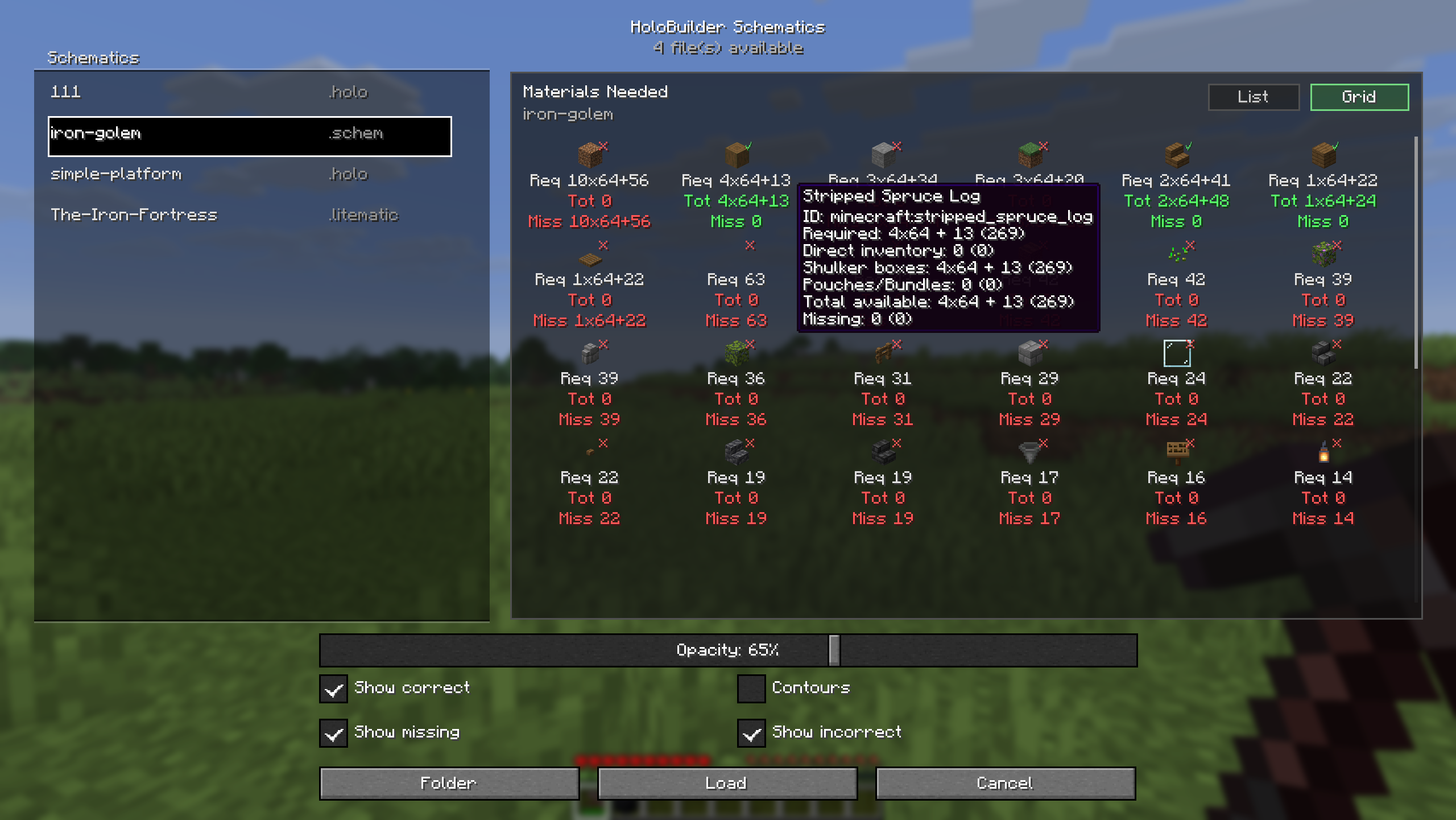 Survival Material List Also detects the items present in your shulker or pocket
 -
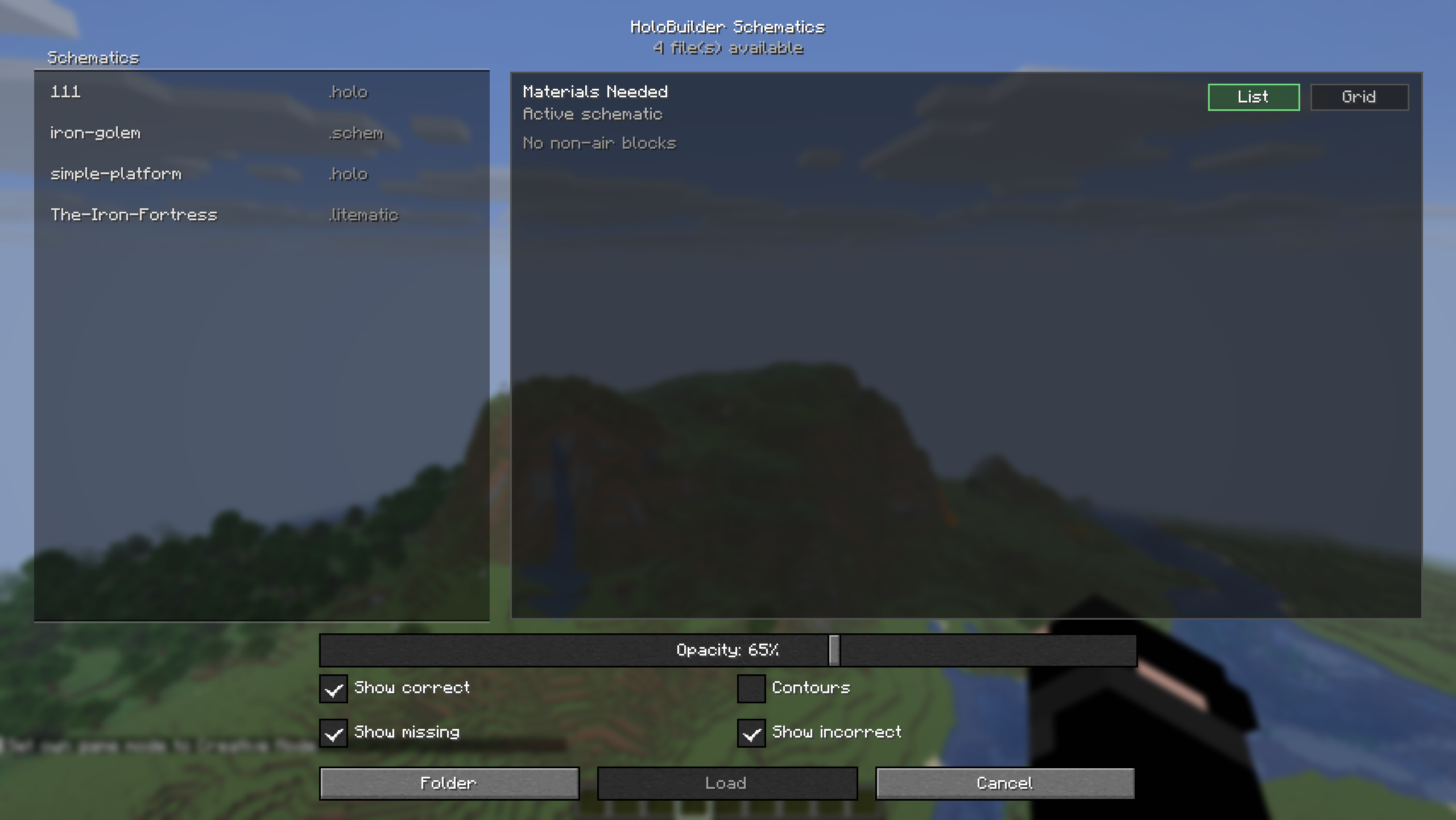 HoloBuilder Menu Press "H" to open
 -
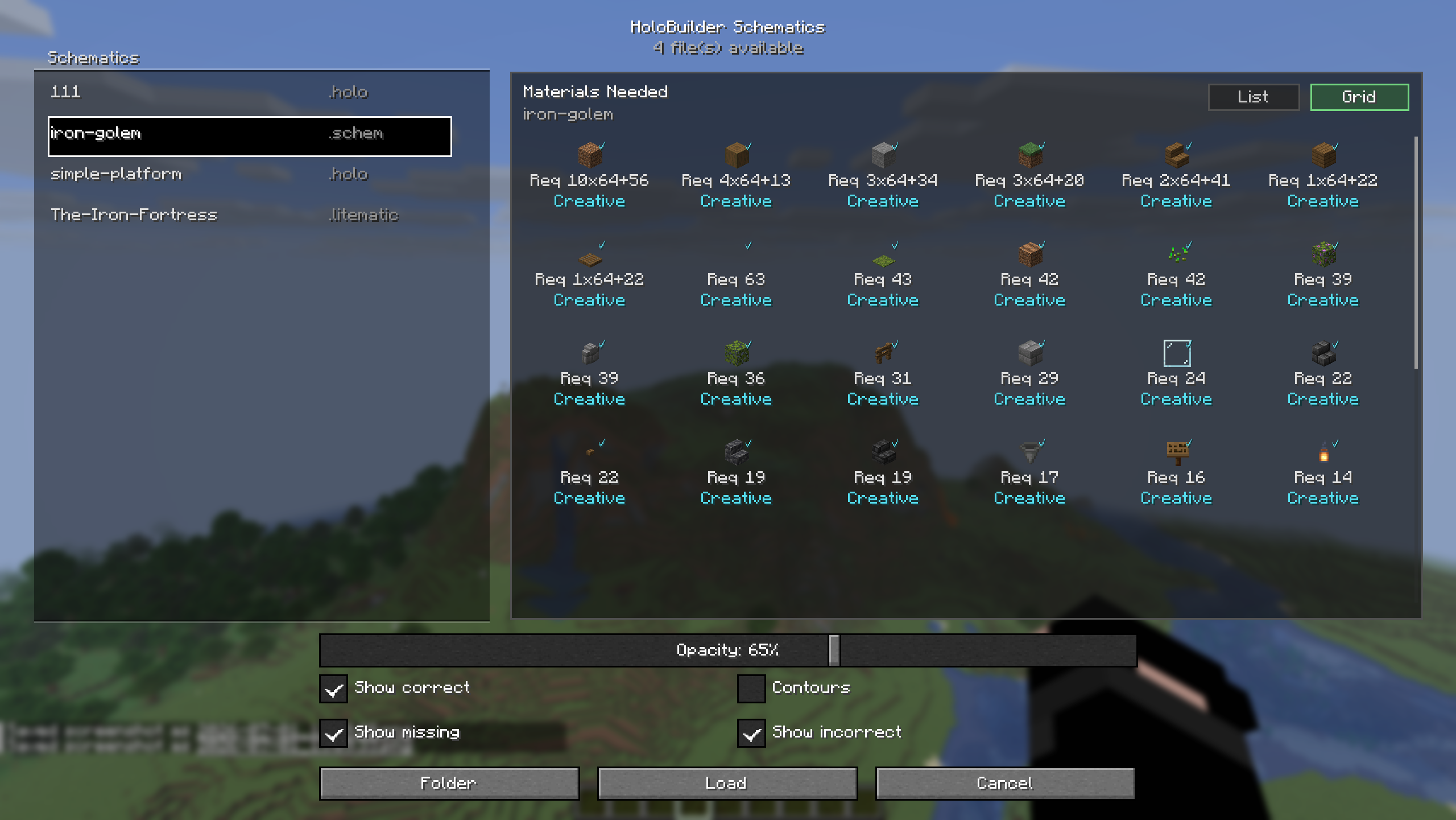 Schematic mosaic list display You may switch between List and Mosaic modes for displaying material lists
 -
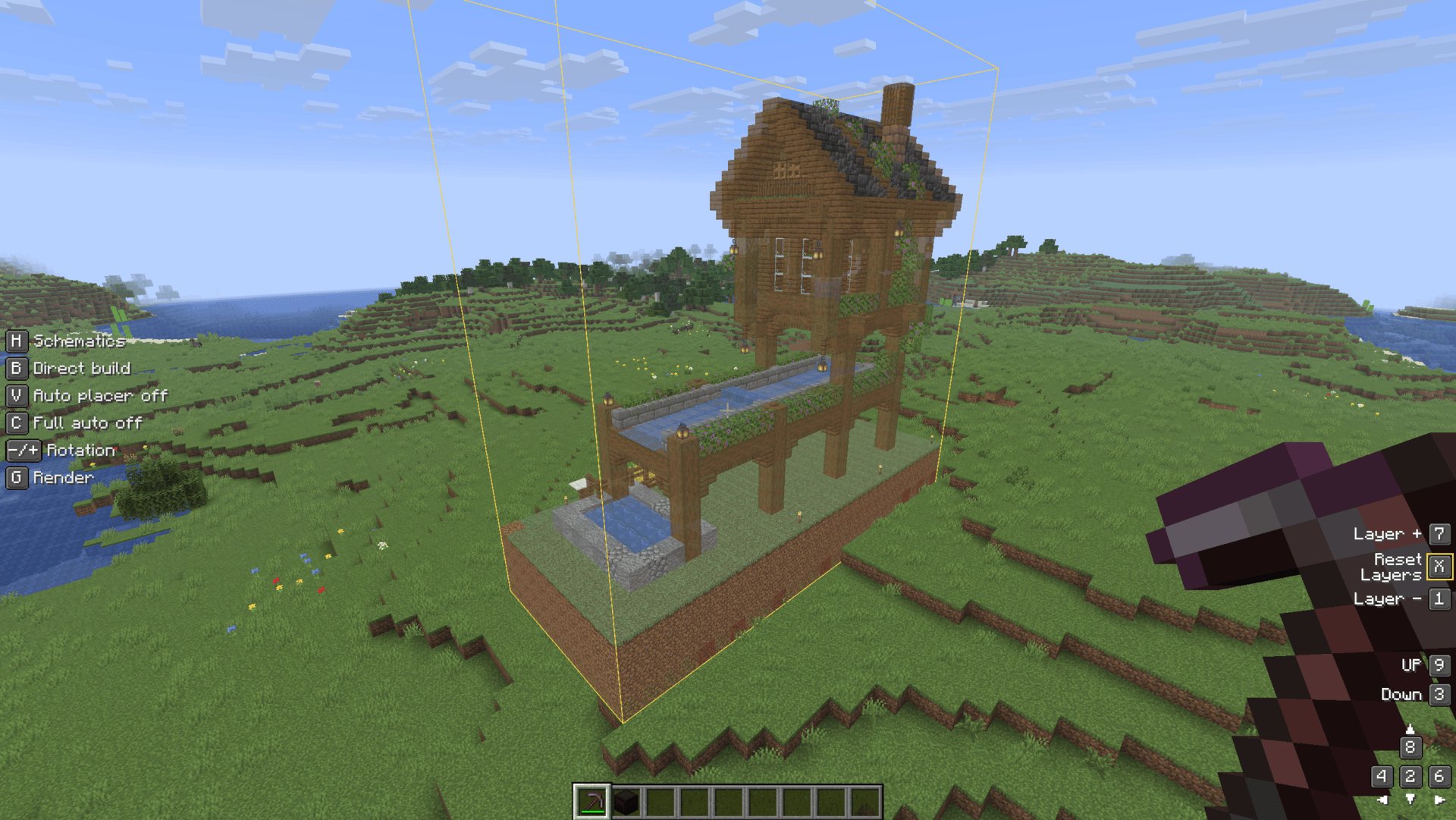 Schematic in world Schematic placed in the world with 80% opacity
 -
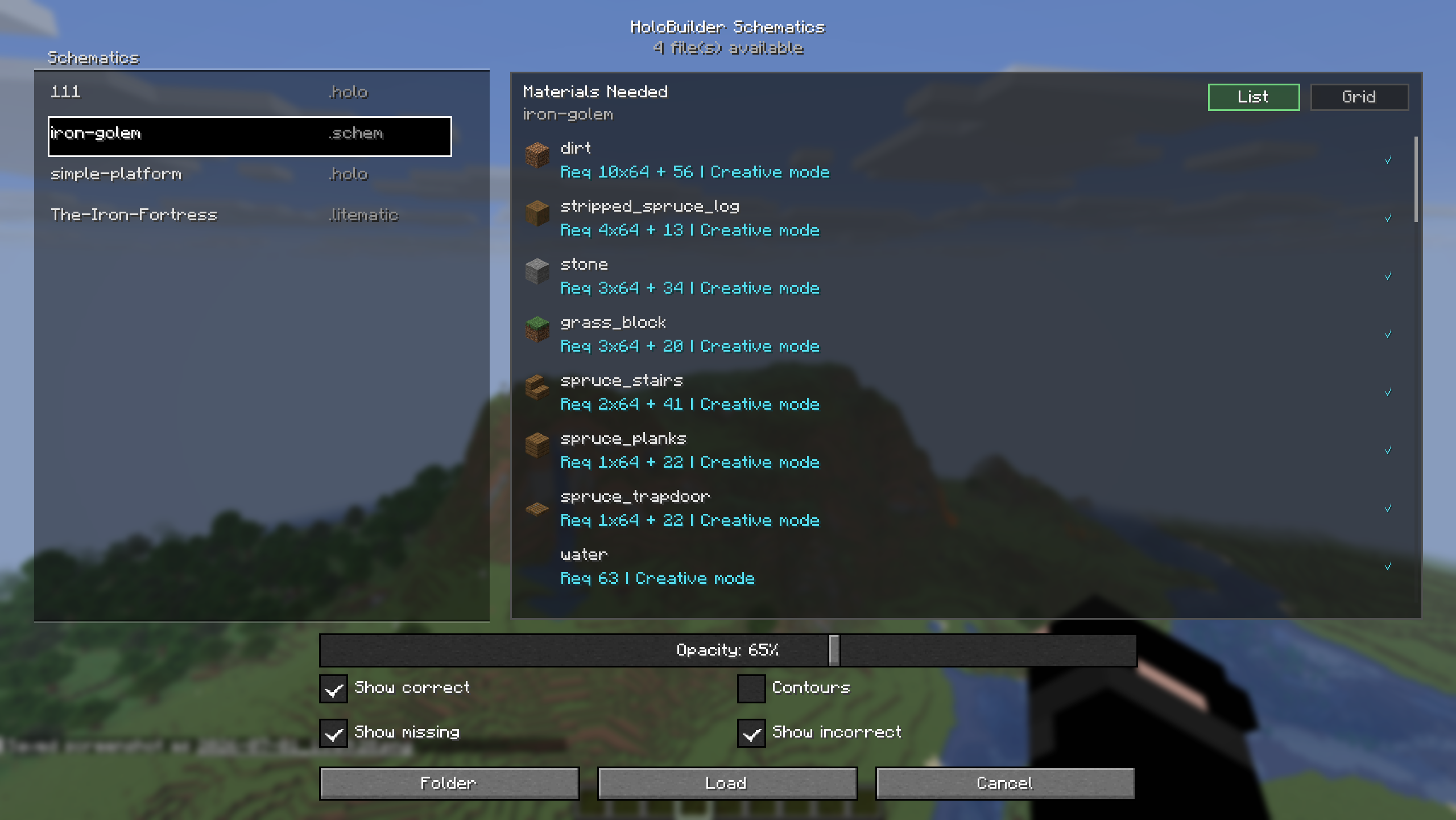 schematic selected - creative Material list when you select a schematic
Versions
Files
Relations
Project Relations
More like this
Similar Mods
Suggestions use data such as tags, dependencies, dependents, descriptions, titles, and more to rank how much they overlap with this mod.
On ModDex
Community snapshot
By the numbers
Statistics

Get it on
Available Platforms
On ModDex
Community snapshot
By the numbers
Statistics
Resources