Community listing page, reviews here may not be monitored by the author.
Immersive Science

No reviews yet
Applied Science is an immersive multi-disciplinary science mod that turns the world into a hands-on laboratory.
Community voices
Reviews
No reviews yet. Be the first to review this project!
Get it on
Available Platforms
About
Project Details
For authors
Embed Badge
If you're the author of this project, you can embed a live badge anywhere that supports HTML or Markdown. It updates automatically whenever ratings change.
Use HTML for any page that supports it, or Markdown for README files and Markdown-based descriptions.
Identifiers
Platform IDs
Resources
External Links
About
Description
Build a laboratory. Study the unknown. Turn Minecraft resources into scientific discovery.
Immersive Science is a hands-on, vanilla-plus science mod for Minecraft Java Edition 1.21.1. It adds a connected chemistry and research sandbox built around finite matter, physical laboratory procedures, procedural substances and diseases, analytical instruments, all-element discovery, and player-specific scientific records.
Instead of reducing science to a single crafting block, Immersive Science asks you to perform the process: extract a substance, measure it, control its conditions, separate the mixture, analyze the evidence, and file the result. The reward is not simply another item—it is knowledge that changes what your character can understand.
The decorative artwork on this page is illustrative rather than a gameplay screenshot. Each section piece is based on recognizable in-mod models, sprites, and visual designs.
Start here
- Install Fabric Loader, Fabric API, and Cardinal Components API for Minecraft 1.21.1.
- Place Immersive Science and both required API mods in the
modsfolder. For multiplayer, install them on the server and on every joining client. - Craft a Chemistry Textbook and Lab Notebook. The Textbook teaches the controls and procedures; the Notebook stores your own observations, reports, discovered substances, procedures, experiments, and elements.
- Use the recipe book and Textbook to build your first Hotplate, glassware, Pipette, Thermometer, Mortar and Pestle, Scale, and safety equipment.
- Begin with extraction and measurement, then advance into chromatography, crystallography, separation, prepared reagents, titration, spectroscopy, elemental analysis, reaction chemistry, and gas handling.
No outside chemistry knowledge is required. The Textbook explains unfamiliar operations in-game, while the physical controls and crosshair HUD show what each visible part of an instrument does.
The Chemistry System
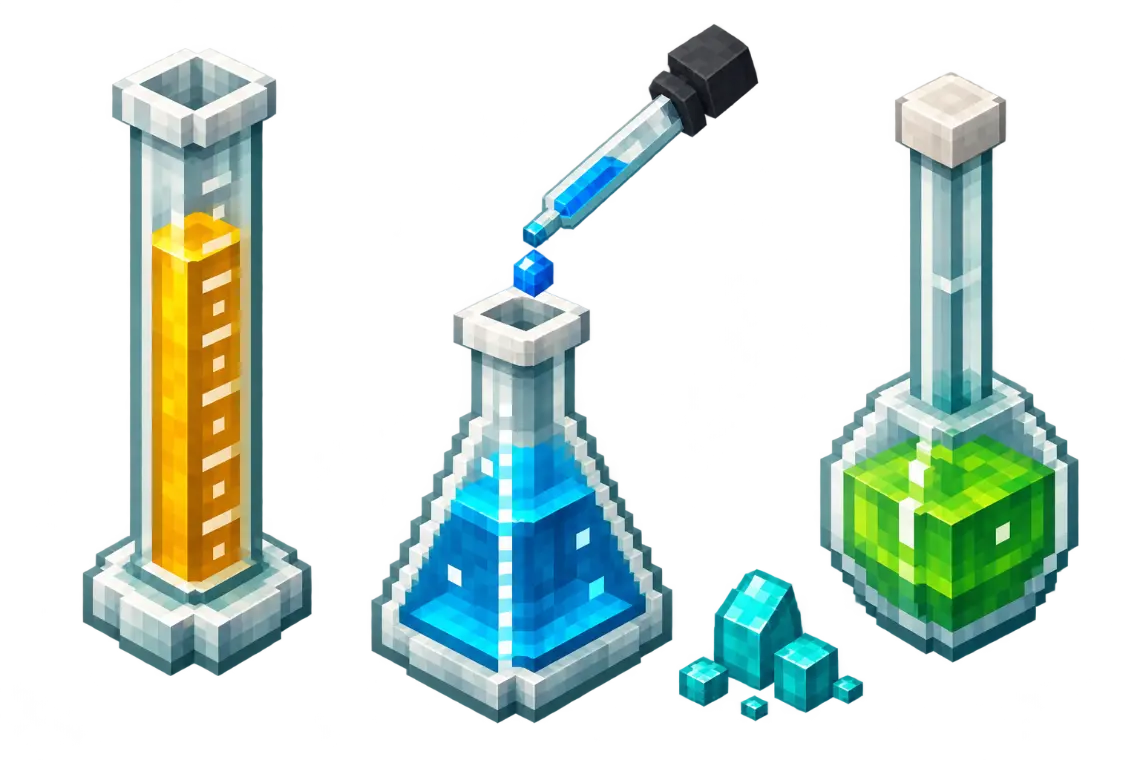
Chemistry in Immersive Science is a matter system rather than a list of decorative recipes. Solutions retain their actual contents and amounts while the game tracks the simplified scientific properties needed to make laboratory choices meaningful.
- Extract substances from vanilla resources using compatible solvents and conditions.
- Measure and transfer finite millibucket volumes without silently creating or deleting matter.
- Grind crystals and solid sources into powder with the Mortar and Pestle.
- Weigh powders with the Scale, Weigh Boat, and Scoopula.
- Dissolve materials incrementally instead of watching them transform all at once.
- Heat, cool, stir, concentrate, crystallize, decant, and prepare repeatable reagents.
- Work with temperature, pH, phase, concentration, purity, solubility, polarity, reaction equivalents, conversion, and yield.
- Use specialized vessels: Beakers for general work, Erlenmeyers for swirling, Graduated Cylinders for measurement and transfer, and Volumetric Flasks for calibrated preparation.
- See liquid and powder levels, colors, process state, and contents reflected across held, placed, mounted, and inventory presentations.
Substances begin unknown. Appearance can suggest a difference, but identity has to be earned through evidence.
The Reaction Engine
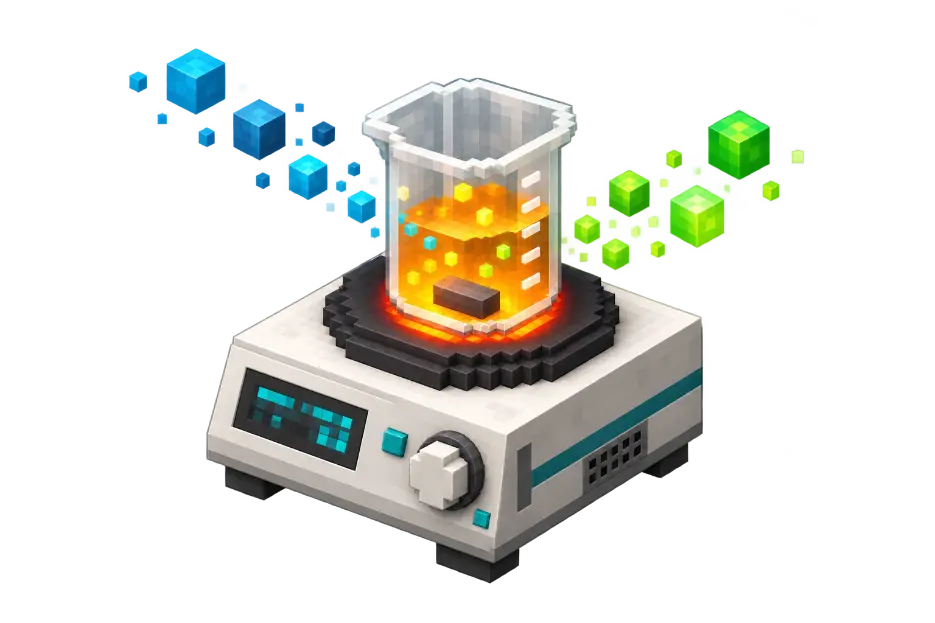
The Reaction Engine evaluates what is actually in a vessel and whether the required conditions have been met. It is not shapeless “combine anything” crafting: structure, quantity, apparatus, and environment matter.
- Reactions conserve atoms and charge and retain excess material after the limiting reagent is exhausted.
- Temperature, pH, stirring, headspace, catalysts, prepared reagents, and metered gas can determine whether a process starts or pauses.
- Invalid or incomplete setups explain what is missing instead of consuming inputs invisibly.
- Progress is gradual, visible, persistent, and resumable.
- Authored structural families include oxidation, reduction, hydration, dehydration, hydrogenation, and chloro-hydrolysis.
- Inorganic rules support charge-balanced ionic formula units, double displacement, solubility-driven precipitation, acid/base behavior, titration, and metal-acid hydrogen production.
- Hotplates can heat, stir, process a solution, and accept routed gas as parts of one connected experiment.
The system is broad enough to support experimentation while remaining deliberately authored: arbitrary mixtures do not automatically produce arbitrary real-world reactions.
Laboratory Techniques and Apparatus
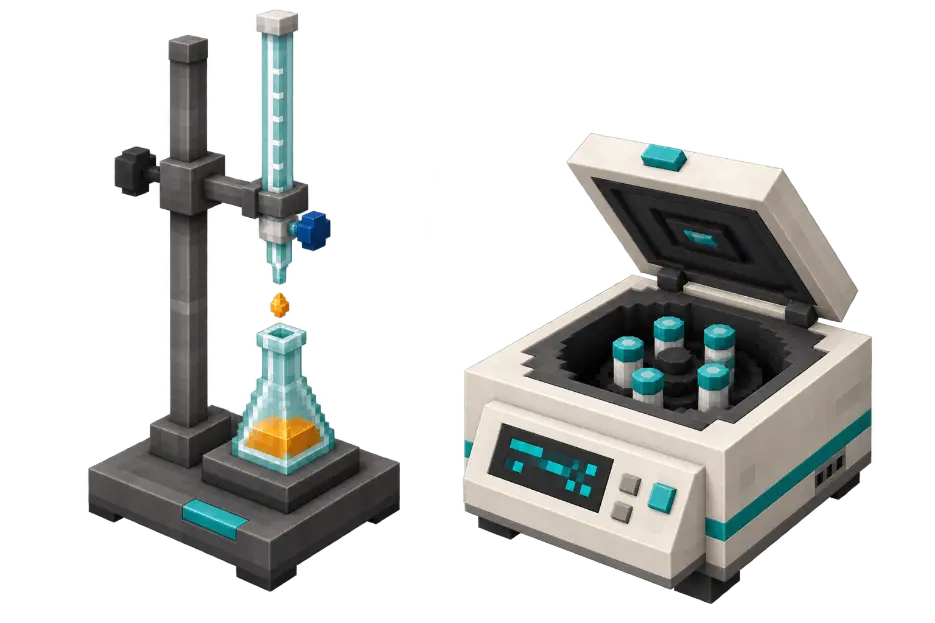
Laboratory equipment is designed around visible parts and distinct procedures. Aim at the actual vessel, slot, clamp, valve, button, tray, screen, or control you intend to use; the outline and crosshair HUD identify the active target.
Heat, cooling, and measurement
- Use the Hotplate for controlled heating and magnetic stirring.
- Ignite and adjust the Bunsen Burner as a standalone heat source.
- Set the reusable Cooling Basin to a cooling target without feeding it endless ice items.
- Read samples with the Thermometer, pH Paper, and reusable pH Meter.
- Use the Scale for mass-aware powder work and reagent preparation.
Separation and purification
- Develop paper chromatograms in a prepared Petri Dish.
- Pack a Burette for column chromatography and collect separate fractions.
- Add an Automatic Stopcock when a procedure requires precise fraction control.
- Perform gravity separation, Büchner filtration, distillation, cooling-driven precipitation, and concentration.
- Use the Centrifuge when an emulsion or close-density mixture cannot settle cleanly on its own.
Gas handling
- Produce, vent, route, collect, and analyze gases.
- Connect a Delivery Tube between a source and a receiver.
- Capture gas in a Test Tube or Eudiometer and route a sealed sample into another process.
- Choose sealed-source or ambient routing deliberately; the ambient route samples room air and is not an exhaust filter.
The modular Ring Stand brings these systems together through mounted vessels, Burettes, Condensers, Delivery Tubes, Büchner Funnels, Cuvettes, Test Tubes, heat sources, and cooling equipment.
Analysis, Discovery, and All 118 Elements
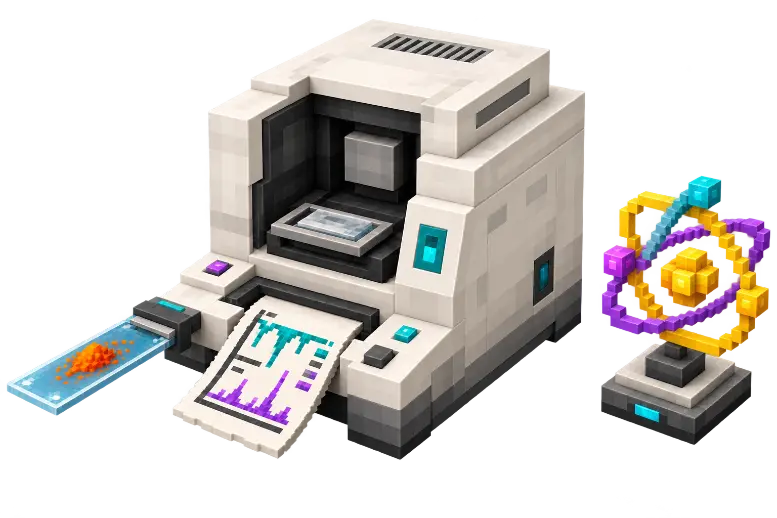
The In My Elements system extends the research architecture across all 118 atomic-number slots. Each world receives a persistent Immersive identity map with fictional names, symbols, colors, and patterns, while the underlying chemistry remains attached to the same scientific element.
Diffractometer
Concentrate a solution into a Crystal, analyze it, and print a Crystallograph. Diffraction provides identity-safe evidence such as provisional atomic sites, ratios, lattice geometry, coordination, symmetry, approximate distances and angles, a crystal system, and a repeatable powder trace. It does not magically reveal the hidden elements or complete molecular graph.
Spectrometer
Prepare a liquid Cuvette, powder-coated Glass Slide, or gas-filled Eudiometer and insert it into the correct physical port.
- Molecular Analysis reveals spectral evidence and can ultimately unlock formula, connectivity, bonds, functional groups, charges, and molecular properties.
- Elemental Analysis characterizes individual atomic species during a private analysis session and prints one report for each completed element.
- The same captured carrier can support both modes, once each, before it is removed.
- Unfiled elemental discoveries are temporary; removing the empty carrier ends the session and discards anything that was not printed and filed.
File Elemental Analysis Reports to unlock player-specific periodic-table pages with proton, neutron, and electron counts, electron configurations, shell diagrams, orbital boxes, category, state, oxidation behavior, electronegativity, and other supported properties.
Scope note: all 118 elements participate in the reference, identity, and analytical architecture. That does not mean every element is common, naturally obtainable, or allowed inside unrestricted random molecule generation. Rare, synthetic, and chemically difficult regions remain intentionally bounded.
Research That Remembers
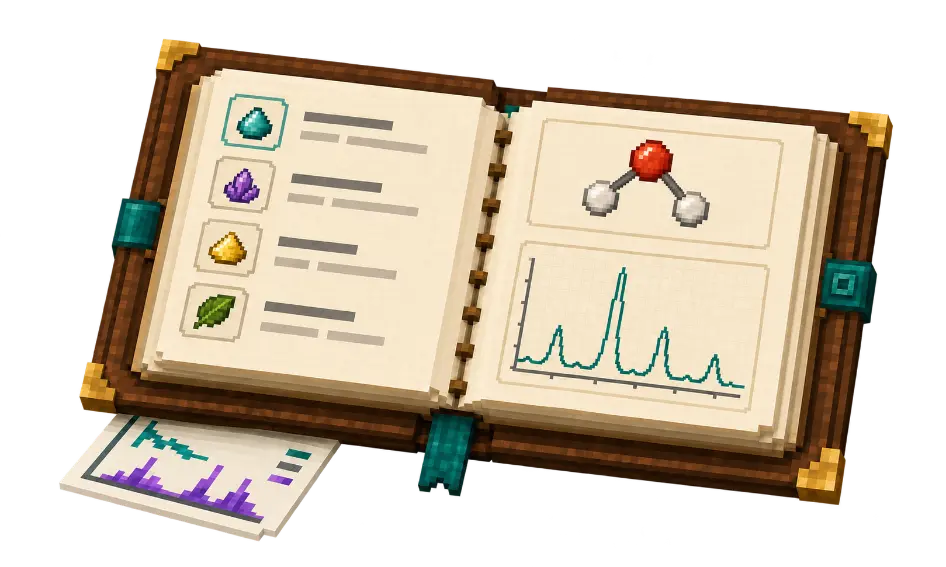
The Chemistry Textbook is the laboratory manual. The Lab Notebook is the record of what a particular player has actually learned.
Your Notebook can organize:
- substances and unknown mixture components;
- experiment logs and analytical failures;
- procedures, sources, and methods;
- reaction records;
- chromatograms, crystallographs, and molecular spectrographs;
- discovered elements and the Periodic Table;
- bookmarks, search results, and shared reports.
Knowledge advances through a real sequence:
chromatography → provisional diffraction → molecular analysis → Ponder → elemental reports
Printing is not enough. Reports must be physically filed into a writable Notebook before their results become permanent knowledge. Unresolved records remain private and do not leak hidden identities to another player simply because they received the item.
Press K to switch learned chemical presentation between Realistic and Immersive Science modes. The displayed names, symbols, and colors change; the substance and its behavior do not.
Microbiology, Disease, and Laboratory Safety
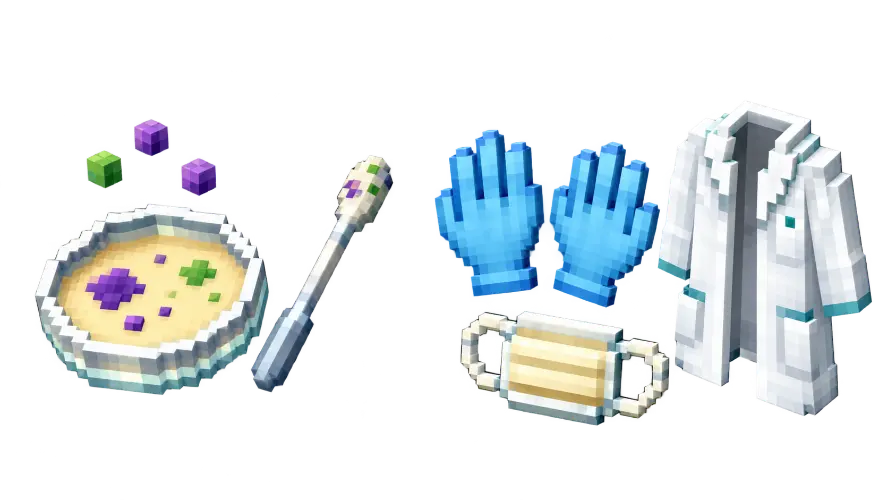
Immersive Science also contains a procedural disease and contamination system. Diseases combine generated properties, appearances, symptoms, treatment profiles, and airborne, contact, or foodborne transmission.
- Contamination can travel through mobs, dropped items, containers, vehicles, and food logistics—not only direct player contact.
- Use Swabs, Glass Slides, Petri Dishes, and the Microscope to collect, culture, inspect, and identify samples.
- Use chemistry-derived treatments only when a solution matches the disease's treatment profile.
- Clean contaminated work with disinfecting supplies and dispose of used material through the Biohazard Waste Bin and sealed waste bags.
- Structure- and pH-derived chemical hazards can expose players through contact or vapor routes.
Protection is layered rather than cosmetic:
- Nitrile Gloves protect contact handling and can themselves become contaminated.
- Face Masks reduce airborne and vapor exposure.
- Lab Coats and Gowns provide partial protection appropriate to their role.
- Goggles protect the eyes and expose more detailed laboratory readouts.
- A properly sealed Hazmat Suit provides the strongest route protection.
Clean Gloves and Face Masks are single-use once removed. Used protection looks used and cannot simply be equipped forever.
Why Immersive Science?
- It makes the procedure the gameplay. Measurement, transfer, separation, analysis, and documentation are meaningful actions rather than decorative menus.
- It creates a different scientific world each time. Procedural source profiles, Immersive element identities, substances, and diseases make discovery worth repeating.
- It respects uncertainty. Unknowns remain unknown, incomplete evidence stays provisional, and unavailable real-world element data is not presented as false certainty.
- It teaches without requiring homework. The in-game Textbook introduces each concept, while the systems preserve recognizable ideas from real science.
- It looks and sounds physical. Vessels show their contents, controls move, carriers enter visible ports, reports emerge from trays, PPE appears on the player, and a material-driven sound library gives laboratory actions tactile feedback.
- It is built for a longer world. Early extraction and glassware grow into separation, gas chemistry, spectroscopy, elemental analysis, and a permanent research archive.
Cross-Mod Integration Roadmap
Planned—not included in 2.6.3. The integrations described below are the intended direction for future releases. Installing these companion mods today will not add cross-mod recipes, automation hooks, energy requirements, colony disease events, medications, or special compatibility blocks.
Create: a laboratory that joins the factory
Planned Create integration will connect laboratory work to Create's automation language. Mechanical systems such as belts, funnels, pipes, deployers, sequenced processes, and other appropriate components are intended to transport samples, handle repeatable preparation steps, and automate established procedures. The goal is to let a mature laboratory grow into a working scientific production line without removing the need to discover, validate, and understand a process first.
FE/RF-style power: energy becomes part of the experiment
When a supported energy mod is present, future analytical and advanced laboratory blocks are intended to connect to Forge Energy (FE) and compatible networks—often informally called RF-style power. Some machines would require power to operate, making generation capacity, energy storage, throughput, and laboratory infrastructure meaningful parts of progression. Compatibility-specific power interfaces or blocks may become available only when the relevant mod is detected.
MineColonies: diagnose and defend a living colony
Planned MineColonies integration will allow Immersive Science diseases to affect colonists and spread through colony life. The player would investigate outbreaks, identify the disease, develop the correct cure or medication, and supply the colony with treatment. This is intended to connect diagnosis, chemistry, disease transmission, and future medication development to the health of an entire settlement rather than only the player.
Conditional compatibility modules
Future releases are intended to detect supported companion mods and make purpose-built blocks, recipes, interfaces, or procedures available for those combinations. These additions will be authored for specific integrations; Immersive Science will not automatically invent compatibility for every installed mod.
Current status: Create automation, FE/RF energy use, MineColonies disease support, medication production, and detected-mod compatibility blocks are all roadmap features. They are not functional in version 2.6.3 and should not be used as a reason to install the current release.
Controls at a Glance
| Input | Laboratory use |
|---|---|
| Right-click | Ordinary use of the targeted part |
| Sneak + right-click | Contextual Minecraft secondary use |
| Alt + right-click | Immersive Science alternate laboratory action |
| Alt + scroll in the world | Adjust the setting named by the crosshair HUD |
| Scroll over an inventory item | Change an advertised dose, mark, or wearable setting |
| K | Toggle Realistic/Immersive chemical presentation |
| E inside a book | Go back one level; from Home, close the book |
| Esc | Close the current screen immediately |
Requirements and Important Information
Required
- Minecraft Java Edition 1.21.1
- Fabric Loader 0.18.4 or newer
- Fabric API
- Cardinal Components API 6.1.3 or newer, below 7.0.0
- Java 21
- The mod and required dependencies on both the server and every joining client for multiplayer
Fabric first with NeoForge bridge
Fabric is the primary and supported loader for Immersive Science. There is no native NeoForge build.
On Minecraft 1.21.1, a NeoForge setup is possible through Sinytra Connector and Forgified Fabric API, which provide a bridge for Fabric mods in the NeoForge environment. This route is currently certified for Immersive Science 2.6.3. Use matching 1.21.1 versions of NeoForge, Connector, and Forgified Fabric API; ensure the Cardinal Components API dependency is also satisfied; back up valued worlds; and test in a disposable instance before committing a world or server.
Immersive Science does not support Forge or Bedrock Edition.
Read before adding it to a world
- Immersive Science is a gameplay-focused, near-realistic simulation—not an exhaustive chemistry simulator and never laboratory or medical guidance.
- Back up valued worlds before adding, removing, or updating any large content mod.
- Mix powders intentionally: a mixed powder stack cannot currently be separated back into its original components.
- One Spectrometer carrier can be loaded at a time, and unfiled element identities are lost when that analysis session ends.
- Current chemistry covers authored reaction families and a first-pass inorganic foundation. It does not claim complete coordination, metallic, organometallic, superheavy, or condition-specific real-world chemistry.
- Pharmaceutical production, pills, vaccines, branded medications, and the Pill Maker are not current 2.6.3 gameplay.
Credits
Development: Starship21 Foundation: Immersive Science began as a Minecraft 1.21.1 porting effort based on Minepathy by EightSidedSquare and Luxintrus. That foundation was subsequently and extensively redesigned, expanded, and connected into the current science experience.
Compatibility support: The project contains a locally adapted compatibility subset in EightSidedSquare's zine package namespace.
Immersive Science is distributed under All Rights Reserved. Minecraft, Fabric, and all third-party projects remain the property of their respective owners. Immersive Science is not an official Minecraft product and is not approved by or associated with Mojang or Microsoft.
Observe carefully. Measure twice. Label everything.
Your world is full of unknowns—build the laboratory that can explain them.
Screenshots
Gallery
-
 Immersive Science Title Graphic.png Immersive Science Title Graphic.png
Versions
Files
Relations
Project Relations
More like this
Similar Mods
Suggestions use data such as tags, dependencies, dependents, descriptions, titles, and more to rank how much they overlap with this mod.
On ModDex
Community snapshot
By the numbers
Statistics
Want to reach Minecraft players?
We're looking for a server hosting partner to feature here and other parts of the site. Interested? Send us a message!
Get in touchGet it on
Available Platforms
On ModDex
Community snapshot
By the numbers
Statistics
Resources