
Community listing page, reviews here may not be monitored by the author.
GUI Shop by Rickiewars

No reviews yet
GuiShop is a Fabric server-side mod to create and manage GUI shops in Minecraft. It comes with its own economy but also integrates seamlessly with other economy providers. GuiShop is based on the works of UnsafeDodo, adapted and extended to fit my needs.
Community voices
Reviews
No reviews yet. Be the first to review this project!
Get it on
Available Platforms
Compatibility
Supported Environments
Runs entirely on the server. Also works in singleplayer.
About
Project Details
For authors
Embed Badge
If you're the author of this project, you can embed a live badge anywhere that supports HTML or Markdown. It updates automatically whenever ratings change.
Use HTML for any page that supports it, or Markdown for README files and Markdown-based descriptions.
Identifiers
Platform IDs
Resources
External Links
About
Description
GUI Shop
GuiShop is a Fabric server-side mod to create and manage GUI shops in Minecraft. It comes with its own economy but also integrates seamlessly with other economy providers. GuiShop started as a fork of UnsafeDodo's work, but has since been heavily modified to fit my needs.
Features
Support for multiple shops

Sell as many items you want

Shop view supports pagination

Support for multiple balances

Buy and sell one or multiple items at once

Bought items appear in your cursor

Other notable features:
- Drag and drop any items from your inventory to the shop. If it can be sold, it will be sold.
- Selling back a used item applies a configurable payout penalty, see Sell pricing.
- Shop items support item components (enchantments, custom names, custom model data, etc.).
- Supports multiple currencies, each item can be configured to use a different currency.
- Supports any economy mod that implements the Common Economy API.
- Has its own built-in economy provider that can be configured with multiple currencies and accounts.
- These currencies can be used by other mods that use the Common Economy API.
- Has commands to manage balances (view, send, add, remove).
- Can simulate any real-life currency by configuring prefix, suffix, decimal places and an icon.
Installation
Put the .jar file in the "mods" folder
(Requires Fabric API and (optionally) a supported Economy)
Commands and permissions
All commands can be used by admins (permission level 2 or higher, see each command below) or by users/groups with the specific permission
| Description | Command | Permission |
|---|---|---|
| Main command, opens shop selection menu | /guishop |
guishop.main |
| Create a shop | /guishop create <shopName> |
guishop.create |
| Delete a shop | /guishop delete <shopName> |
guishop.delete |
| Add an item in a shop | /guishop additem <shopName> <itemId> <buyPrice> <sellPrice> <currency> <description> |
guishop.additem |
| Add the item in your hand to a shop | /guishop addhelditem <shopName> <itemName> <buyPrice> <sellPrice> [currency] [description] |
guishop.additem |
| Remove an item from a shop | /guishop removeitem <shopName> <itemName> |
guishop.removeitem |
| Open a shop for a player | /guishop open <shopName> <playerName> |
guishop.open |
| List all shops | /guishop list |
guishop.list |
| List all items in a shop | /guishop list <shopName> |
guishop.list |
| Force save config | /guishop forcesave |
guishop.forcesave |
| Reload config file | /guishop reload |
guishop.reload |
| Show balance for all currencies | /guishop balance |
guishop.balance |
| Show balance for a currency | /guishop balance <currency> |
guishop.balance |
| Send your money to another player | /guishop balance <currency> send <playerName> <amount> |
guishop.balance.send |
| Increase a player's balance | /guishop balance <currency> add <playerName> <amount> |
guishop.balance.add |
| Decrease a player's balance | /guishop balance <currency> remove <playerName> <amount> |
guishop.balance.remove |
| Sell the item in your hand | /sell hand |
guishop.sell.hand |
Commands examples
Create a shop: /guishop create "Test shop""
Add item in a shop: /guishop additem "Diamond" minecraft:diamond[minecraft:enchantment_glint_override=true,minecraft:custom_name=hello] 250 100 guishop:credit "This is a Diamond\\An expensive diamond\\Shiny" (you can split each description line by using "\\")
Item components are supported in the same way as in the
/givecommand. You can use an item generator like mcstacker or the one from Gamergeeks to generate items with components like enchantments, custom names, etc. In-game, you'll also get suggestions for item components.
The buy and sell prices are without any formatting so say you configured 2 decimal places in your config and you want to sell an item for 1.50, you would use 150 as the sell price.
Remove item from shop: /guishop removeitem "Test shop" "Diamond"
Open a shop and show it to a specific player: /guishop open "Test shop" "Steve"
You can also add items only to be bought or sold in a shop. Items with a buy price of -1 can only be sold and items with a sell price of -1 can only be bought.
Configuration
Everything GuiShop writes lives under ./config/gui-shop/:
config/gui-shop/
├── config.json              # economy, database, commands and sell pricing
└── shops/
    ├── spawn_shop.snbt      # one file per shop, named after the shop id
    ├── farm_shop.snbt
    └── backups/             # copies taken automatically before a shop is upgraded to a newer Minecraft version
Shops are no longer part of the main config file. Each shop is its own .snbt file, which is
Minecraft's own item format, so item components survive a Minecraft update instead of having to be
re-entered by hand.
Main configuration
./config/gui-shop/config.json:
{
  "economyDisabled": false,
  "database": {
    "type": "sqlite",
    "fileLocation": "./world/guishop.sqlite"
  },
  "economy": {
    "currencies": {
      "credit": {
        "name": "Credits",
        "prefix": "$",
        "suffix": "",
        "decimalPlaces": 2,
        "icon": "minecraft:diamond"
      }
    },
    "accounts": {
      "account": {
        "name": "Account",
        "currency": "credit",
        "icon": "minecraft:diamond"
      }
    }
  },
  "command": {
    "disabled": false,
    "alias": ""
  },
  "economyProviders": {
    "guishop:credit": [
      "account"
    ]
  },
  "sellPricing": {
    "firstUsePenalty": 0.15,
    "minValueFraction": 0.05,
    "damageCurveExponent": 3.0,
    "repairCostPenaltyPerPoint": 0.02,
    "customNamePenalty": 0.1,
    "lorePenalty": 0.1
  }
}
economyDisabled, database and economy configure the built-in economy provider. Set
economyDisabled to true if you only use another economy mod; the rest of that block is then
ignored.
economyProviders selects which economies the shops actually use. It maps mod_id:currency_id to a
list of account_ids. That can be an external economy mod that uses the
Common Economy API, or the built-in provider, for
the built-in one, prefix your configured currency with guishop:.
sellPricing sets the server-wide defaults for what a used item is worth when a player sells it
back. Any shop can override these individually, see below.
Sell pricing
When a player sells an item back, GuiShop doesn't always pay the full sellPrice, it pays less if
the item was damaged, repaired (which lowers max durability), renamed, or had its lore changed while
the player owned it. This stops players from buying an item, using it for a while, and selling it
back for the same price, and rewards selling items in near-mint condition.
The payout is sellPrice × multiplier, where multiplier starts at 1.0 (full price) and gets
multiplied down by each of these, in order:
| Setting | What it controls | Range | Default |
|---|---|---|---|
firstUsePenalty |
Instant price drop the moment a tool/weapon/armor piece takes its very first point of damage, even a single hit. | 0 - 1 |
0.15 |
damageCurveExponent |
How the price keeps falling as the item wears down further. 1 = drops linearely. Below 1, it drops fast at first then levels off once the item gets more damaged (like a new car losing value the moment you drive away from the dealership). Above 1, it barely drops at first but falls off a cliff near the end of its durability. |
> 0 |
3.0 |
repairCostPenaltyPerPoint |
Extra price drop for every "repair cost" point an anvil repair or enchant has added while the player owned the item (anvils get pricier to use the more you use them). | 0 - 1 |
0.02 |
customNamePenalty |
Price drop if the player renamed the item (e.g. in an anvil). | 0 - 1 |
0.10 |
lorePenalty |
Price drop if the player changed the item's lore text. | 0 - 1 |
0.10 |
minValueFraction |
Safety floor: no matter how worn, repaired, or renamed the item is, it will never sell for less than this fraction of sellPrice. |
0 - 1 |
0.05 |
Items that aren't damageable (blocks, food, etc.) always sell for full price unless they've been
renamed or had their lore changed. sellPrice: -1 (item can't be sold) and sellPrice: 0 are
unaffected by any of this, a 0 sell price always pays out 0.
Every shop entry can override any of these six settings just for that item, see Shop files below.
The math behind it
An item that isn't sellable (sellPrice: -1) or whose sellPrice is 0 always pays out 0.
Otherwise:
adjustedPayout = max(round(sellPrice * multiplier), 1)
multiplier     = max(damageMultiplier * repairMultiplier * nameMultiplier * loreMultiplier, minValueFraction)
damageMultiplier (1.0 for non-damageable items, or if the item hasn't taken damage):
remainingDurabilityFraction = (maxDamage - damage) / maxDamage
damageMultiplier = minValueFraction
    + (1 - firstUsePenalty - minValueFraction) * remainingDurabilityFraction ^ damageCurveExponent
repairMultiplier:
delta = max(0, repairCost - originalRepairCost)
repairMultiplier = max(minValueFraction, 1 - delta * repairCostPenaltyPerPoint)
nameMultiplier is 1 - customNamePenalty if the item was renamed, else 1.
loreMultiplier is 1 - lorePenalty if the item's lore was changed, else 1.
Shop files
Each shop is one .snbt file in ./config/gui-shop/shops/. The file name is the shop id; the
displayName inside is what players see, so renaming a shop does not rename its file.
{
  DataVersion: 4671,
  displayName: "Spawn Shop",
  icon: "minecraft:chest",
  defaultCurrency: "guishop:credit",
  entries: [
    {
      displayName: "The boat",
      description: ["This is a nice boat", "Very beautiful"],
      buyPrice: 50L,
      sellPrice: 25L,
      stack: {id: "minecraft:acacia_chest_boat"}
    },
    {
      displayName: "Free BBQ Sword",
      buyPrice: 0L,
      sellPrice: -1L,
      currency: "guishop:credit",
      stack: {
        id: "minecraft:diamond_sword",
        components: {
          "minecraft:enchantments": {"minecraft:sharpness": 5},
          "minecraft:custom_name": {text: "Hello", bold: true}
        }
      }
    },
    {
      displayName: "Amethyst",
      description: ["<red>Such a spectacular</red>", "<purple>amethyst</purple>", "<rainbow>SHINY</rainbow>"],
      buyPrice: 200L,
      sellPrice: 100L,
      stack: {id: "minecraft:large_amethyst_bud"}
    }
  ]
}
DataVersionis the Minecraft version the file was written for. Leave it alone, the mod stamps it, and uses it to upgrade the file's items automatically after a Minecraft update, taking a copy intoshops/backups/first.stackis a vanilla item stack, in exactly the shape the/givecommand uses.buyPriceandsellPriceare longs (note theL).-1means the item cannot be bought, or cannot be sold, respectively.currencyis optional per entry and falls back to the shop'sdefaultCurrency.descriptionis optional and is omitted entirely when empty.iconis optional and defaults tominecraft:chest.- A shop may also carry its own
sellPricingblock, with the same keys as the one inconfig.json, to override the server-wide defaults for that shop only.
Both displayName and description support the
Simplified Text Format.
You can edit these files by hand or use the in-game commands. Just remember to:
- reload the mod using
/guishop reloadafter editing a shop file, - save in-game changes using
/guishop forcesaveto write them back to disk, - not work in the files and in-game at the same time.
- If in-game changes are saved, they overwrite any edits made to the files.
- If the files are reloaded, they overwrite any unsaved in-game changes.
- Be careful making large-scale edits while the server is running, since the mod saves in-game changes automatically every 30 minutes.
Upgrading from an older GuiShop
The old ./config/guishop.json and ./config/guishopeconomy.json are migrated automatically on
first start: settings move into config/gui-shop/config.json, each shop becomes a .snbt file, and
the originals are kept as .pre-migration-backup copies next to where they were.
Supported Economies:
From 1.4.5 and onwards, the mod supports any (combination of) economy mod that uses the Common Economy API. A great example is Common Bridge, which bridges multiple economy plugins to use the Common Economy API.
GuiShop also comes with its own economy provider which can be configured in the config file. This build-in economy provider can be configured with multiple currencies and accounts. (The multi-account per currency functionality has not been properly implemented yet.)
Screenshots
Gallery
-
 Support for multiple shops Run the command /guishop to open this menu to select the shop you want to browse in. Click on a shop to open it.
 -
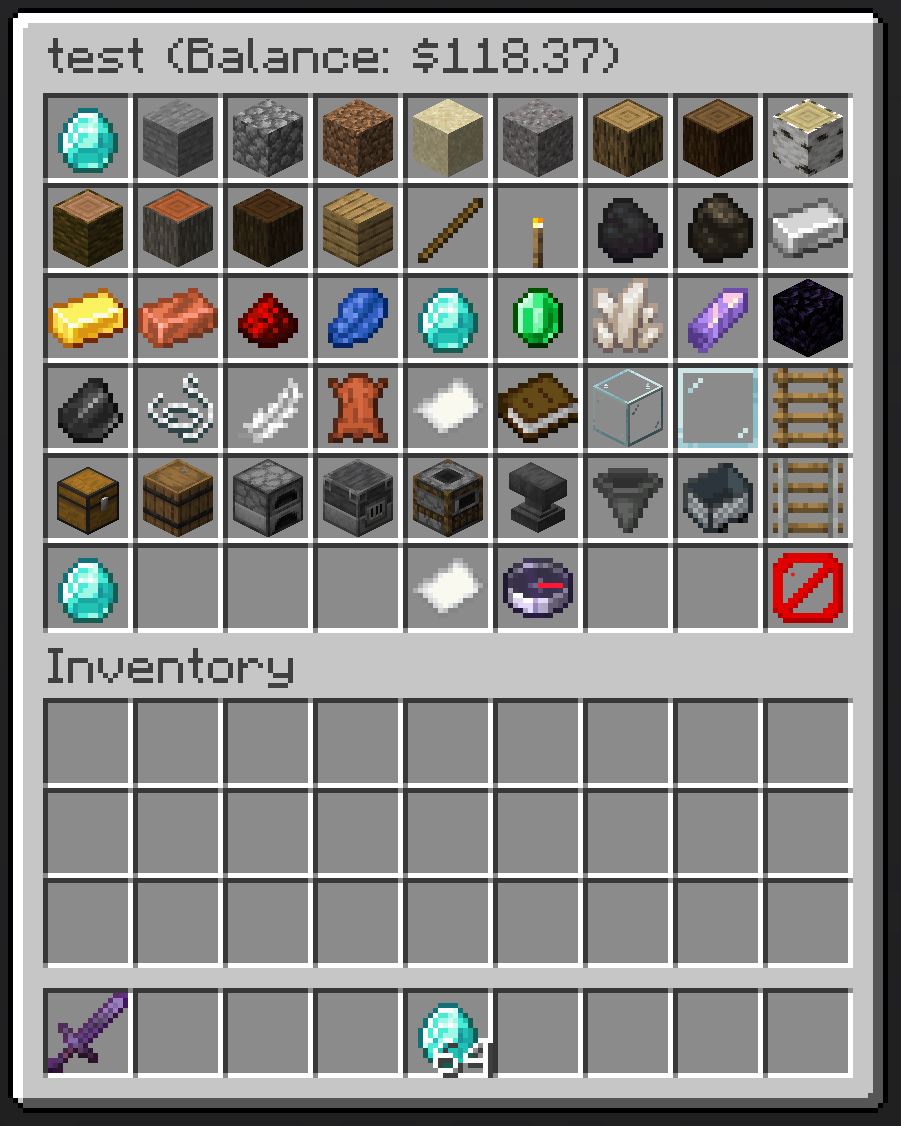 Sell as many items you want Add diamonds, books or any enchanted item.
 -
 Support for multiple balances Some items in a shop may be sold using a different currency. The currency slot shows the balance of every currency which is used by the items in this shop.
 -
 Shop view supports pagination One shop can have an infinite amount of items. When the items don't fit on one page anymore, pagination is there to save the day. The compasses point to the direction you're switching pages to and the paper shows what page you are currently on.
 -
 Buy and sell one or multiple items at once Left click to buy 1 or hold shift to buy an entire stack. Right click to sell 1 item or hold shift to sell an entire stack. You can only buy as much as you can hold though so remember to put that stack in your inventory!
 -
 Bought items appear in your cursor Click on an item and that item will be bought and copied to your cursor. Click again and another copy will be bought. Shift click to fill the cursor to the maximum stack size (if you can afford it). It's quite similair to the behavior of a creative menu.
Versions
Files
Relations
Project Relations
More like this
Similar Mods
Suggestions use data such as tags, dependencies, dependents, descriptions, titles, and more to rank how much they overlap with this mod.
On ModDex
Community snapshot
By the numbers
Statistics

Want to reach Minecraft players?
We're looking for a server hosting partner to feature here and other parts of the site. Interested? Send us a message!
Get in touchGet it on
Available Platforms
On ModDex
Community snapshot
By the numbers
Statistics
Resources