Community listing page, reviews here may not be monitored by the author.


Community voices
Reviews
No reviews yet. Be the first to review this project!
Get it on
Available Platforms
Compatibility
Supported Environments
Runs entirely on the server. Also works in singleplayer.
About
Project Details
For authors
Embed Badge
If you're the author of this project, you can embed a live badge anywhere that supports HTML or Markdown. It updates automatically whenever ratings change.
Use HTML for any page that supports it, or Markdown for README files and Markdown-based descriptions.
Identifiers
Platform IDs
About
Description
Saddle
Saddle: A Datapack Debugger for Live Editing
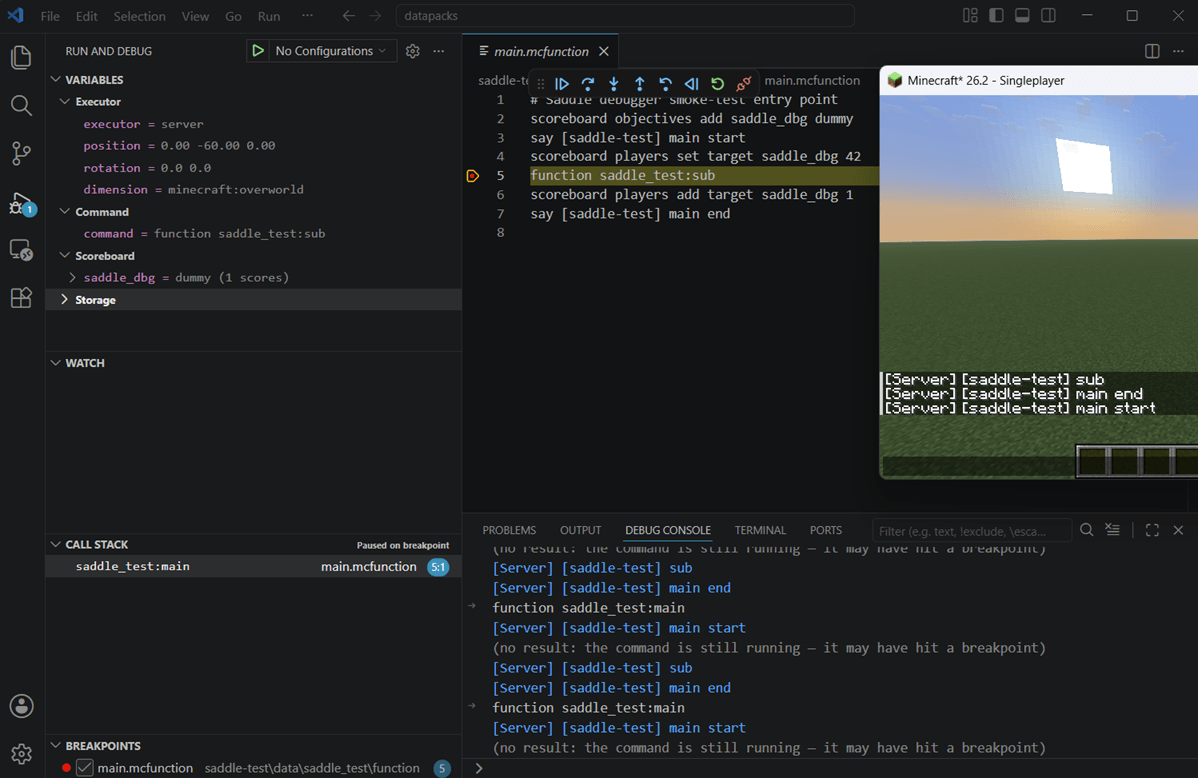
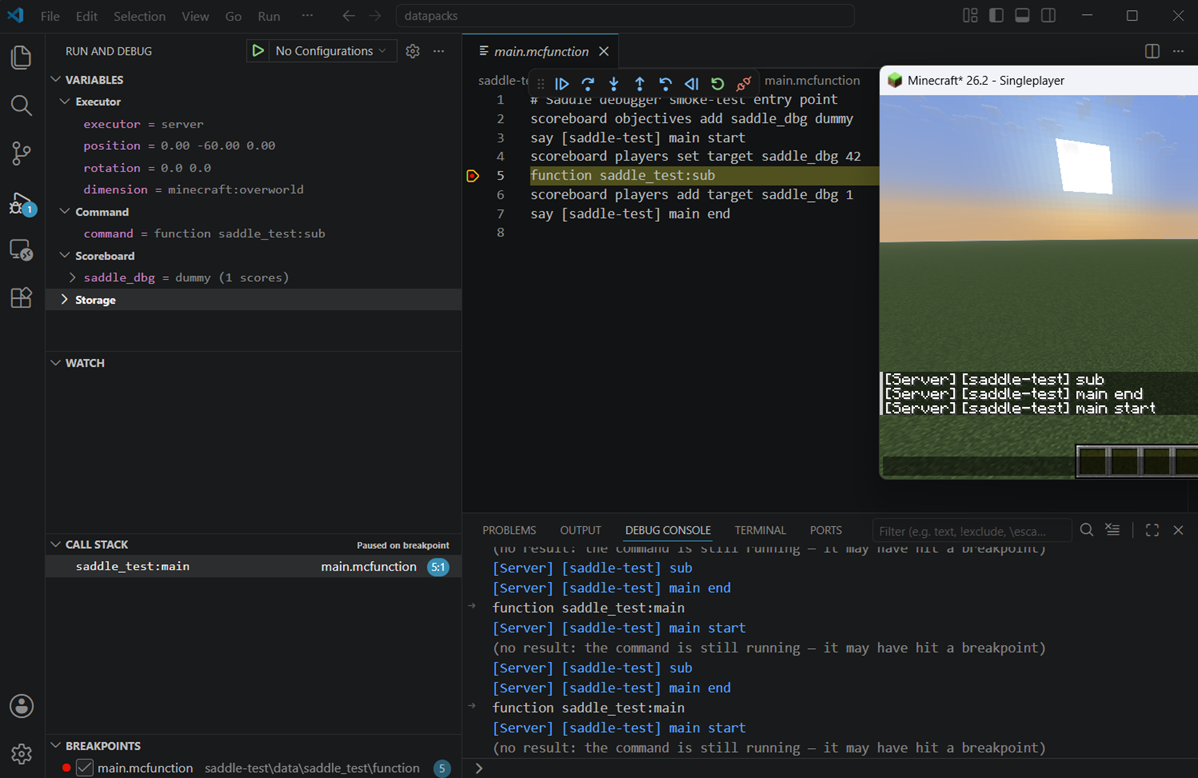
A Fabric mod that embeds a Debug Adapter Protocol server in Minecraft, so datapack .mcfunction files can be debugged from VS Code (or any DAP client) — breakpoints, stepping, time travel, and live inspection and editing of the game state your functions run against.
In Minecraft, a saddle is what lets you take the reins of something that otherwise runs on its own. This mod puts a saddle on datapack execution: stop it where you want (breakpoints), back it up (time travel), and steer it (live edits) — instead of watching it gallop by.
- Minecraft 26.2 / Fabric Loader ≥ 0.19.0 / Fabric API
- Java 25 (26.x is unobfuscated; the buildscript uses the no-remap
net.fabricmc.fabric-loomplugin) - DAP endpoint:
127.0.0.1:16352— override with-Dsaddle.host/-Dsaddle.port. Non-loopback binds are refused unless-Dsaddle.allowRemote=trueis set: the debug port allows unauthenticated command execution, so only expose it on trusted or tunneled networks
Quick start
- Install the mod (plus Fabric API) and start a world or server.
- Install the VS Code extension Saddle — Minecraft Datapack Debugger from the Marketplace (or search "Saddle" in the Extensions view). To build it from source instead:
   cd vscode-extension
   npx --yes @vscode/vsce package --allow-missing-repository
code --install-extension saddle-debug-*.vsix- Open your datapack folder in VS Code, set breakpoints in
.mcfunctionfiles, and run Attach to Minecraft (Saddle) (or press F5). The Debug Console and game chat both announce which world you attached to. - Trigger a function in game, from a tick function, or straight from the Debug Console.
See vscode-extension/README.md for the editor-side feature tour.
How it works
- A mixin into
CommandFunction.fromLineswraps every parsed command entry with a decorator carrying its(function id, source line)origin and records the function source text. Macro ($...) lines are tagged at parse time and wrapped whenMacroFunctioninstantiates them, so they are debuggable too. When no debug client is attached, the runtime overhead per command is one volatile read. - On a breakpoint/step/pause hit, the server thread is parked inside command execution — the game freezes mid-function with vanilla execution state intact. While parked, the thread serves a task queue, so DAP requests that need game state (variables, evaluate, introspection) still run safely on the server thread.
- Breakpoint paths are mapped to function ids from the
data/<namespace>/function/<path>.mcfunctionsegment of the file path, so any workspace layout works without configuration. Breakpoints requested on comments or blank lines shift down to the next executable line.
DAP support
| Area | Requests |
|---|---|
| Lifecycle | initialize, launch/attach, configurationDone, disconnect |
| Breakpoints | setBreakpoints, breakpointLocations — plain commands and macro lines; comment/blank lines shift to the next executable line |
| Execution | continue, next, stepIn, stepOut, pause |
| State | threads, stackTrace, scopes, variables, setVariable, source |
| Console | evaluate — runs any command, responding asynchronously so a command that hits a breakpoint never delays the stack view; while suspended it executes in an isolated ExecutionContext. completions serves Brigadier suggestions, so the Debug Console autocompletes like the in-game chat |
| Hover | evaluate(context: hover) resolves macro arguments ($(name)), entity selectors (@e[...]) and coordinate triples (~ ~2 ~) without executing commands |
| Output | in-game chat is mirrored to the client as output events: system broadcasts (/say, deaths, joins), player chat, and per-player messages (/tellraw, /msg) |
| Time travel | stepBack / reverseContinue navigate a recording of executed commands (ring buffer, -Dsaddle.ttd.steps, default 20k). While in the past, the stack, executor, macro arguments and reconstructed scoreboard/storage state are shown for that moment — the scopes keep their live names so expanded rows survive moving between present and history, and the Executor scope carries a (time travel) marker. Forward stepping replays the recording back to the present; continue past the recording resumes live execution. saddle/trace returns the recent execution trace |
Variables ("registers & memory")
Each stack frame exposes live scopes, all reading game state while stopped:
- Executor — command source summary (executor, position, rotation, dimension) plus a lazily expanded, editable NBT tree of the executing entity.
- Macro Arguments — the
$(...)values of the current macro frame. - Command — the command about to run, with every entity selector resolved to the entities it currently matches (each expandable into live NBT) and every coordinate triple resolved to the block it points at.
- Watched — user-pinned expressions (see below), re-resolved live on every request.
- Scoreboard — every objective with its scores; score values are editable via
setVariable. - Storage — every command storage id as an editable NBT tree; leaf values accept SNBT via
setVariable. Container previews are size-based ({400 entries}), so browsing large storages stays fast; edits push aninvalidatedevent so the client re-fetches stale rows.
Hovering over $(name), @e[...] or 1 2 3/~ ~2 ~ in a .mcfunction file while stopped shows the same data inline (via the VS Code extension).
Watch & pin expressions
The VS Code WATCH panel, the pinned "Watched" scope (saddle/pin, saddle/unpin, saddle/pins) and the Saddle Watch view all accept:
@e[type=pig]— matched entities, expandable into live NBTstorage <id> [path]/entity <uuid> [path]/block <x> <y> <z> [path]— live (editable) NBT at the targetscore <objective> [holder]— one score, or the whole objective (editable) when the holder is omittedscoreboard/storage— every objective / every storage id$(name)— macro argument of the selected frame; bare coordinate triples resolve to the block they point at
Saddle Watch (real time + editable, no breakpoint required)
The extension adds a Saddle Watch view to the Run and Debug sidebar — one watch panel that does what WATCH and Variables do together, without needing a breakpoint:
- Real time: pinned expressions refresh on a timer (
saddle.liveWatchRefreshInterval, default 1 s) through the statelesssaddle/live {expression, path}request, which reads game state on the server thread whether the game is running or suspended — scoreboards tick up live, entity positions move, storage updates as your functions write it. - Editable: rows backed by scores or NBT show an inline pencil; edits go through
saddle/liveSet {expression, path, name, value}and apply to the live game immediately. - Native styling: the view renders with VS Code's own debug token theme (monospace rows,
debugTokenExpression.*colors for names, numbers, strings), so it looks exactly like the Variables/WATCH panels.
To keep a single watch panel, hide the built-in one once: right-click any section header in the Run and Debug sidebar and uncheck Watch — VS Code remembers. (Extensions cannot remove or replace built-in views, and the built-in WATCH only re-evaluates when the debugger stops; both are platform limits. Drag Saddle Watch to WATCH's old spot and the layout also sticks.)
Custom requests
minecraft/getScoreboard,minecraft/setScore {objective, holder, value}minecraft/getStorage {id?, path?},minecraft/listEntities {selector},minecraft/getEntity {uuid}(includes NBT)minecraft/getData/minecraft/setData{type: storage|entity|block, target, path, value}— vanilla/data-style access; block targets are"x y z [dimension]"minecraft/getBlock {pos, dimension?}— block state plus block-entity NBT
Testing
# first time only: accept the EULA and disable the tick watchdog
mkdir -p run
printf 'eula=true\n' > run/eula.txt
printf 'max-tick-time=-1\nonline-mode=false\npause-when-empty-seconds=0\n' > run/server.properties

./gradlew runServer                 # terminal 1
python3 scripts/dap_smoke_test.py   # terminal 2
The script installs scripts/test-datapack into the world, /reloads, and exercises the full debug loop end to end (108 checks): breakpoints, stepping, time travel (step back / reverse continue / historical state reconstruction), macro breakpoints and macro-argument values, comment-line shifting, live variable read/write (scoreboard, storage NBT, entity NBT), selector/coordinate resolution, hover evaluation, console completions, chat output mirroring, entity/block data requests, evaluate and pause. CI runs the same suite against a real dedicated server, and pushing a v* tag publishes the jar and vsix as a GitHub Release.
Notes
- Keep the mod and the VS Code extension on matching versions: the mod sends a
saddle/versionevent on attach and the extension warns when the two drift apart (major.minor). - On dedicated servers set
max-tick-time=-1: suspending at a breakpoint parks the server thread, which would otherwise trip the watchdog. - In singleplayer, the internal client may disconnect if the game stays suspended for a long time.
- Stepping past the end of all queued commands leaves the session in the running state until the next breakpoint/pause hit (e.g. the next tick-function command).
Troubleshooting
- Edits don't seem to apply /
data getshows old values. First check the attach announcement: on attach, Saddle printsSaddle: debugger attached to world '…'in the Debug Console and[Saddle] Debugger attachedin the game chat. If the chat message does not appear in your world, another Minecraft instance with Saddle owns the port (its log showsFailed to bind DAP server) and your edits are landing in that instance — close it or use-Dsaddle.portto separate them. Also note that a tick function which rewrites a scoreboard/storage every tick will overwrite manual edits as soon as you resume. - The
Watched/Storagescopes edit live data only. While time-traveling, the same-named scopes show recorded values and are read-only — the(time travel)row in the Executor scope tells you which mode you are looking at.
Saddle
Saddle: A Datapack Debugger for Live Editing
A Fabric mod that embeds a Debug Adapter Protocol server in Minecraft, so datapack .mcfunction files can be debugged from VS Code (or any DAP client) — breakpoints, stepping, time travel, and live inspection and editing of the game state your functions run against.
In Minecraft, a saddle is what lets you take the reins of something that otherwise runs on its own. This mod puts a saddle on datapack execution: stop it where you want (breakpoints), back it up (time travel), and steer it (live edits) — instead of watching it gallop by.
Download
| Mod | Modrinth · CurseForge · GitHub Releases |
| VS Code extension | Visual Studio Marketplace (or search "Saddle" in the Extensions view) |
| Source & issues | github.com/d1n-0/saddle · Issues |
Requirements
- Minecraft 26.2 – 26.3, Fabric Loader ≥ 0.19.0, Fabric API, Java 25
- The mod on the side that runs the world: the client for singleplayer, the server for multiplayer
- DAP endpoint:
127.0.0.1:16352— override with-Dsaddle.host/-Dsaddle.port. Non-loopback binds are refused unless-Dsaddle.allowRemote=trueis set: the debug port allows unauthenticated command execution, so only expose it on trusted or tunneled networks
Quick start
- Install the mod (plus Fabric API) and start a world or server.
- Install the VS Code extension.
- Open your datapack folder in VS Code, set breakpoints in
.mcfunctionfiles, and run Attach to Minecraft (Saddle) (or press F5). The Debug Console and game chat both announce which world you attached to. - Trigger a function in game, from a tick function or the Debug Console — or press Ctrl+Alt+Enter (Cmd+Alt+Enter on macOS) / ▶ in a
.mcfunctioneditor to run that file's function. - Optional: turn on
saddle.reloadOnSave(or click Reload on Save in the status bar) to/reloadwhenever a datapack file is saved.
The rest of this README covers the mod and its protocol; see vscode-extension/README.md for the editor-side feature tour.
How it works
- A mixin into
CommandFunction.fromLineswraps every parsed command entry with a decorator carrying its(function id, source line)origin and records the function source text. Macro ($...) lines are tagged at parse time and wrapped whenMacroFunctioninstantiates them, so they are debuggable too. When no debug client is attached, the runtime overhead per command is one volatile read. - On a breakpoint/step/pause hit, the server thread is parked inside command execution — the game freezes mid-function with vanilla execution state intact. While parked, the thread serves a task queue, so DAP requests that need game state (variables, evaluate, introspection) still run safely on the server thread.
- Breakpoint paths are mapped to function ids from the
data/<namespace>/function/<path>.mcfunctionsegment of the file path, so any workspace layout works without configuration. Breakpoints requested on comments or blank lines shift down to the next executable line.
DAP support
| Area | Requests |
|---|---|
| Lifecycle | initialize, launch/attach, configurationDone, disconnect |
| Breakpoints | setBreakpoints, breakpointLocations — plain commands and macro lines; comment/blank lines shift to the next executable line |
| Execution | continue, next, stepIn, stepOut, pause |
| State | threads, stackTrace, scopes, variables, setVariable, source |
| Console | evaluate — runs any command, responding asynchronously so a command that hits a breakpoint never delays the stack view; while suspended it executes in an isolated ExecutionContext. completions serves Brigadier suggestions, so the Debug Console autocompletes like the in-game chat |
| Hover | evaluate(context: hover) resolves macro arguments ($(name)), entity selectors (@e[...]) and coordinate triples (~ ~2 ~) without executing commands |
| Output | in-game chat is mirrored to the client as output events: system broadcasts (/say, deaths, joins), player chat, and per-player messages (/tellraw, /msg) |
| Time travel | stepBack / reverseContinue navigate a recording of executed commands (ring buffer, -Dsaddle.ttd.steps, default 20k). While in the past, the stack, executor, macro arguments and reconstructed scoreboard/storage state are shown for that moment — the scopes keep their live names so expanded rows survive moving between present and history, and the Executor scope carries a (time travel) marker. Forward stepping replays the recording back to the present; continue past the recording resumes live execution. saddle/trace returns the recent execution trace |
Variables ("registers & memory")
Each stack frame exposes live scopes, all reading game state while stopped:
- Executor — command source summary (executor, position, rotation, dimension) plus a lazily expanded, editable NBT tree of the executing entity.
- Macro Arguments — the
$(...)values of the current macro frame. - Command — the command about to run, with every entity selector resolved to the entities it currently matches (each expandable into live NBT) and every coordinate triple resolved to the block it points at.
- Watched — user-pinned expressions (see below), re-resolved live on every request.
- Scoreboard — every objective with its scores; score values are editable via
setVariable. - Storage — every command storage id as an editable NBT tree; leaf values accept SNBT via
setVariable. Container previews are size-based ({400 entries}), so browsing large storages stays fast; edits push aninvalidatedevent so the client re-fetches stale rows.
Hovering over $(name), @e[...] or 1 2 3/~ ~2 ~ in a .mcfunction file while stopped shows the same data inline (via the VS Code extension).
Watch & pin expressions
The VS Code WATCH panel, the pinned "Watched" scope (saddle/pin, saddle/unpin, saddle/pins) and the Saddle Watch view all accept:
@e[type=pig]— matched entities, expandable into live NBTstorage <id> [path]/entity <target> [path]/block <x> <y> <z> [path]— live (editable) NBT at the target;<target>is anything/data get entityaccepts: a player name, a UUID or a single-entity selector (@sis the executor of the selected frame)score <objective> [holder]— one score, or the whole objective (editable) when the holder is omittedscoreboard/storage— every objective / every storage id$(name)— macro argument of the selected frame; bare coordinate triples resolve to the block they point at
Saddle Watch (real time + editable, no breakpoint required)
The extension adds a Saddle Watch view to the Run and Debug sidebar — one watch panel that does what WATCH and Variables do together, without needing a breakpoint:
- Real time: pinned expressions refresh on a timer (
saddle.liveWatchRefreshInterval, default 1 s) through the statelesssaddle/live {expression, path}request, which reads game state on the server thread whether the game is running or suspended — scoreboards tick up live, entity positions move, storage updates as your functions write it. - Editable: rows backed by scores or NBT show an inline pencil; edits go through
saddle/liveSet {expression, path, name, value}and apply to the live game immediately. Pins that name a single value —score <objective> <holder>or an NBT path such asstorage <id> <path>/entity <target> <path>(e.g. added with Add to Saddle Watch) — are editable too:saddle/liveSetwithoutnamesets the expression's own value. - Watch a nested node: right-click an expanded child row (an NBT key or list item, an objective, a score holder, a storage id, a matched entity) and choose Add to Saddle Watch to pin it as its own entry — e.g.
storage mypack:store players.list[0],entity Steve Inventory[0]orscore kills Steve. Players are pinned by name; other entities by UUID, the only reference that keeps pointing at the same entity. Every variable that has a live, standalone equivalent reports it as its DAPevaluateName, which also enables VS Code's built-in Add to Watch in the Variables view. Recorded (time-travel) values and block NBT have none: a watch expression cannot name the block's dimension. - Display names: right-click a pin and choose Rename (or select it and press F2) to show it under a name of your own, e.g.
pig inventoryinstead ofentity 1a2b…-… Inventory. Only the displayed name changes — the pinned expression stays the same and is shown in the tooltip. Names are kept per workspace, so a pin gets its name back when it is pinned again in a later session; clearing the name restores the expression.
Editor integration: run from file & reload on save
- Run Function From File (
saddle/runFunction {path, arguments?, executor?}): runs the function defined by a.mcfunctionfile. The path resolves exactly like a breakpoint path (data/<namespace>/function/<path>.mcfunction), so any workspace layout works.argumentsis the SNBT compound for macro functions — the extension asks for it when the file contains$lines and remembers the last value per file.executor(settingsaddle.runFunctionExecutor, e.g.@p) wraps the call inexecute as <executor> at @s run; empty runs it as the server, like the Debug Console. The response is asynchronous, so a function that stops at a breakpoint behaves exactly like one started from the console. Unsaved changes are saved first, and with reload on save the run waits until that reload has finished. - Reload on save (
saddle/reload): the equivalent of/reload(current packs plus newly discovered, non-disabled ones), answered once the new resources are live. The extension debounces saves of datapack files —pack.mcmetaand anything underdata/in a folder that also holds apack.mcmeta— so "Save All" triggers a single reload, and reports the outcome in the status bar; the Debug Console logsSaddle: datapacks reloaded. Reloading is refused while execution is stopped at a breakpoint, because the paused function would otherwise run against a swapped function library — continue first.Saddle: Reload Datapacksreloads on demand.
/deploy — ship the map
/deploy (permission level 4) saves the world as a distributable map: builds and command blocks (region files), entities, points of interest, saved data (scoreboards, command storage, maps, …), datapacks and world settings (level.dat) are kept; player data — the players/ folder (inventories, positions, advancements, statistics; also the legacy playerdata/, advancements/, stats/ folders) and the singleplayer owner and last played time (singleplayer_uuid, legacy Player, LastPlayed) recorded in level.dat/level.dat_old — is removed. Until the deployed world is first opened, the singleplayer world list shows no meaningful last played date for it.
Run by a player, /deploy opens a dialog with a destination field and two choices:
- Create Copy (
/deploy copy [path]): flushes the world to disk and writes a cleaned copy topath. Relative paths are created next to the world folder (in singleplayer that is the saves folder, so the copy shows up in the world list); the default is<world>-deploy. The destination must be outside the world and either missing or an empty folder; a failed copy removes what it wrote. The running world is not modified. The copy runs on the server thread so nothing can write to the world mid-copy — the game pauses for as long as the copy takes. - Apply to This World (
/deploy apply): cleans this world itself. Because the game writes every online player's data again while shutting down, the world is closed first (singleplayer returns to the title screen; a dedicated server stops) and the cleanup runs after the final save.
Only the server console (including rcon and the Debug Console) and the singleplayer owner may copy to an arbitrary path; other operators — e.g. LAN guests with cheats on — are limited to destinations inside the folder that contains the world, and on a singleplayer/LAN world only the owner may apply in place. Both actions are refused while execution is stopped at a breakpoint. Without a player (server console, rcon, the Debug Console), /deploy prints the two subcommands instead of the dialog. The dialog buttons act immediately, without Minecraft's usual "run this command?" prompt: they send custom click actions (saddle:deploy/copy, saddle:deploy/apply) that the server checks for permission level 4 itself.
Custom requests
minecraft/getScoreboard,minecraft/setScore {objective, holder, value}minecraft/getStorage {id?, path?},minecraft/listEntities {selector},minecraft/getEntity {uuid}(includes NBT)minecraft/getData/minecraft/setData{type: storage|entity|block, target, path, value}— vanilla/data-style access; block targets are"x y z [dimension]"minecraft/getBlock {pos, dimension?}— block state plus block-entity NBTsaddle/runFunction {path, arguments?, executor?},saddle/reload— see Editor integration
Building
./gradlew build                     # mod jar in build/libs/

cd vscode-extension                 # extension .vsix
npx --yes @vscode/vsce package
code --install-extension saddle-debug-*.vsix
Minecraft 26.x is unobfuscated, so the buildscript uses the no-remap net.fabricmc.fabric-loom plugin. The mod is built against 26.2 (gradle.properties); pass -Pminecraft_version=26.3 -Pfabric_api_version=<version> to build or runServer against another supported version.
Testing
# first time only: accept the EULA and disable the tick watchdog
mkdir -p run
printf 'eula=true\n' > run/eula.txt
printf 'max-tick-time=-1\nonline-mode=false\npause-when-empty-seconds=0\n' > run/server.properties

./gradlew runServer                 # terminal 1
python3 scripts/dap_smoke_test.py   # terminal 2
The script installs scripts/test-datapack into the world, /reloads, and exercises the full debug loop end to end (141 checks): breakpoints, stepping, time travel (step back / reverse continue / historical state reconstruction), macro breakpoints and macro-argument values, comment-line shifting, live variable read/write (scoreboard, storage NBT, entity NBT), selector/coordinate resolution, hover evaluation, console completions, chat output mirroring, entity/block data requests, evaluate and pause, reload and run-from-file, and /deploy copy. CI runs the same suite against a real dedicated server for every supported Minecraft version (26.2 and 26.3), and pushing a v* tag publishes the jar and vsix as a GitHub Release.
Notes
- Keep the mod and the VS Code extension on matching versions: the mod sends a
saddle/versionevent on attach and the extension warns when the two drift apart (major.minor). - On dedicated servers set
max-tick-time=-1: suspending at a breakpoint parks the server thread, which would otherwise trip the watchdog. - In singleplayer, the internal client may disconnect if the game stays suspended for a long time.
- Stepping past the end of all queued commands leaves the session in the running state until the next breakpoint/pause hit (e.g. the next tick-function command).
Troubleshooting
- Edits don't seem to apply /
data getshows old values. First check the attach announcement: on attach, Saddle printsSaddle: debugger attached to world '…'in the Debug Console and[Saddle] Debugger attachedin the game chat. If the chat message does not appear in your world, another Minecraft instance with Saddle owns the port (its log showsFailed to bind DAP server) and your edits are landing in that instance — close it or use-Dsaddle.portto separate them. Also note that a tick function which rewrites a scoreboard/storage every tick will overwrite manual edits as soon as you resume. - The
Watched/Storagescopes edit live data only. While time-traveling, the same-named scopes show recorded values and are read-only — the(time travel)row in the Executor scope tells you which mode you are looking at.
License
Screenshots
Gallery
-
 saddle_screen.png saddle_screen.png
Versions
Files
Relations
Project Relations
More like this
Similar Mods
Suggestions use data such as tags, dependencies, dependents, descriptions, titles, and more to rank how much they overlap with this mod.
On ModDex
Community snapshot
By the numbers
Statistics
Want to reach Minecraft players?
We're looking for a server hosting partner to feature here and other parts of the site. Interested? Send us a message!
Get in touchGet it on
Available Platforms
On ModDex
Community snapshot
By the numbers