
Community listing page, reviews here may not be monitored by the author.
Spoilage Enhanced

No reviews yet
Realistic food spoilage for survival: perishable food decays and expires from fresh to stale to rotten on a per-item timer that keeps running inside chests, barrels, hoppers and bundles. Rotten food poisons you but is the best compost in the game.
Community voices
Reviews
No reviews yet. Be the first to review this project!
Get it on
Available Platforms
About
Project Details
For authors
Embed Badge
If you're the author of this project, you can embed a live badge anywhere that supports HTML or Markdown. It updates automatically whenever ratings change.
Use HTML for any page that supports it, or Markdown for README files and Markdown-based descriptions.
Identifiers
Platform IDs
Resources
External Links
About
Description
Spoilage Enhanced
Food in Minecraft never goes off. This mod makes it — and it keeps going off while the food sits in your chests.
How it works
Every edible carries its own freshness timer, counted in game time. When the fresh period runs out the item turns stale; when the stale period runs out it turns rotten. Nothing is destroyed — rotten food stays in your inventory and still has a use.
Shelf life is per item, roughly by how fast the real thing goes off. Milk lasts about half a game day, raw fish and meat about one, produce and cooked dishes one and a half, bread and baked goods two, dried and preserved food up to four. Cooking and preserving are worth doing because they buy you time, not just saturation.
The three stages
| Stage | What you get from it | What it does to you |
|---|---|---|
| Fresh | full nutrition | nothing |
| Stale | hunger and saturation halved | 50% chance of Nausea for 10 seconds |
| Rotten | nothing at all | Poison for 10 seconds, always |
Milk is a special case: stale milk still clears your effects, rotten milk does not and poisons you instead. Feeding rotten food to an animal cancels breeding and leaves it poisoned and weak. Spoiled items cannot be cooked.
Stacks rot individually
A stack of ten apples can genuinely be five fresh and five rotten. Hover it and the tooltip shows how many of each; hold Shift for the breakdown and the time to the next change. When you take from a stack, the worst piece goes first — otherwise splitting a stack between chests would launder spoilage away.
Storage is not a freezer
Food ages in placed chests, barrels and shulker boxes, in your ender chest, in hoppers, in storage minecarts, in fridges and brewing stands, in villager and wandering-trader inventories, in llama, donkey and mule chests, and in an allay's hands. Bundles age too, including a bundle inside a shulker box inside a chest.
Food found in dungeon and village chests arrives already aged: roughly 60% fresh, 30% stale, 10% rotten.
Rot is a resource
Rotten food is the best compost in the game — a guaranteed composter fill, against 65% for stale and 30% for fresh. Spoiled produce is worth carrying home.
You cannot plant rotten seeds. A growing crop has no freshness clock at all: the timer starts when the plant is actually ripe, so nothing rots in the ground. Dig one up early and you get rotten produce for your trouble.
It works with other mods
Food from other mods is detected automatically — from the item's own components, from the
conventional c:foods tag, and from recipes. A fruiting tree whose fruit is picked by hand,
and therefore appears in no loot table, is learned from the harvest itself. Nothing needs to be
configured for a modded food to start spoiling.
What you see
A freshness bar on the item, a coloured stage in the tooltip, and a line on the HUD for the block you are looking at. Five languages, loaded from your game's language setting with no resource pack: English, Русский, Українська, Español (España), Español (Latinoamérica).
Configuring it
config/spoilage_enhanced.json opens with a step-by-step guide: how to make an item spoil, how
to give it a custom shelf life, how to stop something spoiling. Anything you write there is
never overwritten by auto-detection.
The global pace is one number — spoilage_speed_multiplier. 2.0 spoils twice as fast, 0.5
twice as slow. Apply changes in game with /spoilage config reload; no restart needed.
Installing
One jar for Fabric, Forge and NeoForge. Required on both client and server. On Fabric it needs the Fabric API.
Screenshots
Gallery
-
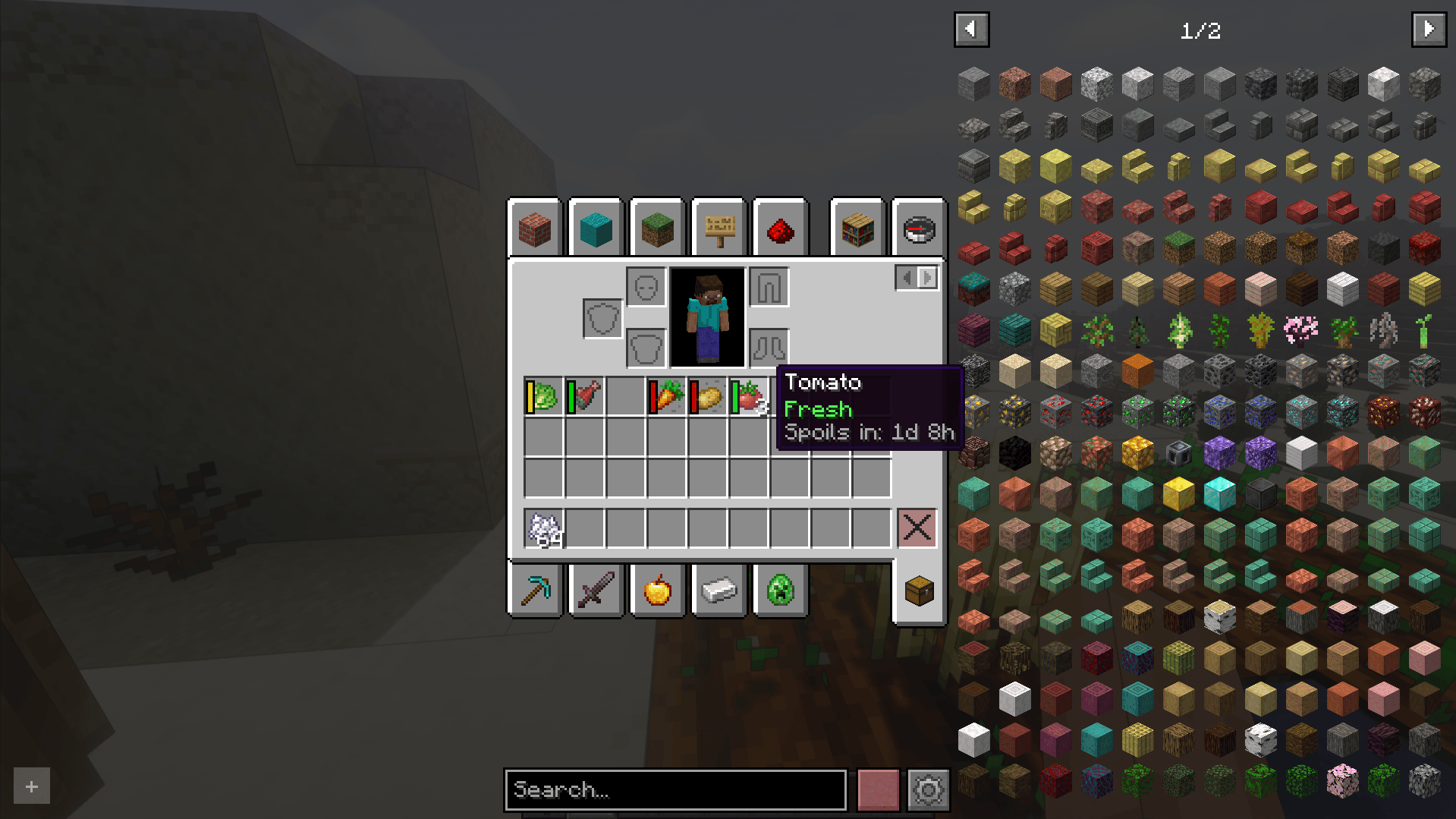 Fresh.png
 -
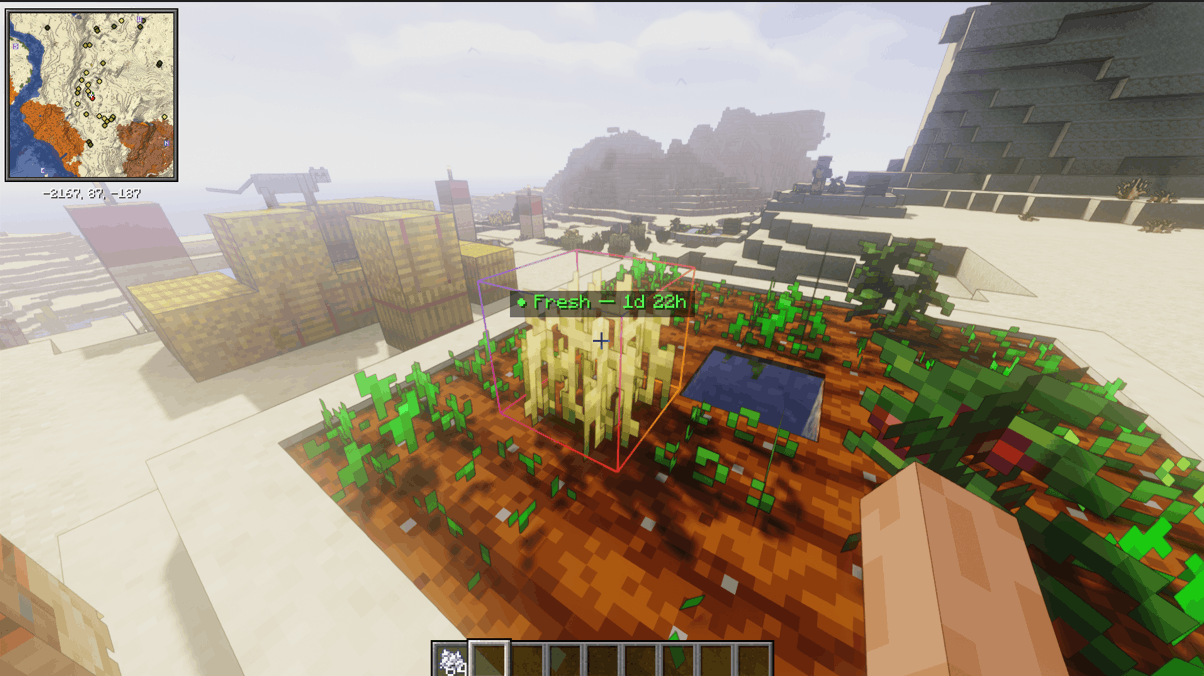 Wheatpng
Versions
Files
Relations
Project Relations
More like this
Similar Mods
Suggestions use data such as tags, dependencies, dependents, descriptions, titles, and more to rank how much they overlap with this mod.
On ModDex
Community snapshot
By the numbers
Statistics
Want to reach Minecraft players?
We're looking for a server hosting partner to feature here and other parts of the site. Interested? Send us a message!
Get in touchGet it on
Available Platforms
On ModDex
Community snapshot
By the numbers
Statistics
Resources