
Community listing page, reviews may not be monitored by the author.
The Cost of Living

No reviews yet
A survival overhaul where hunger, thirst, fatigue, stamina, and livestock feeding make every resource and action count.

Community voices
Reviews
No reviews yet. Be the first to review this project!
Get it on
Available Platforms
About
Project Details
For authors
Embed Badge
If you're the author of this project, you can embed a live badge anywhere that supports HTML or Markdown. It updates automatically whenever ratings change.
Use HTML for any page that supports it, or Markdown for README files and Markdown-based descriptions.
Identifiers
Platform IDs
Resources
External Links
About
Description
The Cost of Living
Every action and resource has a cost.
The Cost of Living connects food, water, fatigue, stamina, health and livestock feeding into one survival system. Travelling is relatively inexpensive, hard work gradually wears you down, and recovery requires supplies. Familiar Minecraft items remain central: water bottles, apples, beds, wool, hay bales and vanilla animals.
Preparation and resource management matter without turning every quiet moment into a struggle. Plant foods help you survive; meat supports sustained work; water helps you recover from activity; and animals must consume feed before providing useful products.
Version 0.7.8 adds raw-food spoilage, smaller food stacks, slower cooking, campfire water purification and ender-chest refrigeration.
The numbers below are the default settings. Balance values can be adjusted in the configuration.
Four visible survival meters
| Meter | Range | Purpose |
|---|---|---|
| Food | 0–20 | Pays for stamina recovery and limited natural healing. |
| Hydration | 0–20 | Pays for clearing fatigue while inactive. |
| Fatigue | 0–100 | Builds through movement and actions, then falls during inactivity. |
| Stamina | 0–100 | Decreases because of fatigue and returns through proper rest. |
There is no hidden vanilla saturation reserve.
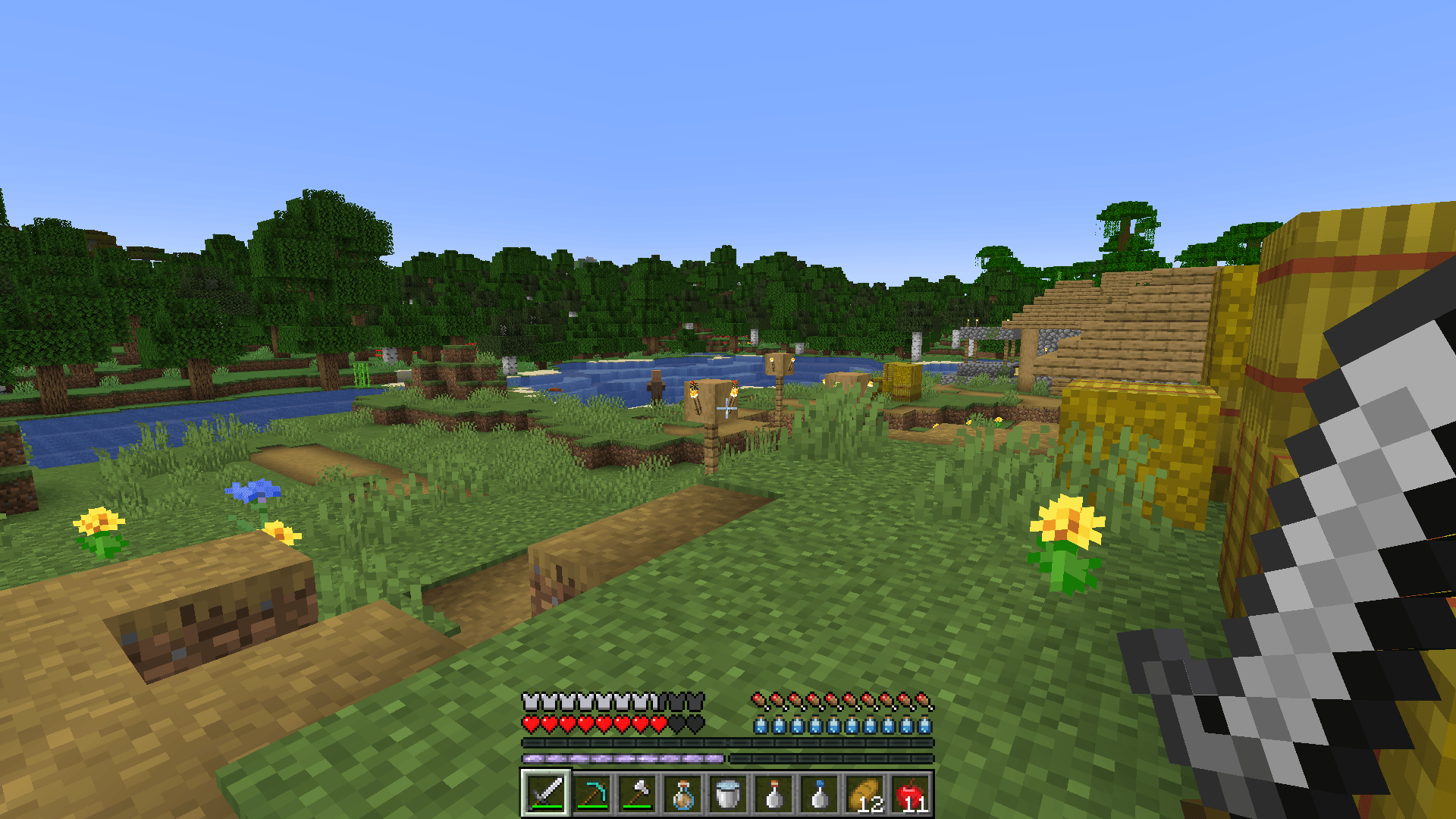
Food and hydration use Minecraft-style icons, with two points per icon. Empty icons in the lower half turn red to mark the danger zone. Stamina and fatigue use compact experience-style bars beneath the experience bar: light-purple stamina on the left and blue fatigue on the right.
Work, fatigue and recovery
Actions increase fatigue rather than directly consuming stamina. Any positive fatigue slowly drains stamina, with a much stronger drain above 80 fatigue.
Stopping clears fatigue at 2 points per second, consuming 0.02 hydration per point removed. Standing still is enough to clear fatigue, but stamina recovery requires a bed or cushion and consumes 0.05 food per point restored.
Rest can restore stamina while fatigue is still present. Both recovery processes can run together, each using its own resource. Remaining fatigue continues to drain stamina, so the net gain can be lower than the bed or cushion’s nominal recovery rate.
- At 10 hydration or below, fatigue cannot clear.
- At 10 food or below, stamina cannot recover.
- Low food does not directly block fatigue recovery, and low hydration does not directly block stamina recovery.
- Working while seated still interrupts recovery.
Food and hydration do not directly modify how much fatigue an action generates. A very small baseline drain remains active even while idle: 0.00025 food and 0.0005 hydration per second in a neutral environment.
Activity costs
| Activity | Fatigue gained |
|---|---|
| Elytra flight or moving by boat | 0.02 per second |
| Walking | 0.04 per second |
| Swimming | 0.16 per second |
| Sprinting | 0.20 per second |
| Mining | 0.40 per second of digging |
| Jumping | 0.40 per jump |
| Melee attacks | 0.40 per attack |
| Placing blocks | 0.60 per block |
| Certain weapon and tool uses | 0.20 per use |
Long journeys are manageable, while sustained mining and construction require more supplies and rest.
Exhaustion
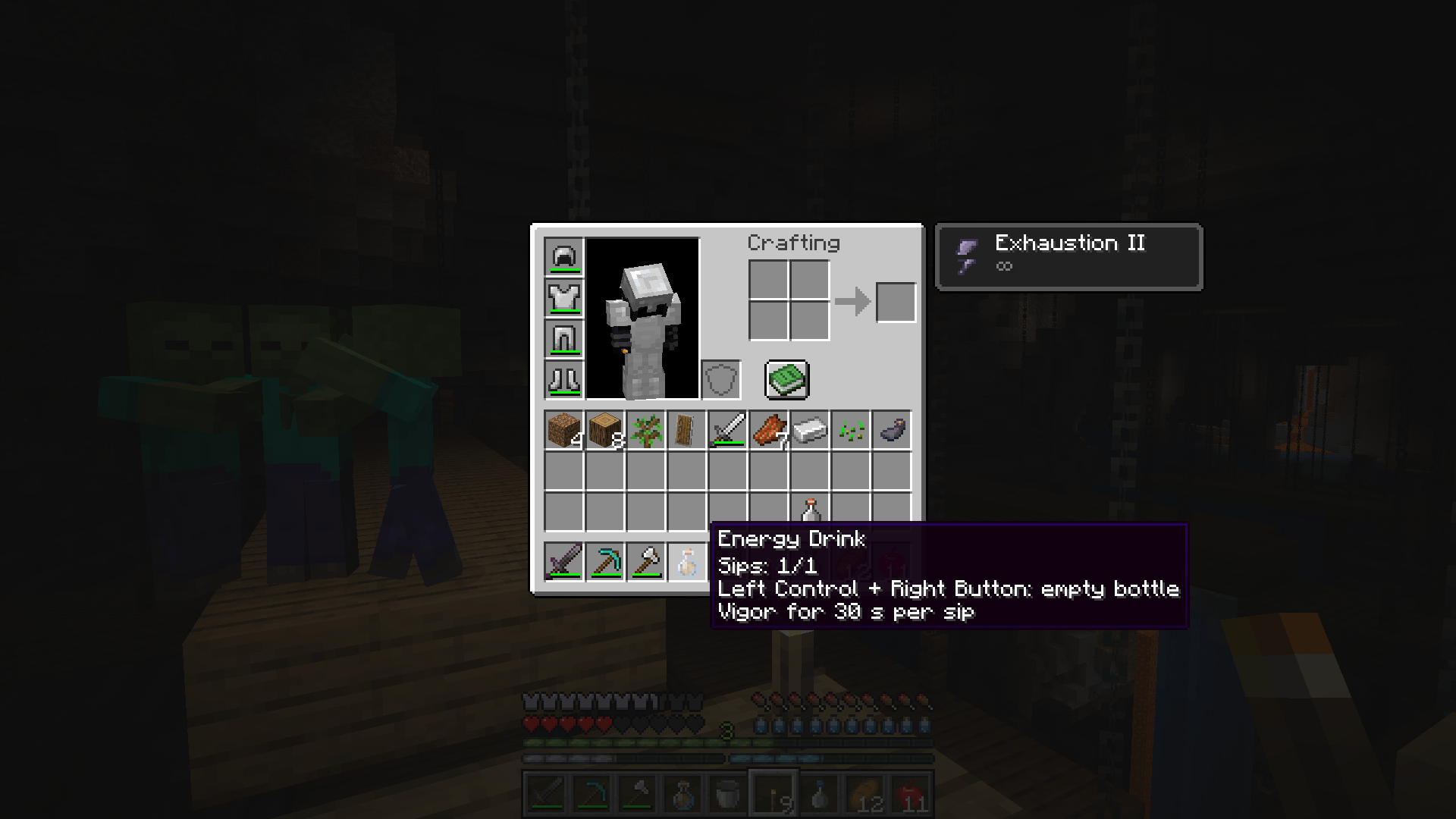
As stamina falls, Exhaustion slows movement, mining and attack recharge. Percentages below are relative to normal speed.
| Remaining stamina | Effect | Movement | Mining | Attack recharge |
|---|---|---|---|---|
| Below 80% | Exhaustion I | 90% | 85% | 95% |
| Below 60% | Exhaustion II | 80% | 70% | 90% |
| Below 40% | Exhaustion III | 70% | 55% | 85% |
| Below 20% | Exhaustion IV | 60% | 40% | 80% |
Milk can remove the effect, but it does not restore stamina. Exhaustion returns when its underlying condition remains.
Cushions, beds and sleep
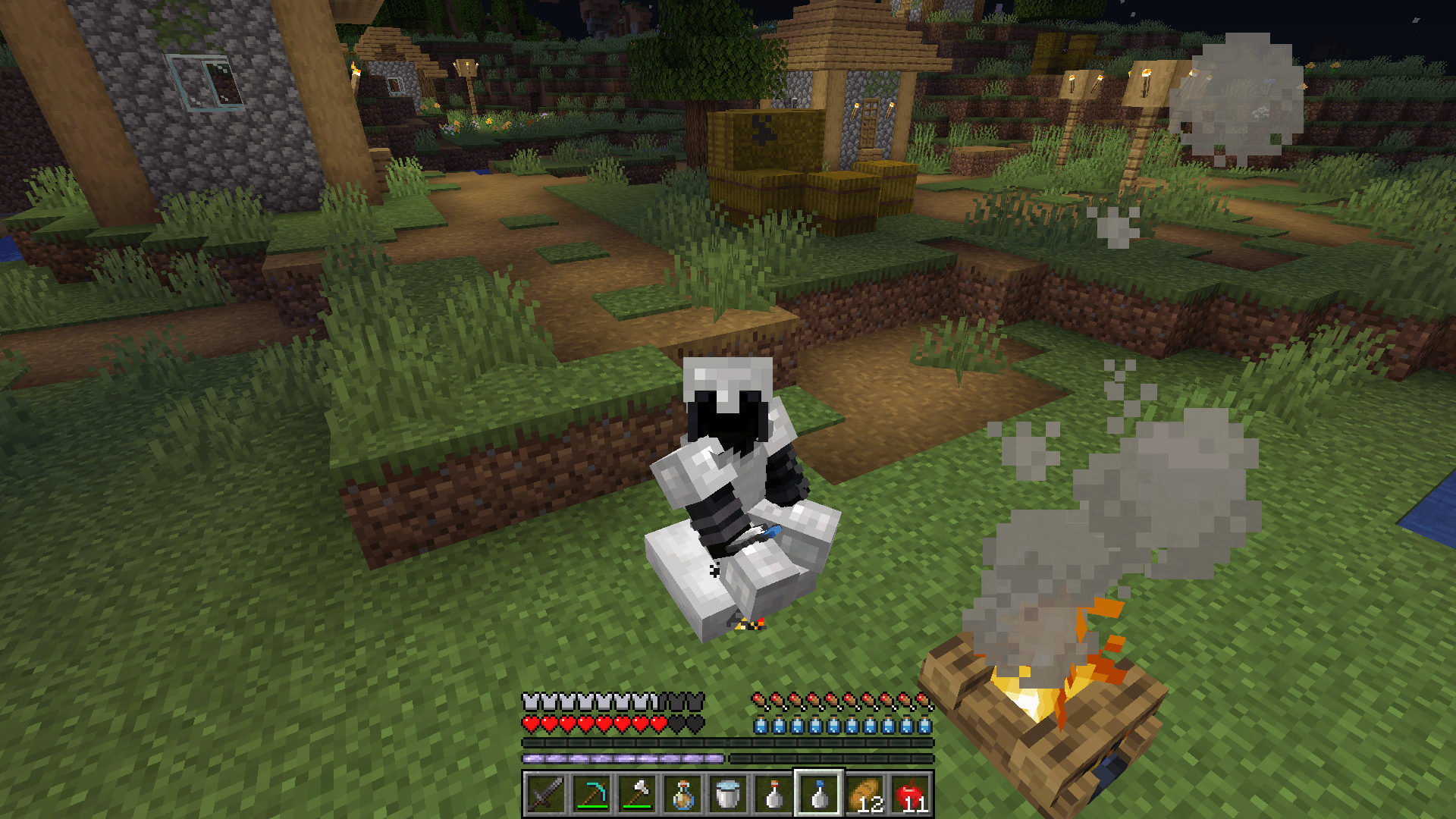
Craft a cushion using three white wool blocks in a horizontal row. Place it on a solid block and right-click to sit. Use your configured Sneak key to stand up.
Cushions work in the Overworld, Nether and End. Beds retain their normal dimension restrictions.
- A cushion restores 0.5 stamina per second.
- Sleeping restores 2 stamina per second.
- Successfully completing a night can restore up to 80 additional stamina, paid for with food.
Remaining fatigue does not prevent these forms of stamina recovery. Completing a night does not clear remaining fatigue for free.
Daytime sleeping is disabled by default, including during thunderstorms, and can be enabled in the configuration.
Configurable night progression
Night acceleration accounts for the proportion of sleeping players:
- 0: normal night progression; sleeping does not skip the night.
- Between 0 and 1: sleeping accelerates the night proportionally.
- 1: allows a full skip when the sleep requirements are met; partial participation accelerates time.
For example, 0.4 with half the players asleep makes the night pass 20% faster. Full skipping also respects Minecraft’s sleeping-percentage rule. Spectators are excluded, and the normal sleep warmup still applies.
Only the time of day accelerates. Animal feeding, food spoilage, resource consumption and recovery continue at their normal simulation rates.
Food has different purposes
Most plant foods and prepared meals restore food or hydration only up to 10 points. They keep you alive, but cannot build the food reserve needed for stamina recovery.
Meat and fish can restore the entire food meter. Eating them in the lower half costs stamina; raw meat restores less and carries a larger penalty.
Meat and fish
| Food | Food restored |
|---|---|
| Steak | 8 |
| Cooked porkchop or cooked mutton | 5 |
| Cooked chicken, cooked rabbit or cooked salmon | 3 |
| Cooked cod | 2 |
| Raw beef | 2 |
| Raw porkchop, mutton, chicken, rabbit, cod or salmon | 1 |
Stamina penalties depend on the food points actually restored:
- Cooked meat and fish: 2 stamina per point restored below 10; no penalty above 10.
- Raw meat and fish: 6 stamina per point restored below 10 and 4 above 10.
If a meal crosses the boundary, each portion uses its corresponding cost. Food that overflows a full meter is not charged.
Vegetables — food up to 10
| Food | Food restored |
|---|---|
| Golden carrot | 4 |
| Baked potato | 3 |
| Carrot | 2 |
| Beetroot, potato or dried kelp | 1 |
Fruit — hydration up to 10
| Food | Hydration restored |
|---|---|
| Chorus fruit | 3 |
| Melon slice or glow berries | 2 |
| Sweet berries | 1 |
Fruit can be eaten with a full food meter when it can still restore hydration. Chorus fruit retains its teleportation effect.
Stews — food and hydration up to 10
| Food | Food restored | Hydration restored |
|---|---|---|
| Rabbit stew | 5 | 4 |
| Mushroom stew or suspicious stew | 3 | 3 |
| Beetroot soup | 2 | 3 |
Food and hydration are restored independently. Suspicious stew’s Saturation effect cannot bypass the lower-half food limit.
Dry and sweet foods — food up to 10, at a water cost
| Food | Food restored | Hydration consumed |
|---|---|---|
| Pumpkin pie | 5 | 2 |
| Bread or honey bottle | 4 | 1 |
| Cookie | 1 | 0.25 |
| Cake, per slice | 2 | 0.5 |
Water costs scale with actual food restoration. For example, bread eaten at 9 food restores only 1 point and consumes 0.25 hydration.
No nutritional value
Spider eyes, rotten flesh, poisonous potatoes, pufferfish and tropical fish restore neither food nor hydration.
Vanilla side effects remain where relevant, including harmful food effects, raw chicken’s Hunger effect and honey’s ability to cure poison.
Food spoilage and storage
Raw meat, nutritious raw fish and selected raw vegetables now have a limited shelf life.
| Food | Time before spoilage |
|---|---|
| Raw cod and salmon | 1 game day |
| Raw chicken | 2 game days |
| Raw rabbit and porkchop | 3 game days |
| Raw mutton | 4 game days |
| Raw beef | 5 game days |
| Potatoes | 8 game days |
| Carrots | 12 game days |
| Beetroot | 16 game days |
One game day equals 24,000 simulation ticks, or 20 minutes at 20 TPS. Sleeping and changing the time of day do not accelerate spoilage.
Cooked foods and all other foods and drinks do not spoil. Tropical fish, pufferfish, rotten flesh, spider eyes and poisonous potatoes remain unchanged.
Freshness and spoiled food
Tooltips show the remaining shelf life.
Food continues aging in ordinary storage, unloaded chunks and offline player inventories while the server runs. Pausing single-player or stopping the server stops aging.
Spoiled food becomes one of ten distinct spoiled items, each with its own texture and model. It restores no food or hydration and has an 80% chance of Hunger I for 30 seconds by default.
Expired ingredients cannot be rescued by cooking or used as fresh ingredients in ordinary crafting.
Splitting and combining stacks
Splitting a stack preserves its age in both resulting portions. Moving, saving and loading food do not reset freshness.
Combining food uses the oldest effective age, without averaging. Adding fresh meat to an old stack cannot extend the old meat’s shelf life.
This also applies to double-click collection, Shift transfers, drag distribution, ground merging and vanilla hopper transfers. Number-key swaps preserve the independent ages of the exchanged stacks.
Some partial transfer paths conservatively apply the older age to the remaining incoming food as well.
Ender chests as refrigerators
Perishable food does not age inside an ender chest.
Refrigeration works while the chest is closed or its owner is offline, and survives saving and loading. Taking food out resumes its remaining shelf life.
Food inside vanilla shulker boxes is also refrigerated while the box remains inside an ender chest. Removing the box resumes aging of its contents.
Refrigeration preserves freshness rather than restoring it. Old food keeps its previous age, and spoiled food remains spoiled.
Smaller food stacks
Food now occupies more inventory space, making the amount and type of supplies worth planning.
| Food | Maximum stack |
|---|---|
| Raw beef | 16 |
| Other supported raw meat and fish | 32 |
| Steak | 8 |
| Cooked porkchop and mutton | 12 |
| Cooked chicken, rabbit and salmon | 16 |
| Cooked cod | 24 |
| Carrots, potatoes and beetroot | 16 |
| Baked potatoes and golden carrots | 8 |
| Dried kelp and other food | 32 |
Smaller original limits remain, including single-item stews and cakes, and honey bottles at 16. Spoiled items use their fresh counterpart’s stack limit.
The five non-nutritious items listed above retain their original stack limits.
Existing oversized stacks are preserved until redistributed. Excess items are not deleted.
Cooking and preservation
Food can be cooked in smokers and on campfires, but no longer in ordinary furnaces. Non-food smelting remains available.
Cooking takes longer, while campfires are 20% faster than smokers by default. All four campfire slots operate simultaneously.
| Ingredient | Smoker | Campfire |
|---|---|---|
| Cod or salmon | 20 seconds | 16 seconds |
| Chicken | 30 seconds | 24 seconds |
| Rabbit | 35 seconds | 28 seconds |
| Porkchop or mutton | 40 seconds | 32 seconds |
| Beef | 60 seconds | 48 seconds |
| Potato | 30 seconds | 24 seconds |
| Kelp | 10 seconds | 8 seconds |
| Water bucket | 40 seconds | 32 seconds |
Ingredients continue aging during cooking, including on unlit campfires. Expiry is checked at completion, so starting to cook an almost-spoiled ingredient does not guarantee a usable result.
Cook food before it expires to turn perishable ingredients into lasting supplies.
Water, bottles and milk
Ordinary and clean water can restore hydration across the full 0–20 meter.
| Drink | Hydration restored | Stamina cost |
|---|---|---|
| Ordinary water, per sip | 1 | 1 |
| Clean water, per sip | 2 | 0 |
| Drinkable potion | 2 | — |
| Milk bucket | 4, plus 1 food | — |
Ordinary bottled water uses the vanilla Water Bottle, preserving normal potion brewing.
Clean water and reusable bottles
Process a water bucket in a smoker or on a campfire to obtain a clean water bucket. Campfires support water purification in all four slots.
Combine a water bucket or clean water bucket with a suitable bottle to fill it; an empty bucket remains.
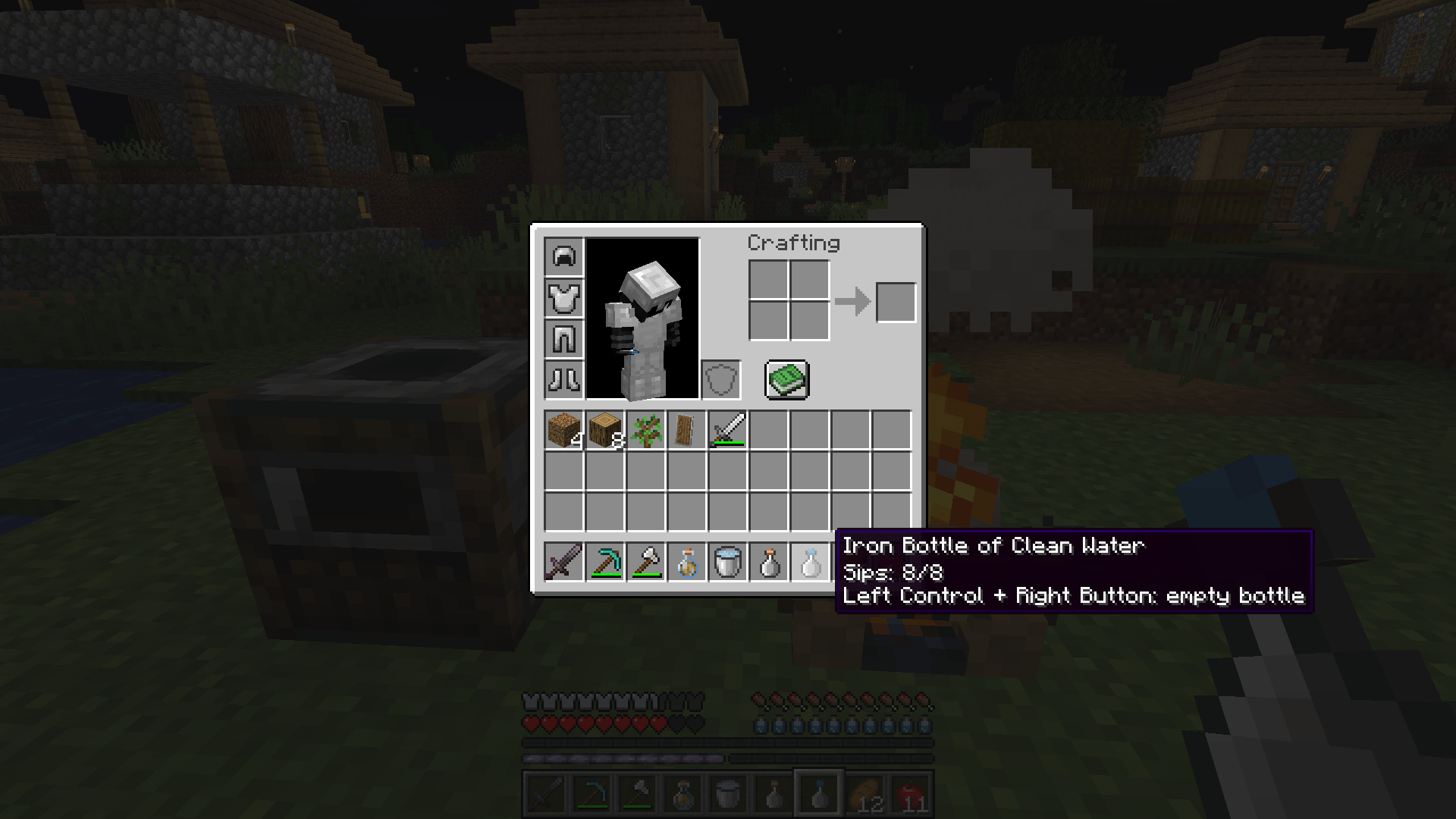
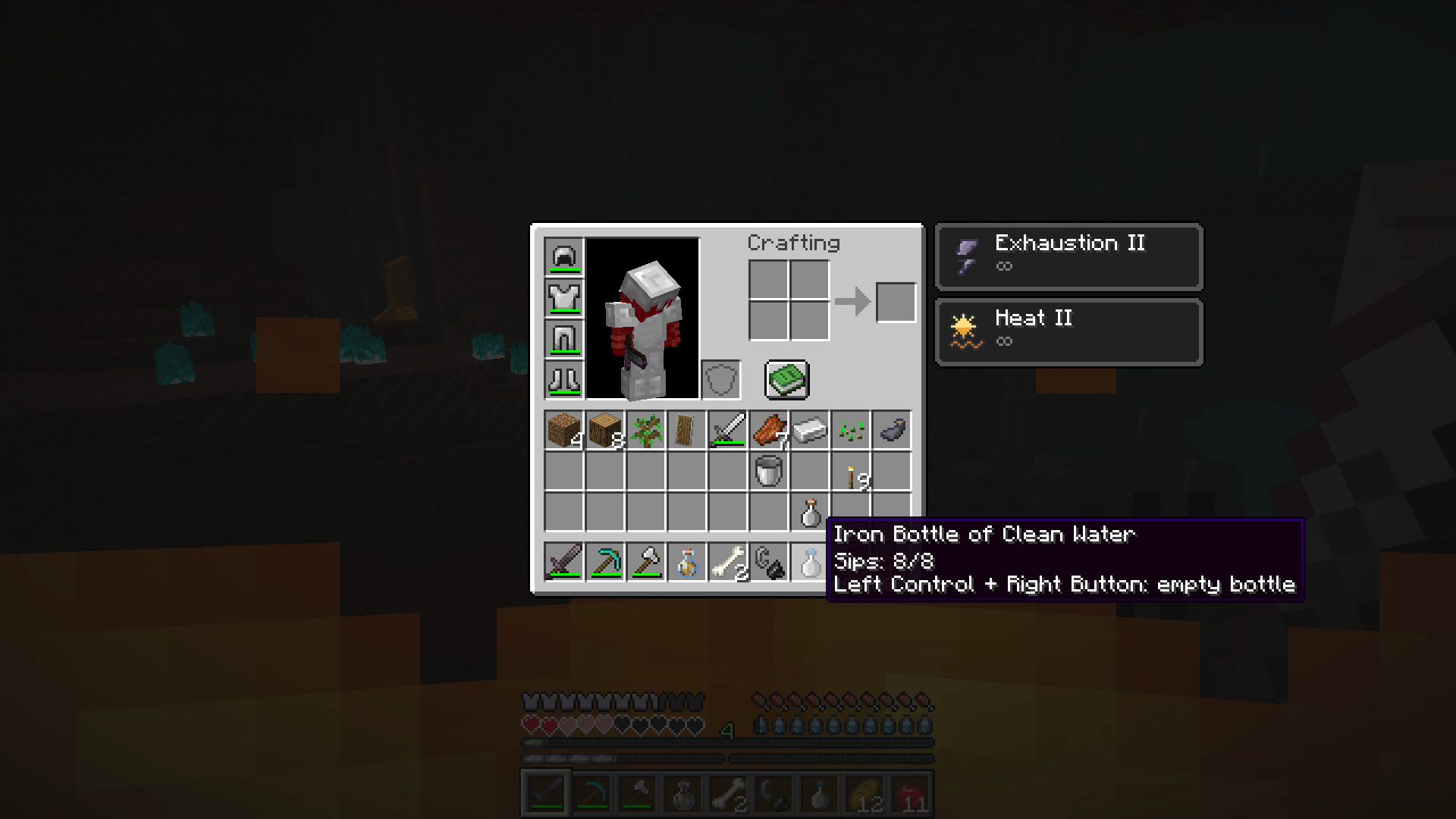
Craft an iron bottle from a glass bottle and an empty bucket. Iron bottles hold eight sips by default and can contain ordinary or clean water. They can be refilled with the same water type; empty them before switching types.
Filled iron bottles have blue caps, empty ones have brown caps, and tooltips show the remaining sips. Glass bottles hold one sip by default. Iron bottles cannot hold energy or recovery drinks.
Drinking from buckets
- Use a clean water bucket to drink it.
- Hold your configured Sneak key and use an ordinary water bucket to drink instead of placing water.
A bucket provides the equivalent of a full iron bottle:
- Clean water: 16 hydration.
- Ordinary water: 8 hydration, with an 8-stamina penalty.
These amounts follow the configured bottle capacity and per-sip values. Drinking leaves an empty bucket.
Drinking controls respect your configured Sneak binding rather than assuming the key is Shift.
Milk retains vanilla effect removal, including removing Vigor, Recovery and apple-granted regeneration. Persistent conditions such as Exhaustion, Heat and Cold return if their causes remain.
Energy drinks
There is one energy drink, crafted in a 2×2 grid from:
- A glass bottle of clean water.
- Cocoa beans.
- Sugar.
- Sweet berries.
Drinking it grants Vigor for 30 seconds, reducing fatigue generation by 70%. It immediately consumes 1 food and 1 hydration.
It does not restore food or water, remove existing fatigue or replenish stamina. While Vigor is active, the fatigue bar turns amber. Its icon and countdown appear in Minecraft’s normal status-effect interface.
Each energy drink is a single serving in a glass bottle. Honey bottles remain ordinary food.
Health and medicine
Eating no longer restores full health automatically.
Limited natural healing
Natural healing reaches only three hearts by default:
- Restores half a heart every 10 seconds.
- Consumes 0.5 food per health point restored, or 1 food per full heart.
- Stops when food or hydration is empty.
Apples as medicine
- Apple: instantly restores 1 heart.
- Golden apple: instantly restores 3 hearts, then grants Regeneration II for 5 seconds and Absorption I for 2 minutes.
- Enchanted golden apple: retains its vanilla protective effects and Regeneration II for 20 seconds.
Apples restore no food or hydration. Ordinary external healing and unauthorized regeneration cannot bypass the mod’s health system.
Oak and dark oak leaves have an increased, configurable apple drop chance: 2% without Fortune, 2.5% with Fortune I, 3% with Fortune II and 4% with Fortune III or higher. Natural leaf decay uses the base chance. Shears and Silk Touch do not produce apples.
Recovery Drink
Craft a Recovery Drink at a crafting table using:
- A glass bottle of clean water.
- A golden carrot.
- An apple.
The recipe is shapeless and requires a workbench. Ordinary water and energy drinks cannot substitute for clean water.
The drink grants Recovery for three minutes, healing half a heart every 15 seconds. A full uninterrupted course can restore up to six hearts.
Each health point actually restored costs:
- 0.5 food
- 0.5 hydration
- 1 stamina
Both food and hydration must remain above 10. Healing pauses in either red zone, and available stamina also limits healing. The effect’s countdown continues while healing is paused.
Full health consumes no supplies. Drinking another dose refreshes the duration rather than stacking its strength. Milk removes the effect. Drinking returns an empty glass bottle.
Recovery does not replenish stamina or remove fatigue. Its resource costs are separate from the climate multipliers for clearing fatigue and restoring stamina.
Duration, healing rate and resource costs are configurable.
Starvation and dehydration
At zero food, starvation deals half a heart every 10 seconds. At zero hydration, dehydration does the same. If both meters are empty, both penalties apply.
Climate changes your supply needs
Hot environments increase water consumption. Cold environments increase food consumption.
| Environment | Effect | Baseline consumption | Recovery cost |
|---|---|---|---|
| Hot biomes | Heat I | Water ×4 | Water used to clear fatigue ×1.25 |
| Cold biomes | Cold I | Food ×4 | Food used to restore stamina ×1.25 |
| Nether | Heat II | Water ×8 | Water used to clear fatigue ×1.5 |
| End | Cold II | Food ×6 | Food used to restore stamina ×1.5 |
Climate changes these resource costs without directly changing fatigue generation or recovery speed. Heat and Cold icons indicate the current conditions.
Biome temperature thresholds and multipliers are configurable, with biome tags available for overrides. The current system uses biome temperature and dimension rules; equipment, shelter, weather and time of day do not change these penalties.
Livestock and stored feed
Cows, mooshrooms, pigs, sheep and chickens have four feeding divisions. Wild animals and newborns start empty. Feeding progress does not decay over time: stored feed is spent when an animal provides something useful.
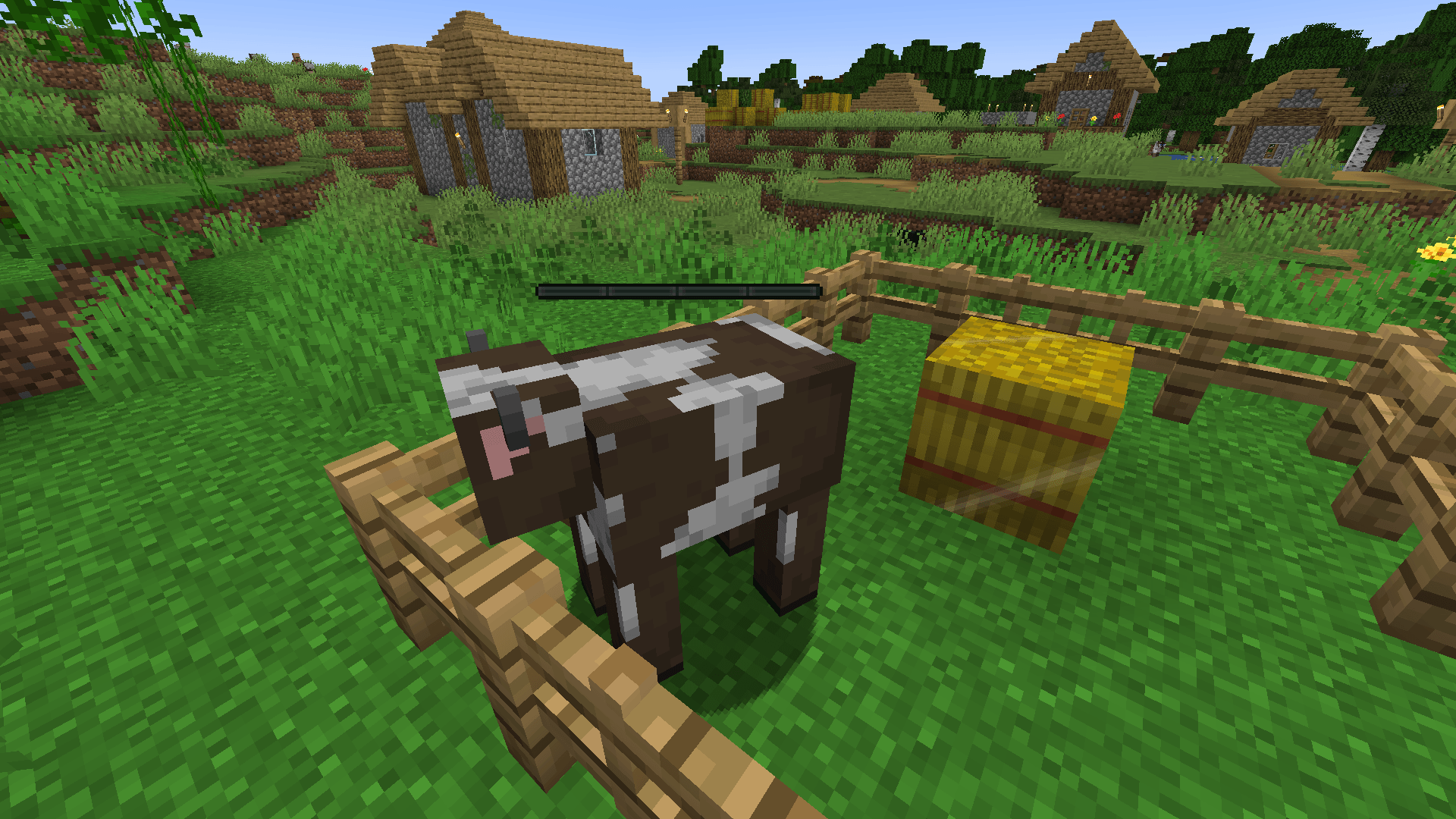
Place ordinary hay bales within four blocks of your animals. Feeding happens automatically, consuming a finite supply of hay:
- Only in loaded, ticking chunks.
- Only under open sky by default.
- During the night and rain as well as during the day.
Roofs, glass and leaves block feeding under the default open-sky rule.
| Animal | Time to fill all four divisions | Hay required |
|---|---|---|
| Cow or mooshroom | 3 Minecraft days | 1 bale |
| Pig | 2 Minecraft days | Half a bale |
| Sheep | 2 Minecraft days | Half a bale |
| Chicken | 1 Minecraft day | Quarter of a bale |
Feeding checks are driven by loaded hay bales, avoiding repeated hay searches by every animal while you explore.
Products and breeding
Obtaining a product normally costs one complete feeding division:
- Milking a cow or mooshroom.
- Collecting stew from a mooshroom.
- Shearing a sheep.
- Right-clicking an adult chicken with an empty hand for an egg.
- Using shears on an adult chicken for feathers.
Grass can regrow a sheep’s wool, but shearing still requires stored feed. Chickens no longer produce free timed eggs.
Shearing a mooshroom also consumes a division; the resulting cow retains the remaining feeding progress.
Breeding requires 4/4 divisions on both parents and empties both meters. Vanilla breeding foods still attract animals and can help babies grow.
Meat yield
| Complete divisions at death | Meat dropped |
|---|---|
| 0 or 1 | 0 |
| 2 | 1 |
| 3 | 2 |
| 4 | 3 |
Looting does not increase this meat yield. Other resources, such as leather, can still be obtained.
Products, breeding and meat draw from the same stored feed. Using an animal for one purpose reduces what remains for the others.
Feeding indicators and consumed hay
Aim at a supported animal within six blocks to see its orange, four-section feeding bar. The bar appears only within the radius of available hay and is dimmed when the open-sky rule prevents feeding. Walls hide it. Feeding-zone visibility updates once per second.
Partially consumed hay displays a subtle white shimmer. Sneak-right-click a bale with an empty hand to inspect its remaining feed.
Fully consumed hay disappears. Breaking partially consumed hay drops nothing, even with Silk Touch.
Recipe book
The mod’s twelve crafting, smoking and campfire recipes are automatically unlocked on login and refreshed when recipes reload:
- Cushion.
- Iron bottle.
- Clean water bucket in a smoker.
- Glass bottle of ordinary water.
- Glass bottle of clean water.
- Iron bottle of ordinary water.
- Iron bottle of clean water.
- Energy drink.
- Recovery Drink.
- Campfire-baked potato.
- Campfire-dried kelp.
- Clean water bucket on a campfire.
Bottle-filling recipes distinguish ordinary and clean water. Energy drinks fit the inventory’s 2×2 crafting grid; Recovery Drinks require a workbench.
Configuration, languages and compatibility
The mod includes English and Russian translations, selected through Minecraft’s language settings.
Configuration files have grouped settings and explanations in both languages. They are stored in the game profile or server’s config folder and apply across local worlds.
| File | Settings |
|---|---|
the-cost-of-living.toml |
Survival meters, activity, rest, health, drinks, energy, Recovery Drink, sleep, climate and apple drops. |
the-cost-of-living-food.toml |
Food values, categories, stamina penalties and apple medicine. |
the-cost-of-living-husbandry.toml |
Feeding times, hay costs, animal products and feeding indicators. |
the-cost-of-living-provisions.toml |
Per-item shelf life, stack limits, spoiled-food effects and separate smoker/campfire cooking times. |
the-cost-of-living-client.toml |
Client interface settings. |
Multiplayer uses the server’s balance settings. Restart the game or server after editing configuration files. Older survivalmod-* configuration filenames are no longer read.
Standard food from other mods has a configurable nutrition fallback. Additional foods, drinks, medicines and animals can be described through the-cost-of-living-integrations.json; validation produces the-cost-of-living-integration-report.json.
Individual mod combinations still require testing, particularly when another mod changes the same survival mechanics or introduces custom storage. Ender-chest refrigeration supports food in vanilla shulker boxes; arbitrary modded backpacks and containers require separate compatibility testing.
Requires Minecraft 1.20.1, Forge 47.4.10 or later in the 47.x branch, and Java 17. Install the same updated build on both client and server, replacing the previous JAR.
Screenshots
Gallery
-
 2026-10-05_23.04.38.png 2026-10-05_23.04.38.png
-
 2026-10-05_23.05.56.png 2026-10-05_23.05.56.png
-
 2026-10-05_23.07.47.png 2026-10-05_23.07.47.png
-
 2026-10-05_23.09.23.png 2026-10-05_23.09.23.png
-
 2026-10-05_23.18.24.png 2026-10-05_23.18.24.png
-
 2026-10-05_23.20.22.png 2026-10-05_23.20.22.png
Versions
Files
Relations
Project Relations
More like this
Similar Mods
Suggestions use data such as tags, dependencies, dependents, descriptions, titles, and more to rank how much they overlap with this mod.
On ModDex
Community snapshot
By the numbers
Statistics

Get it on
Available Platforms
On ModDex
Community snapshot
By the numbers
Statistics
Resources