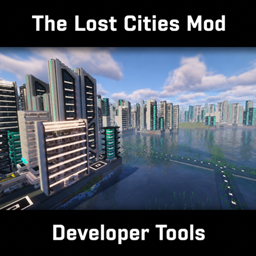
Community listing page, reviews here may not be monitored by the author.
The Lost Cities - DevTool

No reviews yet
Build Lost Cities packs in game, or open one you already have. Write your files with comments and .json5, and have mistakes caught at load time with a line number. Small bugs have optional fixes. KubeJS compatible.
Community voices
Reviews
No reviews yet. Be the first to review this project!
Get it on
Available Platforms
About
Project Details
For authors
Embed Badge
If you're the author of this project, you can embed a live badge anywhere that supports HTML or Markdown. It updates automatically whenever ratings change.
Use HTML for any page that supports it, or Markdown for README files and Markdown-based descriptions.
Identifiers
Platform IDs
About
Description
The Lost Cities - DevTool
A companion mod for The Lost Cities. Build a pack by building it in Minecraft, open a pack you already have by walking around inside it, and find the mistake in the one you are writing.
It adds no blocks, items, mobs or structures to your world, and nothing it does changes world generation unless you switch on one of the optional fixes.
| Minecraft | 1.20.1 |
| Forge | 47+ |
| The Lost Cities | 7.4.12 or 7.5.1 to 7.5.4, required. One file per line, see below |
| Java | 17 or newer |
| Licence | 0BSD |
Pick the file that matches your Lost Cities version. A mod that rewrites another mod's methods is tied to the shape of those methods, and 7.5 moved two of them, so one file cannot serve both lines.
| Your Lost Cities | Download |
|---|---|
| 7.4.12 | 3.0.0 |
| 7.5.1, 7.5.2, 7.5.3, 7.5.4 | 3.0.0-7.5, beta |
The two files are the same mod. Nothing is added or missing on either side.
What it does
A custom city is a lot of small files, and when one of them is wrong, Lost Cities usually tells you in a way that does not name the file.
- Builds a whole pack out of what you build in game, and opens a pack you already have
- Names the building that caused a generation error, and where it is
- Checks your files as they load and reports the file and line number
- Lets you write comments and trailing commas in your JSON
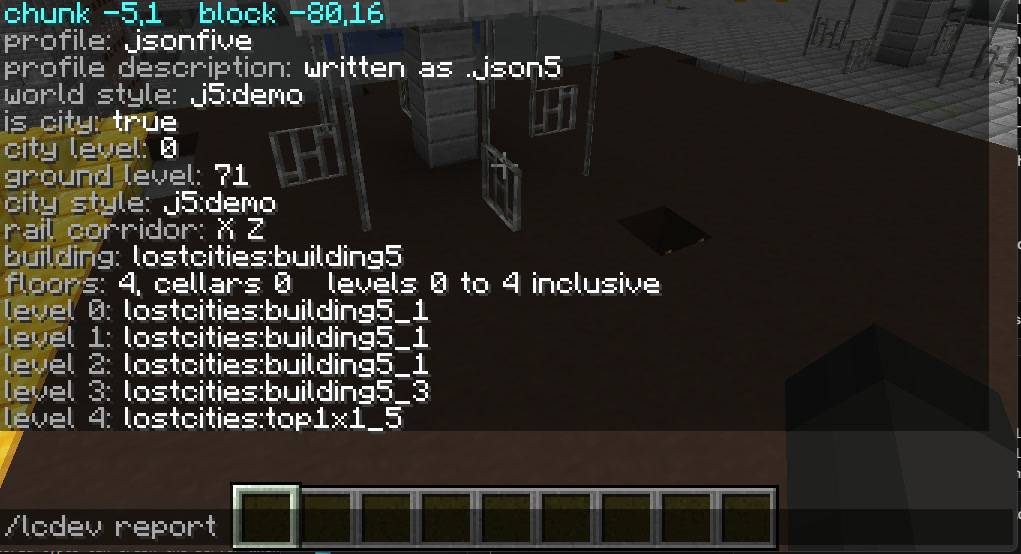
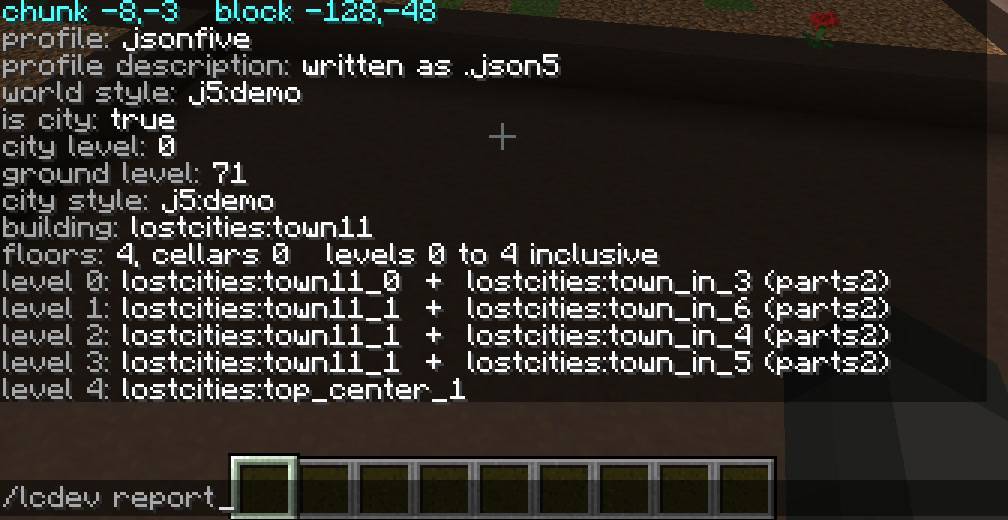
- Shows which building, part and floor the generator picked for a chunk
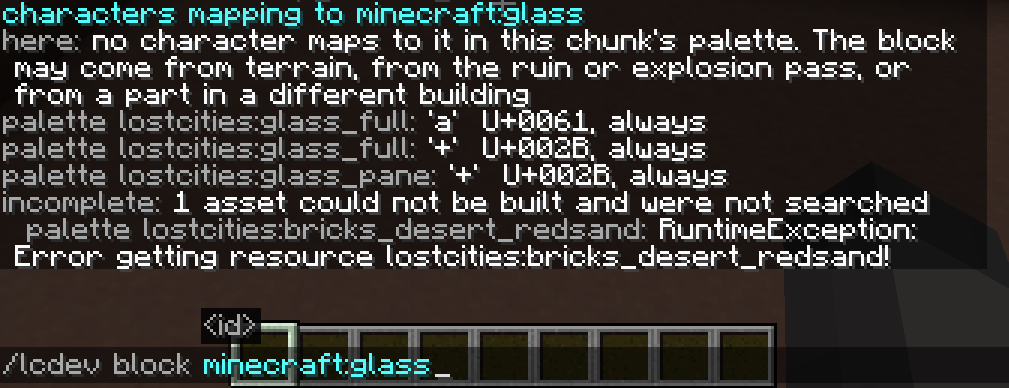
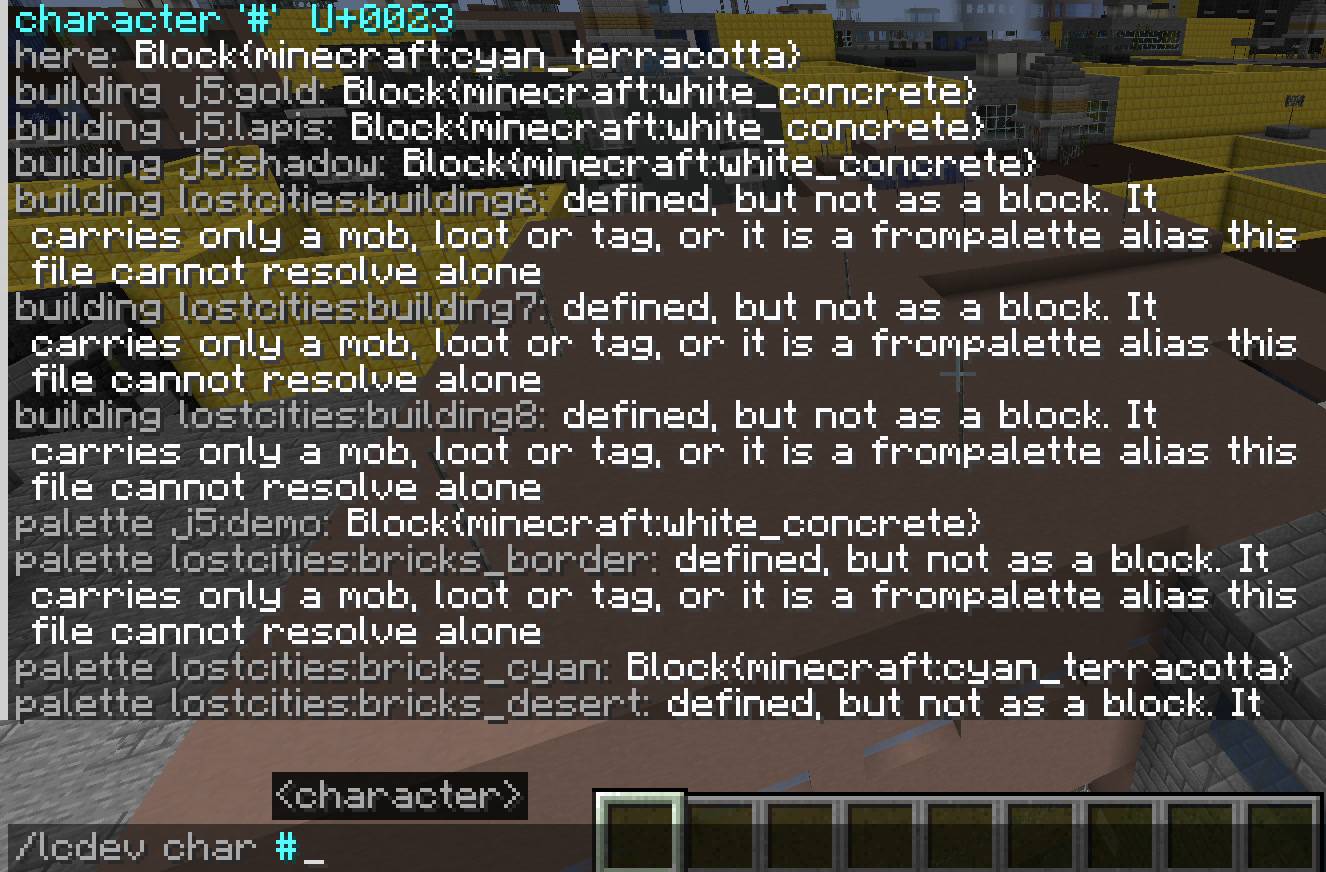
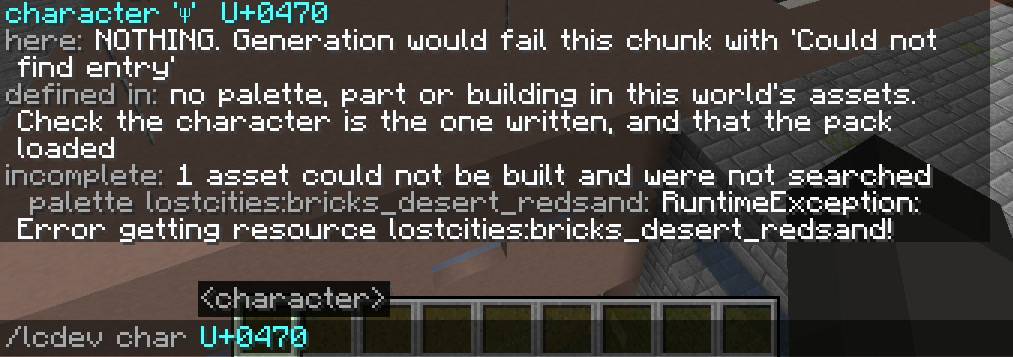
- Looks up palette characters and blocks, in both directions
- Carries a pack's licence with the pack, so credit is not lost in a rebuild
- Keeps a broken file from crashing sphere worlds
Build a pack by building it
The workshop is a dimension laid out as a catalogue, with a plot for every shape a pack can hold: 138 rows covering streets, highways, railways, monorails, parks, fountains, bridges, stairs, fronts, rail dungeons, buildings, and every multibuilding footprint up to the 10x10 that is as wide as one can be. Each plot sits on chunk boundaries and is floor marked in its own colour. Rows start at eight plots and grow as far as you want.
/lcdev workshop build     lay the catalogue out
/lcdev workshop go        travel there
/lcdev workshop leave     go back where you came from
/lcdev workshop here      what the plot you are standing on compiles into
/lcdev workshop rows      every row, each one a place to click
Build in the plots with whatever you normally build with. Then compile the lot:
/lcdev export mypackThat writes a complete datapack and the profile that goes with it, ready to drop into a world. A pack made this way generated a city with 10,672 gold blocks in it.
/lcdev export mypack plot writes just the plot you are standing on, as a fragment
with no world style, for sharing one building rather than a city.
Open a pack you already have
Point it at a pack that is loaded and it pastes that pack into the workshop, so you can walk around it and edit it:
/lcdev import lostcities:standardThe Lost Cities default pack comes in as 42 assets on 42 plots, 714,240 blocks, streets included, even though nothing in that pack names a street part. Change one building and compile the whole thing back out.
A building that names several parts for the same level comes in showing all of them
rather than the first one repeated. A palette entry's tag is carried both ways, so
command blocks keep their commands, chests keep their loot tables and spawners keep
their mobs. Command blocks arrive unable to fire, because forty spawn commands going
off while you are looking at a building is not useful. /lcdev import mypack:main run
pastes them live instead.
tagkeys decides which of a block's NBT reaches the pack, so a chest you opened while
building does not ship its contents, and a loot chest does not ship a seed that pins
one roll into every copy.
Importing a second city leaves the first one's plots alone, since an import only fills
what its own pack needs. It says how many it left behind, and /lcdev workshop clear
empties the workshop when you want to start again, writing a full backup pack first.
Every plot has a settings file beside your world, with the meaning of each key in a comment above it, so a file you open six months later still says what it does. Edit it in game or in a text editor: values are read from the file every time, so both stay in step without syncing anything.
A pack's licence travels with the pack
Import a pack and DevTool shows what its author said about reuse, reading
license.txt from the pack itself. Export, and those statements are carried into what
you build, one heading per namespace, so a pack compiled out of somebody else's content
does not ship with the credit stripped out.
A namespace that states nothing is reported as nothing found, which is not the same as nothing being reserved. Copyright is automatic, so the mod says so rather than guessing on the author's behalf.
Find out what actually went wrong
One broken building makes Lost Cities produce errors from every chunk that asked about it, and none of them say which building it was. DevTool says it directly:
Misconfiguration! Floor were generated for a building where no part condition matches!
  [building mypack:tower at chunk 10,8, levels 0 to 6 inclusive.
   Every chunk that queries this one fails the same way]
On a test pack with three broken buildings, 78 similar looking failures became three named ones. Missing palette characters are reported the same way, with the character's code and name when it cannot be printed.
Your files are checked as they load
Lost Cities asset check: 2 errors, 1 warning
  ERROR  mypack:lostcities/buildings/tower.json:10  levels [3] match no part
         Levels run -0 to 3 INCLUSIVE, so 'maxfloors': 3 is a 4-storey building
  ERROR  mypack:lostcities/palettes/test.json:72  'loot': "minecraft:chests/simple_dungeon"
         looks like an ID, but 'loot' names a Condition
  WARN   mypack:lostcities/buildings/tower.json:13  range "0,2,9" has more than two numbers
         The mod reads the first two and discards the rest, silently
It catches floor ranges that leave a level with nothing to build, conditions that can never match, invalid block names, weighted lists that do not add up, layers that are the wrong size, Condition entries whose weight is missing or unreadable, and two faults that otherwise pass in silence: a monorail part written as a list, which stops a world style loading, and an inline palette written as a bare list, which loads perfectly and generates an empty building.
Nothing is blocked from loading. The check tells you what is wrong and lets the pack run.
Ask why a chunk generated the way it did
/lcdev report                     profile, world style, city style, building, and the part on each level
/lcdev key name                   what a profile key means, its section, type, range and default
/lcdev char G                     what a palette character resolves to here
/lcdev block minecraft:gold_block which characters produce that block here
/lcdev in mypack:mystyle char G   the same lookup inside one named asset
/lcdev conditions                 every Condition loaded
/lcdev condition chestloot        its entries, each one's share, and the test that places it
in inspects a named file without needing a generated city to stand in first, so a
condition can be tested rather than waited on.
condition is worth knowing about. In a palette, loot and mob name a Condition, not
a loot table or an entity, and this shows what one holds without opening the pack file
by hand.
Tab completion does not read every loaded file on every keystroke. On a server holding 911 Lost Cities assets that cost 99 ms a character, close to two seconds to type one name; it is 0.1 ms now.
Palettes as large as your build
Every distinct block state in a pack needs its own palette character. The pool the exporter draws from holds about 40,000 of them, against the roughly 26,000 block states Minecraft ships, so a detailed build does not run out.
Characters are chosen to survive being written to a file and read back: nothing blank,
nothing that reorders the text around it, nothing a normaliser would rewrite, and
nothing above U+FFFF, which Lost Cities would read as two cells and shift the rest of
the row.
Comments in your files
JSON does not allow comments. DevTool does:
// The tower at the centre of the city
{
  "filler": "#",
  "parts": [
    { "part": "mypack:origin" }, // used on every level
  ],
}
Trailing commas work too. Files can be named .json or .json5, and where both exist
the .json5 one wins. This applies to your datapacks and to your Lost Cities profiles.
Where it goes, and where your files can live
Your Lost Cities files can stay where you already keep them: the world's datapacks
folder, a global datapack loader, or kubejs/data.
Everything that matters runs on the server. The workshop, export and import, reading
.json5, the load-time check, the better error messages and every /lcdev command all
live there. Only the Lost Cities menu fixes are client side, so a client install is
optional and a client without the mod can still join a server that has it. In single
player, one install covers both.
The machine loading the pack does need it. Without DevTool, Lost Cities cannot read
a .json5 file at all, and a .json file with comments or trailing commas fails to
load.
Every /lcdev command needs permission level 2, which means op on a server and cheats
enabled in single player. It teleports between dimensions, writes tens of thousands of
blocks and writes files beside your world, so it is a tool for building a pack rather
than a feature for players.
Optional fixes
Two fixes correct bugs in Lost Cities itself. Both are off by default, because
turning one on changes what a seed generates, and each is switched separately in
config/lostcities_devtool-common.toml.
- A
belowpartcondition that checks the part below it, as its name says - A
streetblocks.parts.fulloption that can actually be selected. Measured on the same pack and seed: thefullshape draws nothing with the fix off and 1,504 blocks with it on
Three more are on by default and touch only the Lost Cities menus, so they cannot change a world. Pressing Customize after having played a world no longer crashes the game. Right-clicking the profile button walks back through the list, so overshooting the profile you wanted no longer means cycling all the way around. The Cities button stays where it is when you resize the window.
Sphere worlds do not crash on a broken file
Some Lost Cities world types take the server down when a chunk fails to generate.
Measured on the same pack and seed: 21 crashes before, none after, with all 338
errors logged instead. The broken chunk still fails, and nothing about the fault is
hidden or changed. This is on by default, can be turned off, and covers spheres,
cavernspheres and space.
Try it before you write anything
Three example datapacks are in the wiki repository. They build the same small city three different ways, so you can see how the files fit together before starting your own.
Every command, argument and flag is written up in The DevTool Commands, and the rest of the Lost Cities Wiki covers the format itself with examples.
Credits and licence
The Lost Cities is created by McJty. The Lost Cities Discord answered questions that no documentation covered.
DevTool is an unofficial companion mod and is not affiliated with or endorsed by McJty or The Lost Cities.
Released under 0BSD.
Screenshots
Gallery
-
 s1.jpg s1.jpg
 -
 s2.jpg s2.jpg
 -
 s3.png s3.png
 -
 s4.jpg s4.jpg
 -
 s5.jpg s5.jpg
 -
 s6.jpg s6.jpg
 -
 s7.jpg s7.jpg
 -
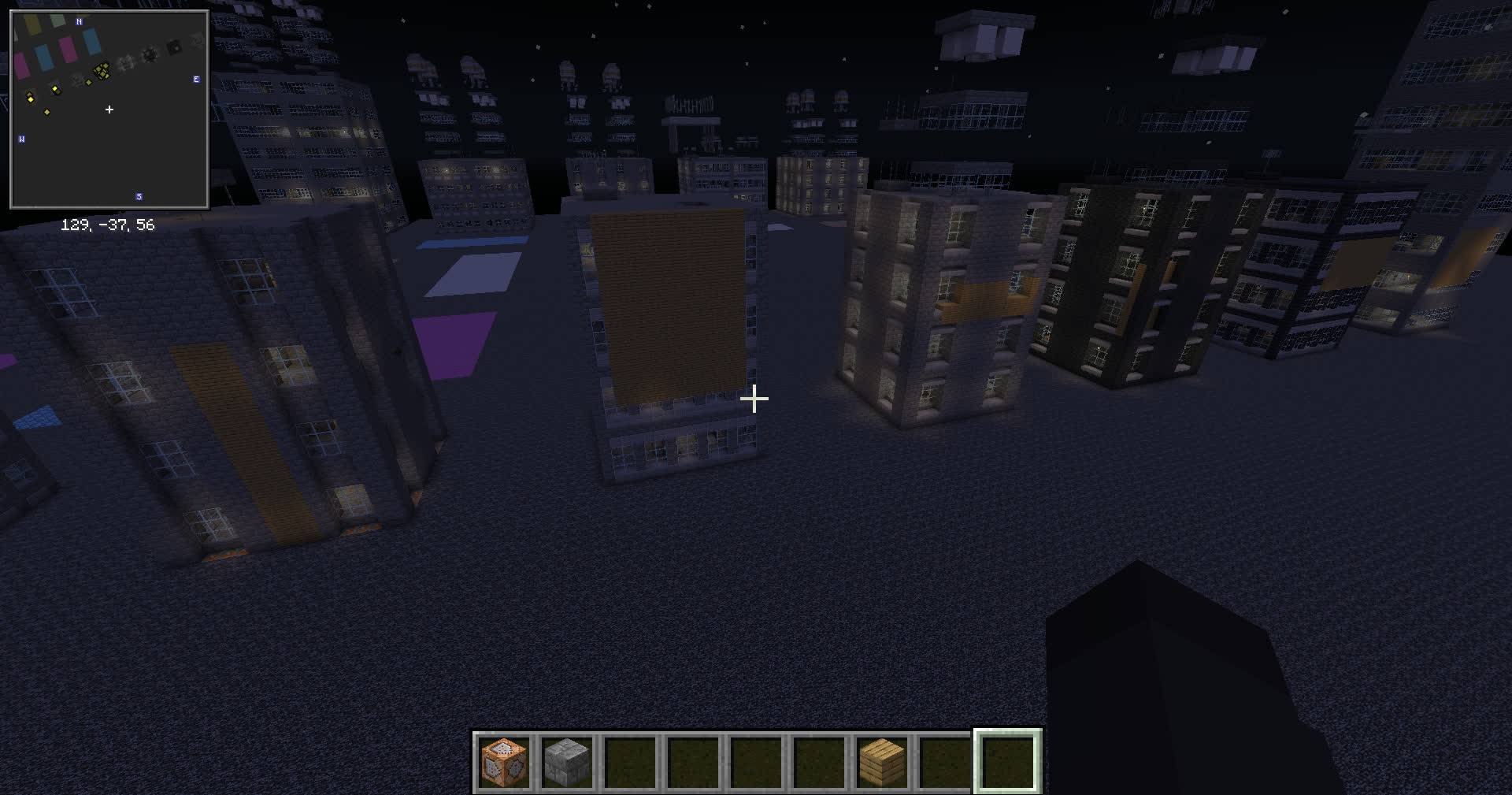 workshop.jpg The workshop dimension.
 -
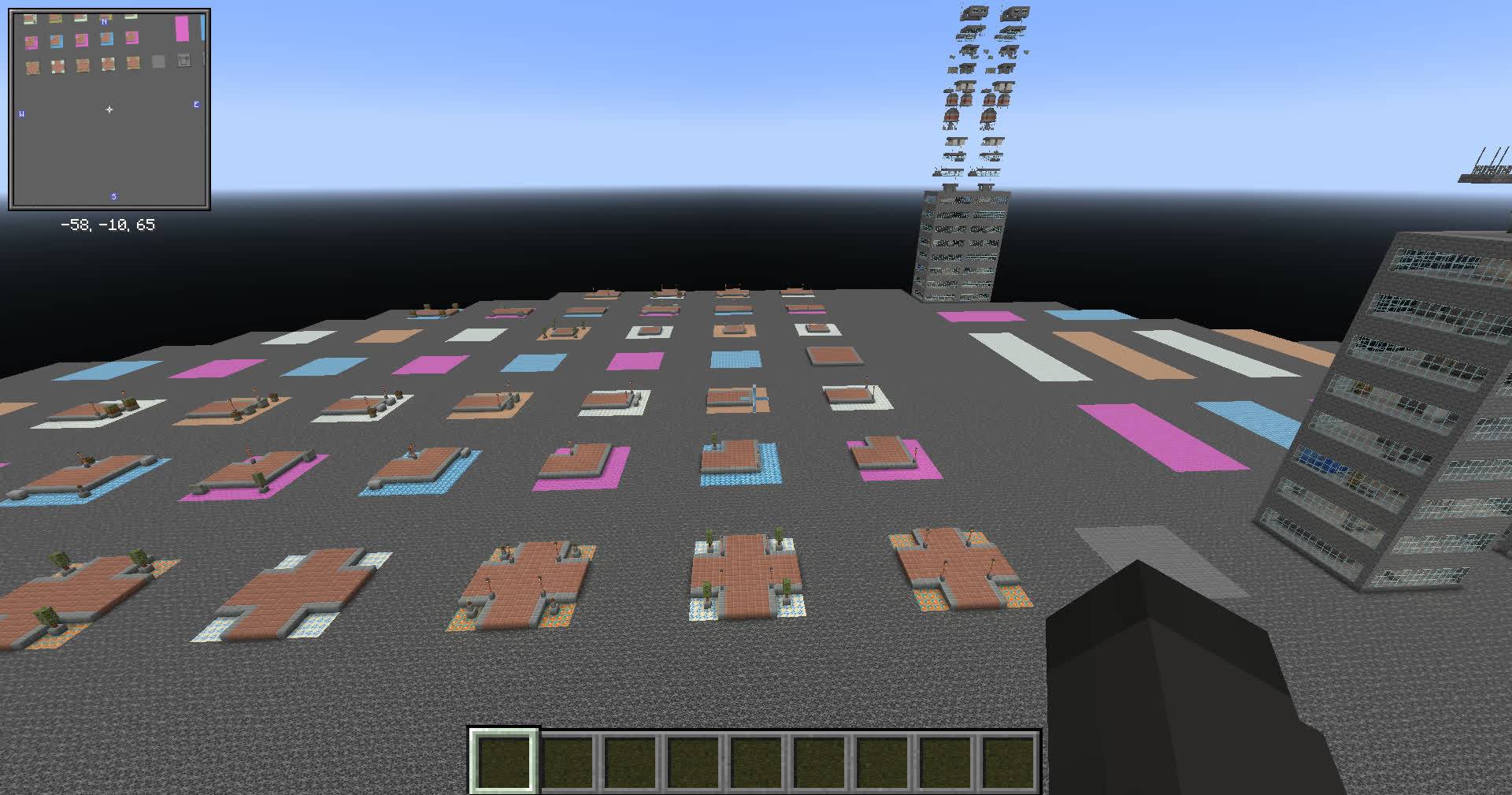 moderntweaks.jpg Imported Lost Cities Modern Tweaks Custom City
 -
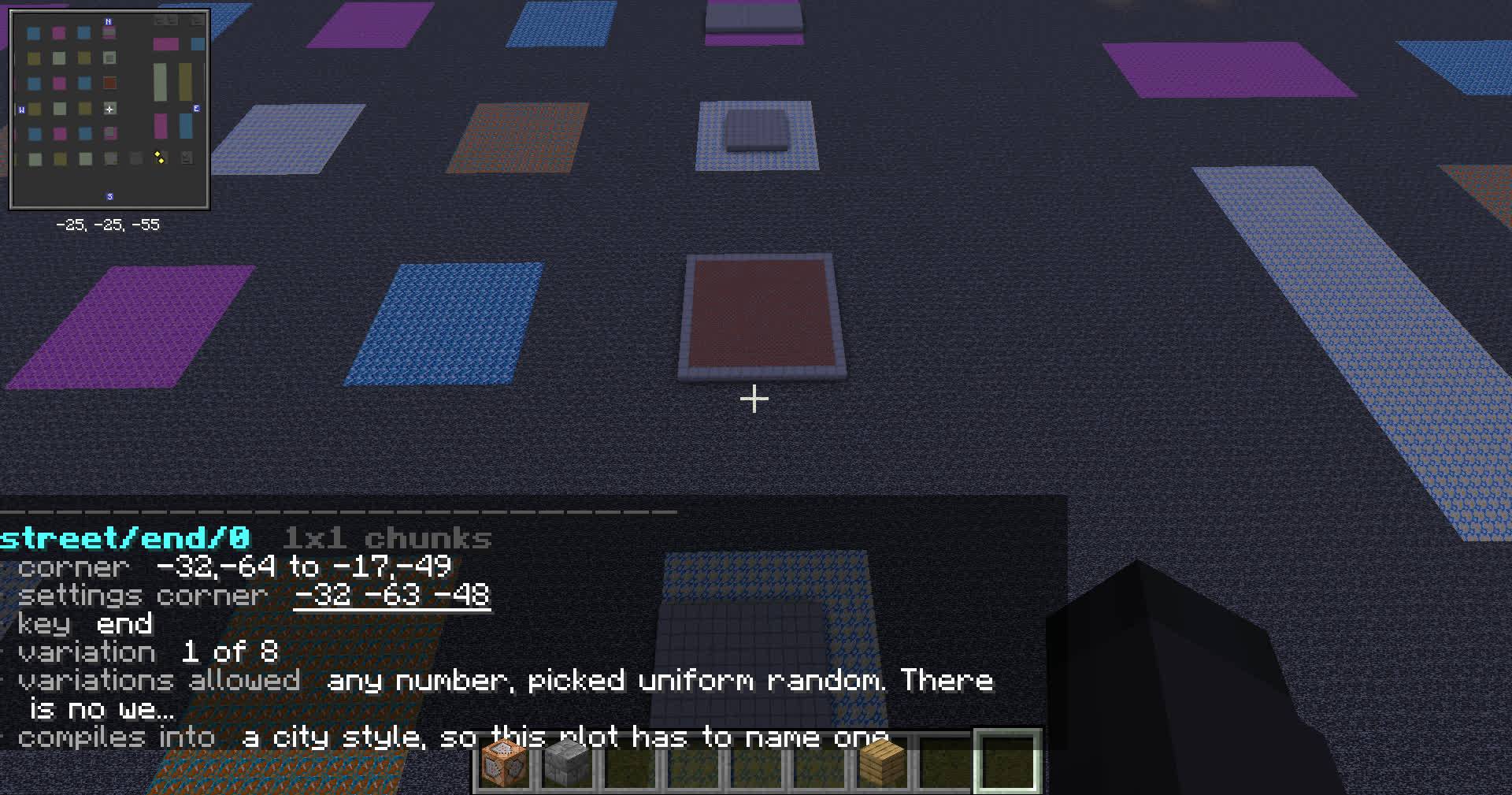 command.jpg Example use case of a command.
Versions
Files
Relations
Project Relations
More like this
Similar Mods
Suggestions use data such as tags, dependencies, dependents, descriptions, titles, and more to rank how much they overlap with this mod.
On ModDex
Community snapshot
By the numbers
Statistics
Want to reach Minecraft players?
We're looking for a server hosting partner to feature here and other parts of the site. Interested? Send us a message!
Get in touchGet it on
Available Platforms
On ModDex
Community snapshot
By the numbers