Community listing page, reviews here may not be monitored by the author.


Community voices
Reviews
No reviews yet. Be the first to review this project!
Get it on
Available Platforms
Compatibility
Supported Environments
Runs entirely on the client. Works on vanilla servers.
Must be installed on both the client and the server.
Varies by version.
About
Project Details
For authors
Embed Badge
If you're the author of this project, you can embed a live badge anywhere that supports HTML or Markdown. It updates automatically whenever ratings change.
Use HTML for any page that supports it, or Markdown for README files and Markdown-based descriptions.
Identifiers
Platform IDs
Resources
External Links
About
Description
Highlights every occurrence of a block pattern near you.
Patterns can be 1D, 2D or 3D, and you can search for shapes and groups of different
blocks, including wildcard (?)
Usage
The easiest way to configure the mod is using the GUI settings screen. This can
be started with the command /blockgrep config, or you can go to
Options → Controls → Key Binds → Block Grep and assign "Open pattern settings" a key.
On Fabric, if you have Mod Menu installed, it'll appear in the mod menu list.
In the settings screen you can create new patterns and configure their rendering settings.
Commands
You can configure the mod entirely using commands if you wish.
/blockgrep pattern [symmetry] <spec>   add a shape of any dimensions
/blockgrep box <x> <y> <z> <blocks>    add a uniform box
/blockgrep list                        show the saved patterns
/blockgrep toggle <n>                  turn one on or off
/blockgrep only <n>                    enable one, disable the rest
/blockgrep all on|off                  every pattern at once
/blockgrep name <n> <text>             rename one
/blockgrep remove <n>                  delete one
/blockgrep radius <blocks>             4–128, default 32
/blockgrep limit <count>               default 512
/blockgrep config                      open the settings screen
/blockgrep status
/blockgrep off
Pattern syntax
Patterns are made of cell predicates, each of which tries to match a block:
| Form | Meaning |
|---|---|
mud |
that block (namespace defaults to minecraft) |
mud,dirt |
Either mud or dirt |
mud,dirt,grass_block |
Either mud or dirt or a grass block |
#minecraft:trapdoors |
any block with that tag, ie. any trapdoor in this example |
? |
any block, including air |
!air |
anything the rest does not match |
These are combined into larger patterns using , | and ||. So,
| Form | Meaning |
|---|---|
mud mud |
Two mud blocks beside each other (east-to-west) |
mud \| mud |
Two mud blocks beside each other (north-to-south) |
mud mud \| mud mud |
Four mud blocks in a 2x2 square |
mud,dirt mud,dirt \| mud,dirt mud,dirt |
Four blocks of mud-or-dirt in a 2x2 square |
stone stone \| stone stone \|\| mud mud \| mud mud |
A 2x2x2 cube with stone on the bottom layer and mud on the top layer |
Examples
A 2x2 square of mud and/or dirt:
/blockgrep box 2 1 2 mud,dirt, or/blockgrep pattern mud,dirt mud,dirt | mud,dirt mud,dirt
A grass block above another grass block:
/blockgrep pattern grass_block || grass_block
A 2x2 of mud, with anything (or nothing) above it:
/blockgrep pattern mud mud | mud mud || ? ? | ? ?
Any 2x2 of logs, of any wood type:
/blockgrep pattern #logs #logs | #logs #logs
Dimensioned form
A pattern can also be given as explicit dimensions followed by x·y·z cells, in x then z then y order:
/blockgrep pattern 2 2 2 mud mud mud mud #logs ? ? #logs
Symmetry
By default a pattern is matched at all four compass orientations. An optional
symmetry spec before the pattern changes that. It is up to three axis letters —
lowercase to allow rotation about that axis, uppercase or absent to pin it — with
h and v to allow horizontal and vertical mirroring.
/blockgrep pattern XYZ   mud ? | ? mud     only as written        (1)
/blockgrep pattern y     mud ? | ? mud     four compass turns     (4, the default)
/blockgrep pattern yh    mud ? | ? mud     ...plus horizontal flips  (8)
/blockgrep pattern yv    mud ? | ? mud     ...plus a top-to-bottom flip (8)
/blockgrep pattern yvh   mud ? | ? mud     both mirror families   (16)
/blockgrep pattern xyz   mud ? | ? mud     all 24 rotations of the cube
/blockgrep pattern xyzvh mud ? | ? mud    all 48, reflections included
Mirror planes can also be named individually after a +, by the axis normal to
each: +x is the east-west flip, +y the top-to-bottom one, +z north-south.
So yh is exactly y+xz, and yv is y+y.
Three things are worth knowing:
- Rotations about two different axes generate rotations about the third, so
xy,yz,xzandxyzall mean the same 24 orientations. - Reflections are not implied by rotations. An L-shape and its mirror image
are different shapes however you turn them, which is why
handvexist. - Mirrors are only interchangeable because of rotation. With the four turns of
yin hand,+xand+zname the same eight orientations; with no rotation at all they are genuinely different flips, andXYZ+xzgives four orientations because composing the two mirrors produces a 180° turn.
Symmetric shapes are deduplicated, so each occurrence is reported once however many orientations were searched.
Performance
The scanner walks chunk sections (16x16x16 blocks) and uses the section palette to reject sections that cannot contain any candidate block, which skips the large majority of them. Scans are cached and re-run only when you move ~8 blocks or every 2 seconds.
Sections are visited nearest-first, so a scan that hits the match limit reports what is around you rather than whatever happened to lie in one corner of the radius. The limit is shared between active patterns, so one very common pattern cannot crowd out the others.
Patterns containing ! cannot use the section palette early-out and so are
correspondingly slower — prefer naming blocks explicitly where you can.
Only chunks the client has loaded are searched, so range is capped by render distance
regardless of the radius setting.
Cheating
Note: this mod can be used as an ore-finder so it should be considered a
bit cheaty. Removing X-ray mode for a "lite" non-cheaty version was considered,
but you'd still be able to look for, say, valuable ore below a grass_block or
stone, highlighting that less-valuable block, so while removing X-ray mode
would limit bulk cheating, it wouldn't make it a fair non-cheaty mod to use.
Highlights every occurrence of a block pattern near you.
Patterns can be 1D, 2D or 3D, and you can search for shapes and groups of different
blocks, including wildcard (?)
Usage
The easiest way to configure the mod is using the GUI settings screen. This can
be started with the command /blockgrep config, or you can go to
Options → Controls → Key Binds → Block Grep and assign "Open pattern settings" a key.
On Fabric, if you have Mod Menu installed, it'll appear in the mod menu list.
In the settings screen you can create new patterns and configure their rendering settings.
Commands
You can configure the mod entirely using commands if you wish.
/blockgrep pattern [symmetry] <spec>   add a shape of any dimensions
/blockgrep box <x> <y> <z> <blocks>    add a uniform box
/blockgrep list                        show the saved patterns
/blockgrep toggle <n>                  turn one on or off
/blockgrep only <n>                    enable one, disable the rest
/blockgrep all on|off                  every pattern at once
/blockgrep name <n> <text>             rename one
/blockgrep remove <n>                  delete one
/blockgrep radius <blocks>             4–128, default 32
/blockgrep limit <count>               default 512
/blockgrep config                      open the settings screen
/blockgrep status
/blockgrep off
Pattern syntax
Patterns are made of cell predicates, each of which tries to match a block:
| Form | Meaning |
|---|---|
mud |
that block (namespace defaults to minecraft) |
mud,dirt |
Either mud or dirt |
mud,dirt,grass_block |
Either mud or dirt or a grass block |
#minecraft:trapdoors |
any block with that tag, ie. any trapdoor in this example |
? |
any block, including air |
!air |
anything the rest does not match |
These are combined into larger patterns using , | and `. So,
#### Examples
* A 2x2 square of mud and/or dirt:
Form
Meaning
mud mudTwo mud blocks beside each other (east-to-west)
mud | mudTwo mud blocks beside each other (north-to-south)
mud mud | mud mudFour mud blocks in a 2x2 square
mud,dirt mud,dirt | mud,dirt mud,dirtFour blocks of mud-or-dirt in a 2x2 square
stone stone | stone stone || mud mud | mud mudA 2x2x2 cube with stone on the bottom layer and mud on the top layer
* /blockgrep box 2 1 2 mud,dirt, or
* /blockgrep pattern mud,dirt mud,dirt | mud,dirt mud,dirt
* A grass block above another grass block:
* `/blockgrep pattern grass_block
grass_block
-
A 2x2 of mud, with anything (or nothing) above it:
/blockgrep pattern mud mud | mud mud || ? ? | ? ?
-
Any 2x2 of logs, of any wood type:
/blockgrep pattern #logs #logs | #logs #logs
Dimensioned form
A pattern can also be given as explicit dimensions followed by x·y·z cells, in x then z then y order:
/blockgrep pattern 2 2 2 mud mud mud mud #logs ? ? #logs
Symmetry
By default a pattern is matched at all four compass orientations. An optional
symmetry spec before the pattern changes that. It is up to three axis letters —
lowercase to allow rotation about that axis, uppercase or absent to pin it — with
h and v to allow horizontal and vertical mirroring.
/blockgrep pattern XYZ   mud ? | ? mud     only as written        (1)
/blockgrep pattern y     mud ? | ? mud     four compass turns     (4, the default)
/blockgrep pattern yh    mud ? | ? mud     ...plus horizontal flips  (8)
/blockgrep pattern yv    mud ? | ? mud     ...plus a top-to-bottom flip (8)
/blockgrep pattern yvh   mud ? | ? mud     both mirror families   (16)
/blockgrep pattern xyz   mud ? | ? mud     all 24 rotations of the cube
/blockgrep pattern xyzvh mud ? | ? mud    all 48, reflections included
Mirror planes can also be named individually after a +, by the axis normal to
each: +x is the east-west flip, +y the top-to-bottom one, +z north-south.
So yh is exactly y+xz, and yv is y+y.
Three things are worth knowing:
- Rotations about two different axes generate rotations about the third, so
xy,yz,xzandxyzall mean the same 24 orientations. - Reflections are not implied by rotations. An L-shape and its mirror image
are different shapes however you turn them, which is why
handvexist. - Mirrors are only interchangeable because of rotation. With the four turns of
yin hand,+xand+zname the same eight orientations; with no rotation at all they are genuinely different flips, andXYZ+xzgives four orientations because composing the two mirrors produces a 180° turn.
Symmetric shapes are deduplicated, so each occurrence is reported once however many orientations were searched.
Cheating
Note: this mod can be used as an ore-finder so it should be considered a
bit cheaty. Removing X-ray mode for a "lite" non-cheaty version was considered,
but you'd still be able to look for, say, valuable ore below a grass_block or
stone, highlighting that less-valuable block, so while removing X-ray mode
would limit bulk cheating, it wouldn't make it a fair non-cheaty mod to use.
Screenshots
Gallery
-
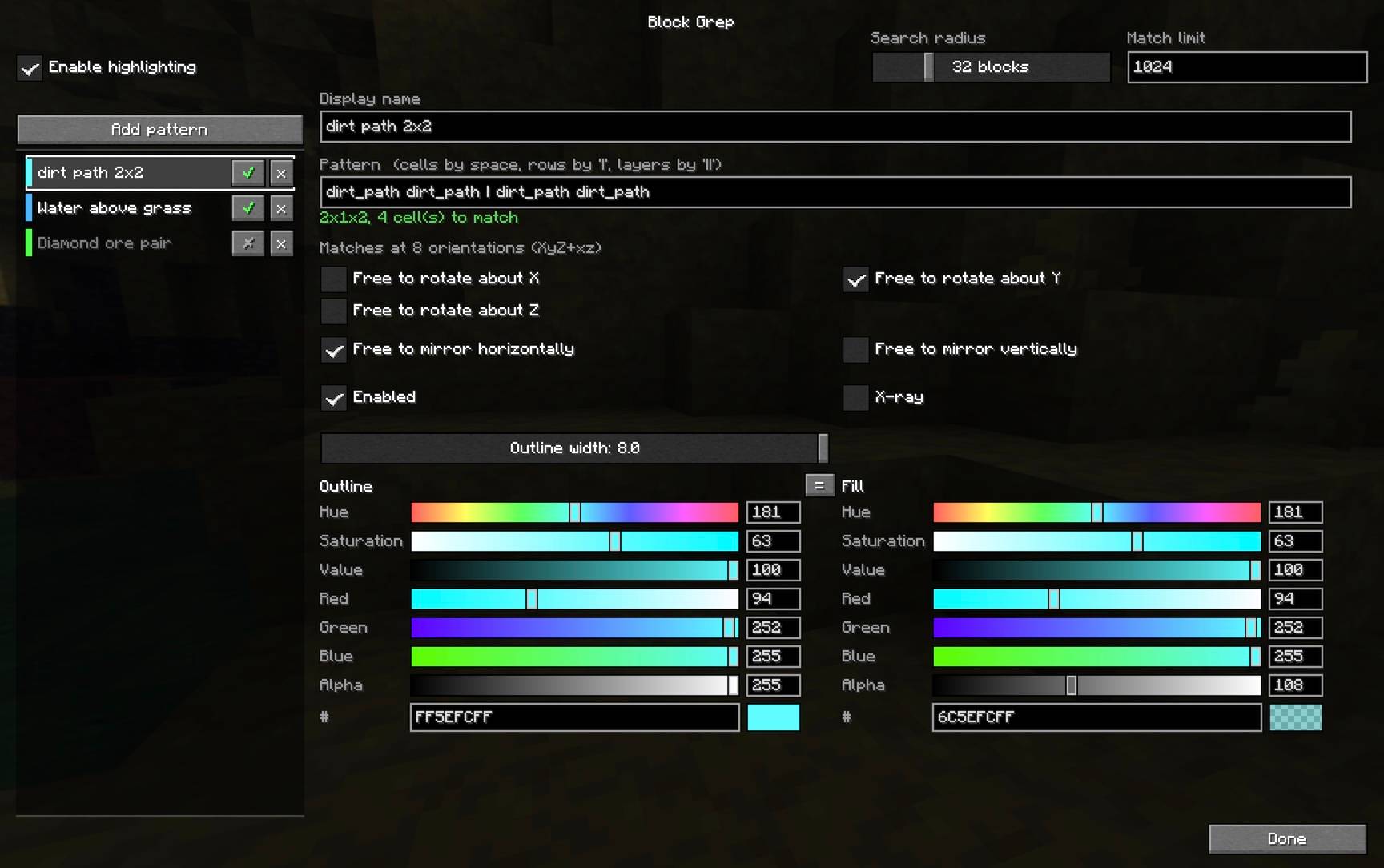 The Settings screen
 -
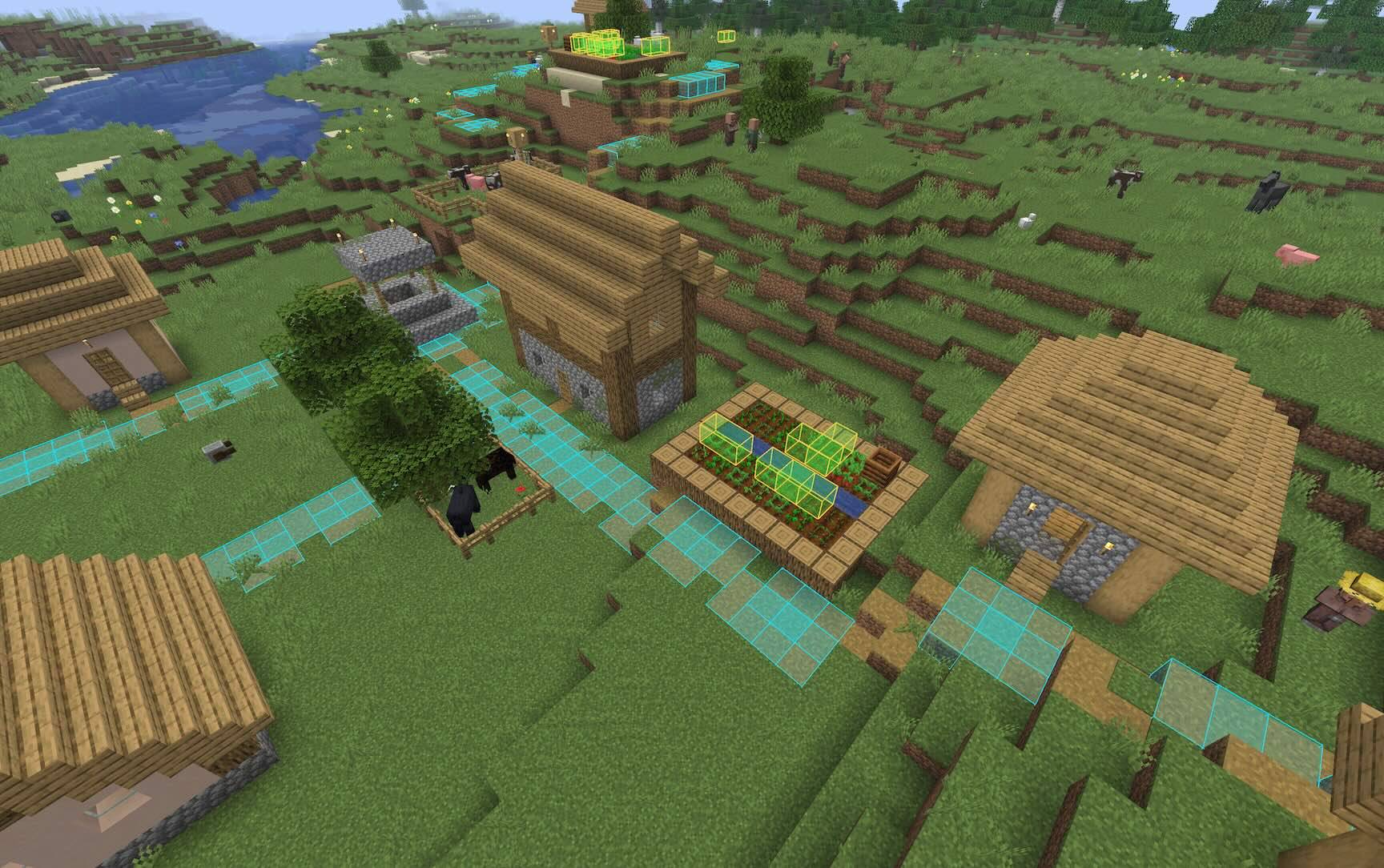 Block Grep in use A village with 2x2 `dirt_path` squares highlighted, as well as carrots-beside-carrots
-
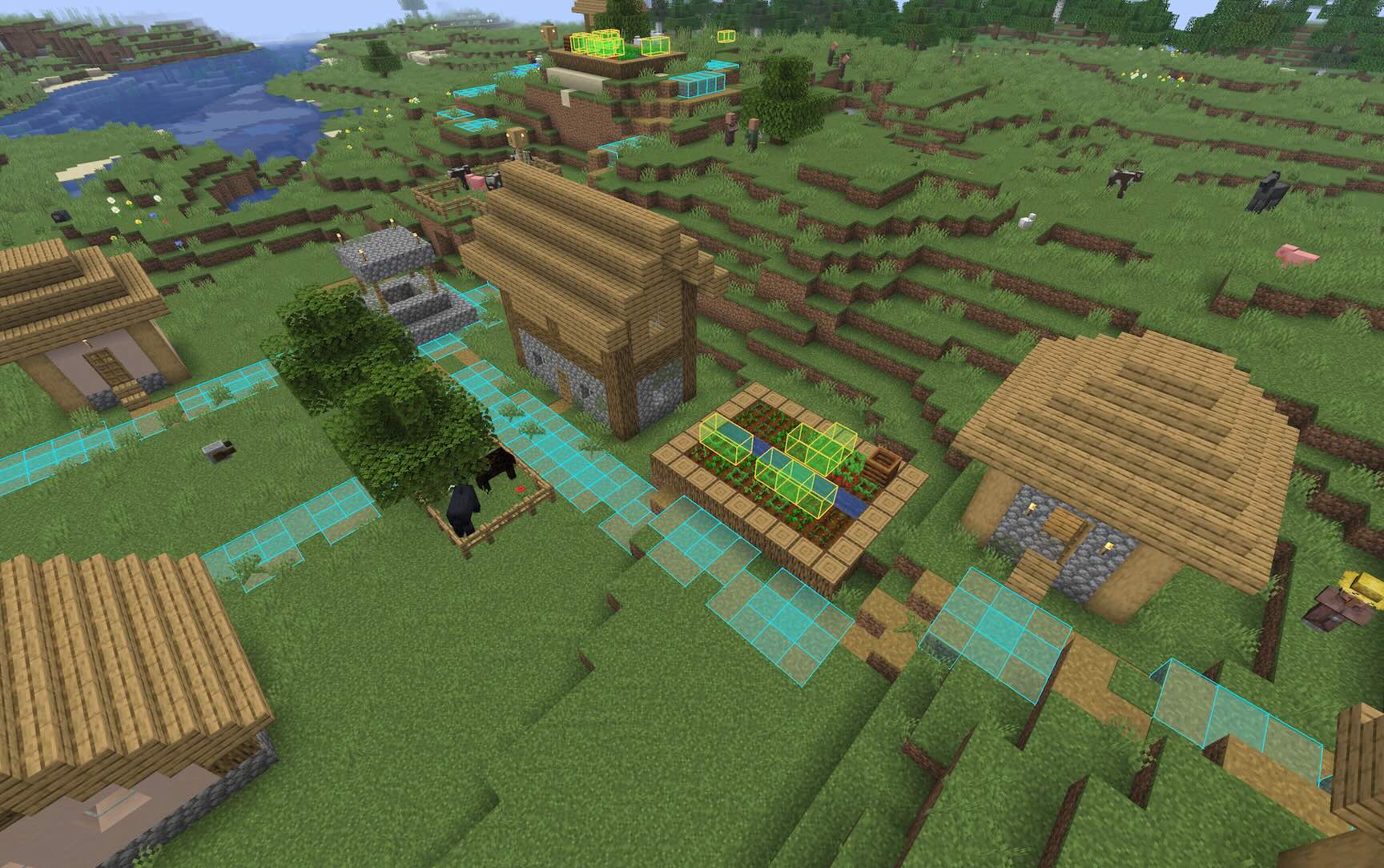 Block Grep in use A village with 2x2 `dirt_path` squares highlighted, as well as carrots-beside-carrots
 -
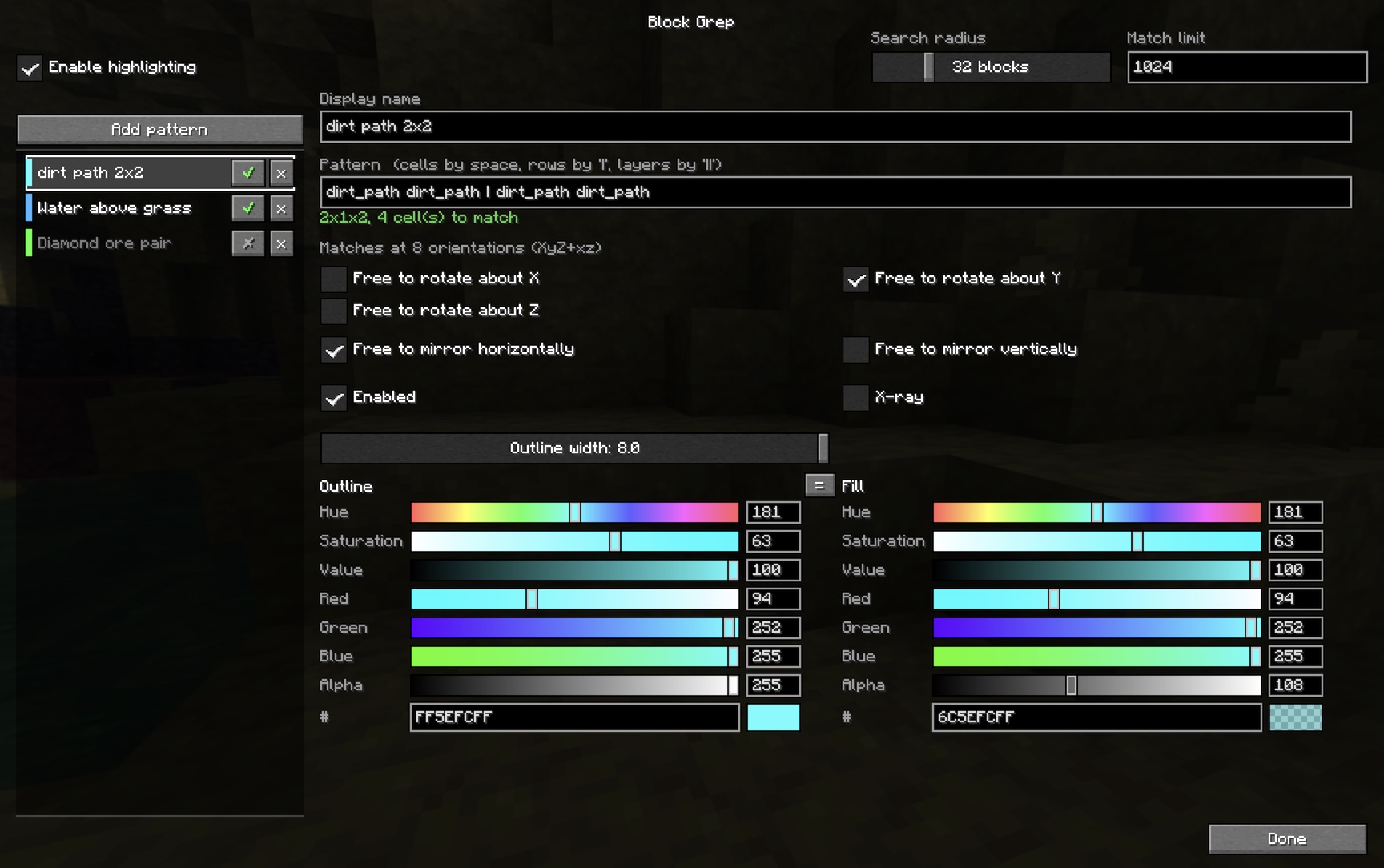 The Settings screen
Versions
Files
Relations
Project Relations
More like this
Similar Mods
Suggestions use data such as tags, dependencies, dependents, descriptions, titles, and more to rank how much they overlap with this mod.
On ModDex
Community snapshot
By the numbers
Statistics
Want to reach Minecraft players?
We're looking for a server hosting partner to feature here and other parts of the site. Interested? Send us a message!
Get in touchGet it on
Available Platforms
On ModDex
Community snapshot
By the numbers
Statistics
Resources