
Community listing page, reviews here may not be monitored by the author.
MCA: Reputation

No reviews yet
MCA: Reputation gives each village a shared memory of your actions, shaping how its community sees and treats you over time.
Community voices
Reviews
No reviews yet. Be the first to review this project!
Get it on
Available Platforms
About
Project Details
For authors
Embed Badge
If you're the author of this project, you can embed a live badge anywhere that supports HTML or Markdown. It updates automatically whenever ratings change.
Use HTML for any page that supports it, or Markdown for README files and Markdown-based descriptions.
Identifiers
Platform IDs
About
Description
MCA: Reputation
Your deeds become stories, and those stories shape how the village treats you.
Credit to TheWiggleDuck for the awesome Curseforge project icon!
MCA: Reputation is an addon for Minecraft Comes Alive: Reborn that gives villages a persistent memory of the things players do.
MCA already tracks how individual villagers feel about you through hearts and relationships. MCA: Reputation adds something different: your public standing with an entire village.
Help a settlement and people will remember. Harm somebody in public and witnesses may spread the story. Make amends later and the damage can be softened, but the history of what happened remains.
Your reputation is tracked separately for every player and every village, so being respected in one settlement does not automatically make you trusted everywhere else.
Village Standing
Every MCA village keeps its own opinion of each player.
Standing progresses through named reputation tiers ranging from Infamous to Revered, with both positive and negative reputations supported.
Your current standing can be viewed through a dedicated Standing screen, which shows:
- Your current reputation score and tier
- Progress toward the next tier
- Titles you have earned
- The deeds the village remembers
- How much each deed currently contributes to your standing
- Whether incidents have been apologized for, atoned for, forgiven, or otherwise resolved
The Standing screen can be opened directly from MCA's villager interaction screen or through an optional keybind.
With MCA: Quests installed, it can also be accessed through the Journal.
Deeds, Not Just Numbers
Reputation is backed by an actual history rather than an unexplained score.
The mod records significant incidents, allowing you to see why a village thinks the way it does.
Built-in incidents include things such as:
- Assaulting a villager
- Killing a villager
- Completing or failing quests
- Completing projects
- Resolving situations
- Keeping or breaking promises
- Public apologies
- Restitution and attempts to make amends
Repeated hits against the same villager are combined into a single assault incident instead of generating a penalty for every damage tick. If the villager is later killed, the preceding assault is accounted for so you are not charged twice for the same event.
The system also recognizes self-defense. If a villager attacked you first, retaliation can receive a reduced penalty instead of being treated exactly like an unprovoked attack.
Witnesses and Rumors
Villages do not magically know everything you do.
For witnessed incidents, nearby MCA villagers determine whether the event becomes public knowledge.
By default:
- Villagers must be close enough to witness an incident.
- Line of sight matters, so somebody behind a wall does not count as a witness.
- A crime with no witnesses does not immediately damage your public standing.
- News gradually spreads from witnesses to other residents.
- Different villagers can learn about the same event at different times.
Rumor spreading is deterministic and does not require constantly scanning villagers every tick.
This means reputation behaves more like information moving through a community than a global morality meter.
Reputation Can Change Over Time
Not every deed has to matter forever.
Incident definitions can specify whether their reputation impact gradually fades. Minor offenses may eventually become less important while serious events can remain part of the village's memory indefinitely.
Negative incidents may also support several forms of resolution:
- Apologized
- Atoned
- Forgiven
- Disproven
Resolving an incident reduces its effect according to that incident's rules while preserving the historical record.
The village may forgive what happened without pretending it never happened.
Designed Around MCA Reborn
MCA: Reputation is intended to complement MCA rather than replace its existing systems.
It does not replace:
- Villager hearts
- Relationships
- Per-villager affection
- Trading
- MCA's normal social mechanics
It also deliberately avoids handing out reputation for easily farmed actions such as repeatedly trading, giving ordinary gifts, clicking conversation options, sleeping in a village, or simply being present.
Reputation is intended to represent meaningful public actions rather than another progression bar to grind.
MCA Addon Integrations
MCA: Reputation works on its own with MCA Reborn, but it becomes more deeply connected when used with other MCA addons.
MCA: Quests
When MCA: Quests is installed:
- Quest outcomes can affect village standing
- Projects can reward or penalize participating players
- Situations can create reputation consequences
- Restitution quests can resolve previous incidents
- The Quest Journal can display and link to Reputation information
- Existing MCA: Quests reputation data can be migrated into MCA: Reputation
Reputation changes are applied per player, so multiplayer participants do not automatically receive each other's standing.
MCA: Conversations
When MCA: Conversations is installed:
- Villagers can consider your standing during conversations
- Reputation can influence trust and respect checks
- Villagers can discuss deeds they have heard about
- Conversation content can react to reputation tiers and incidents
- Dialogue can create or resolve reputation-related events
The Reputation system provides the facts while Conversations provides the villager's voice.
MCA: Crime
MCA: Reputation also supports integration with MCA: Crime.
Both mods can deal with actions such as attacking or killing villagers, so they coordinate ownership of those events to prevent the same offense from being recorded and penalized twice.
MCA: Crime can handle detecting the criminal action while MCA: Reputation continues to manage the resulting deed, witnesses, standing, decay, and gossip.
Player Feedback
Reputation changes can be shown through lightweight in-game notifications.
Depending on configuration, the mod can display:
- Standing changes in the action bar
- Tier advancement notifications
- Messages when your standing drops into a lower tier
- Exact reputation values or more qualitative descriptions
Multiple changes occurring together can be combined to avoid flooding the screen.
All presentation options are client-side and do not change the reputation stored by the server.
Configuration
MCA: Reputation includes separate server and client configuration files.
Server Configuration
config/mcareputation-common.toml
Server owners and pack authors can configure features including:
- Enable or disable the reputation system
- Minimum and maximum reputation
- Reputation decay
- Automatic assault detection
- Automatic killing detection
- Minimum damage required to count as an incident
- Self-defense behavior and penalty reduction
- Witness radius
- Witness line-of-sight requirements
- Maximum witnesses
- Rumor spread timing
- Incident history limits
- MCA: Quests integration
- MCA: Conversations integration
- Legacy reputation migration
- Debug logging
Disabling a subsystem does not delete existing reputation data. It simply stops that system from changing it.
Client Configuration
config/mcareputation-client.toml
Players can customize presentation options such as:
- Showing the Standing button
- Reputation change notifications
- Tier notifications
- Exact numerical scores
- Incident contribution values
These settings affect only what the player sees.
Datapack Support
Nearly all of the important reputation content is datapack-driven.
Pack authors can create custom:
- Incident types
- Reputation tier ladders
- Titles
- Reputation values
- Visibility rules
- Incident severity
- Decay behavior
- Resolution effects
- Gossip information
- Retention policies
Definitions are loaded from:
data/<namespace>/mcareputation/incidents/
data/<namespace>/mcareputation/reputation_tiers/
data/<namespace>/mcareputation/titles/
Legacy MCA: Quests reputation tier and title datapack paths are also supported for compatibility.
Definitions can be reloaded with /reload, and /mcareputation validate can check loaded definitions for authoring problems.
Invalid content is handled defensively so a malformed definition does not need to destroy the previously working reputation configuration.
Commands
The main command is:
/mcareputation
with the shorter alias:
/mcarep
Players can inspect their own standing without operator permissions.
Administrative commands allow server staff and pack developers to:
- View reputation
- List known villages
- Inspect reputation history
- Add or set standing
- Create and resolve incidents
- Grant or revoke titles
- Inspect reputation tiers
- Validate datapacks
- Run migration tools
- Debug communities, witnesses, standing, and integrations
Administrative reputation changes are logged by the server.
Existing World Migration
Players upgrading a world that previously used MCA: Quests' reputation system can carry their existing village standing into MCA: Reputation.
Legacy standing is imported as a starting balance rather than fabricating deeds that never actually occurred.
Migration is performed carefully and is designed to happen only once for each eligible player.
For Mod Developers
MCA: Reputation provides a public, server-authoritative Java API for other mods that want to participate in the system.
Integrations can:
- Read village reputation
- Query reputation tiers
- Check reputation conditions
- Record custom incidents
- Resolve incidents
- Work with titles
- Query whether villagers know about particular deeds
- Supply gossip information
- React to reputation events
- Coordinate ownership of automatically detected incidents
The API is designed so optional integrations can fail safely rather than making Reputation a mandatory dependency for another mod.
Performance and Multiplayer
MCA: Reputation is designed around server-authoritative multiplayer use.
Reputation belongs to an individual player within an individual village. Two players living in the same settlement can therefore have completely different histories and reputations.
Witness checks happen when an incident occurs rather than continuously scanning the world.
Rumor propagation is calculated deterministically instead of maintaining an expensive constantly updating social graph.
History is bounded to prevent unlimited save growth, and old records can be pruned without changing the player's actual reputation score.
Requirements
Minecraft: 1.20.1
Mod Loader: Forge 47.x
Java: 17
Required: Minecraft Comes Alive: Reborn 7.6 through 7.7.x
Optional Integrations
- MCA: Quests
- MCA: Conversations
- MCA: Crime
Architectury is not separately required by MCA: Reputation.
In Short
MCA: Reputation makes your relationship with an MCA settlement feel persistent.
A village can remember what you did, who saw it, how the story spread, whether you tried to make things right, and how all of that changed the community's opinion of you.
Instead of every village treating the player like a blank slate, your actions become part of its history.
Screenshots
Gallery
-
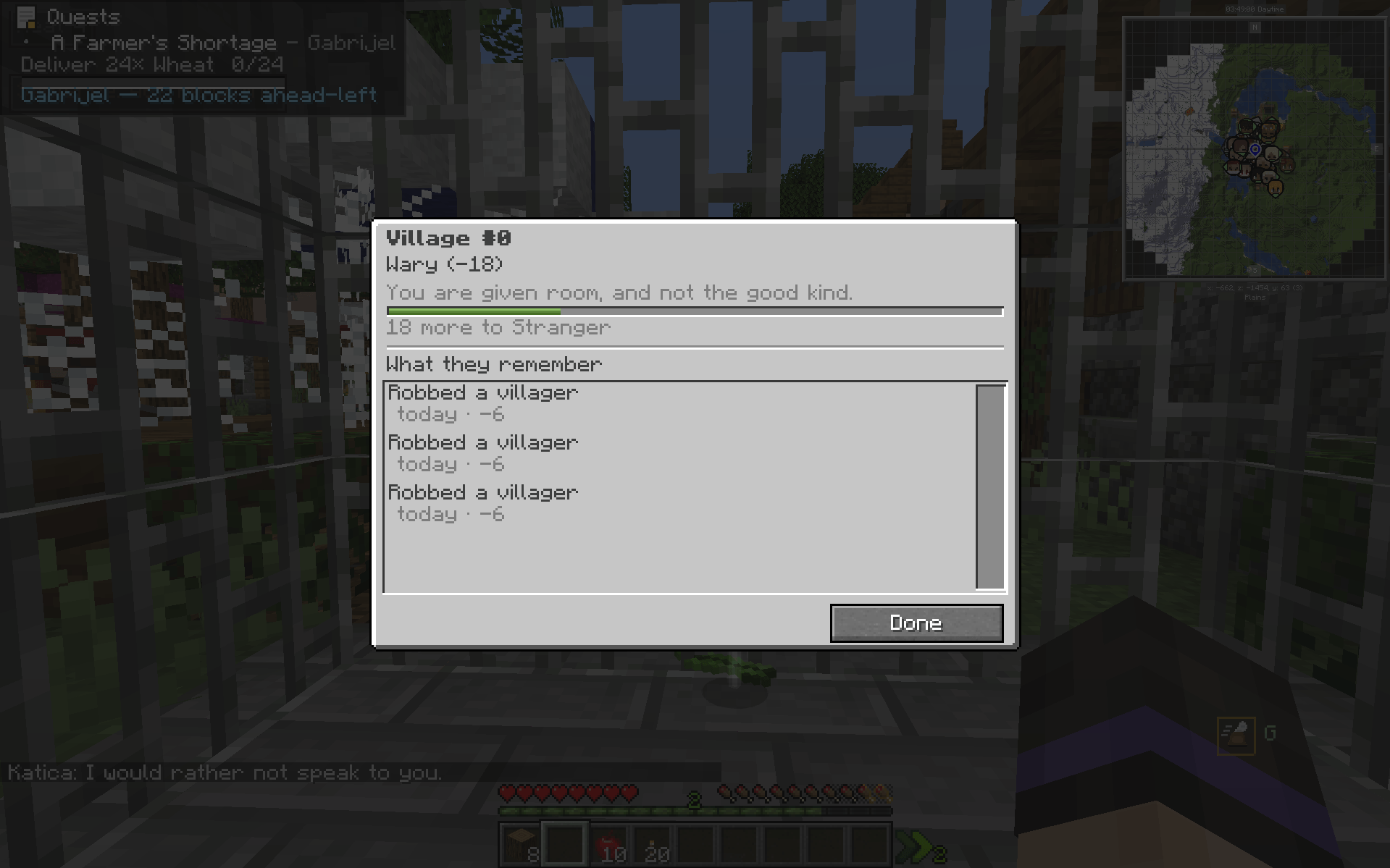 Reputation Main Window
 -
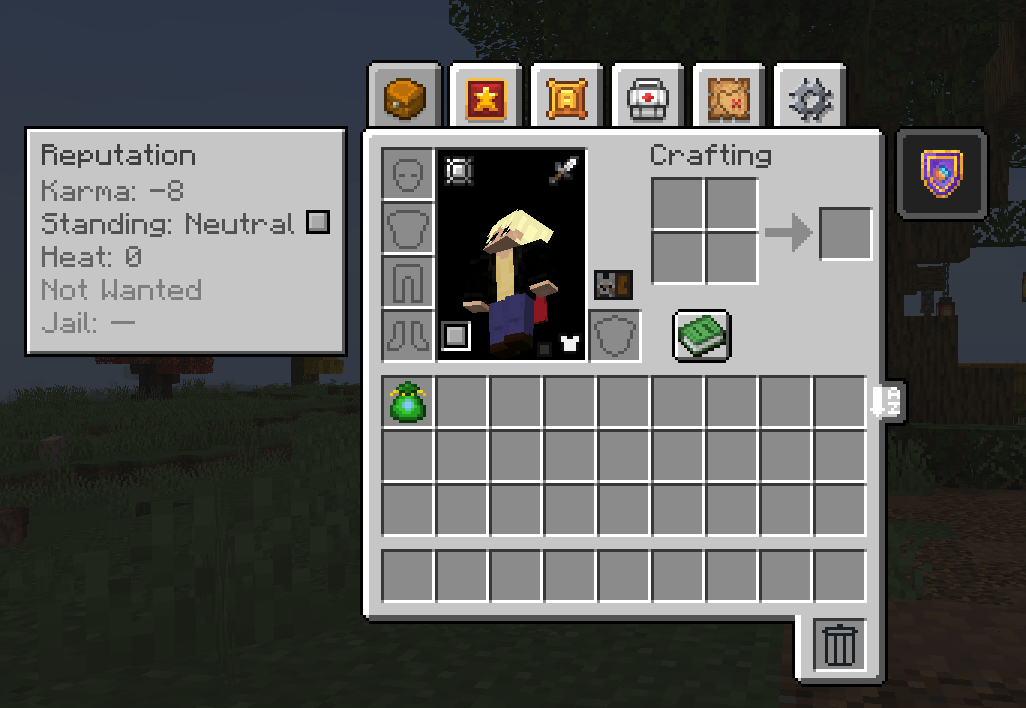 Reputation Mini-Window
 -
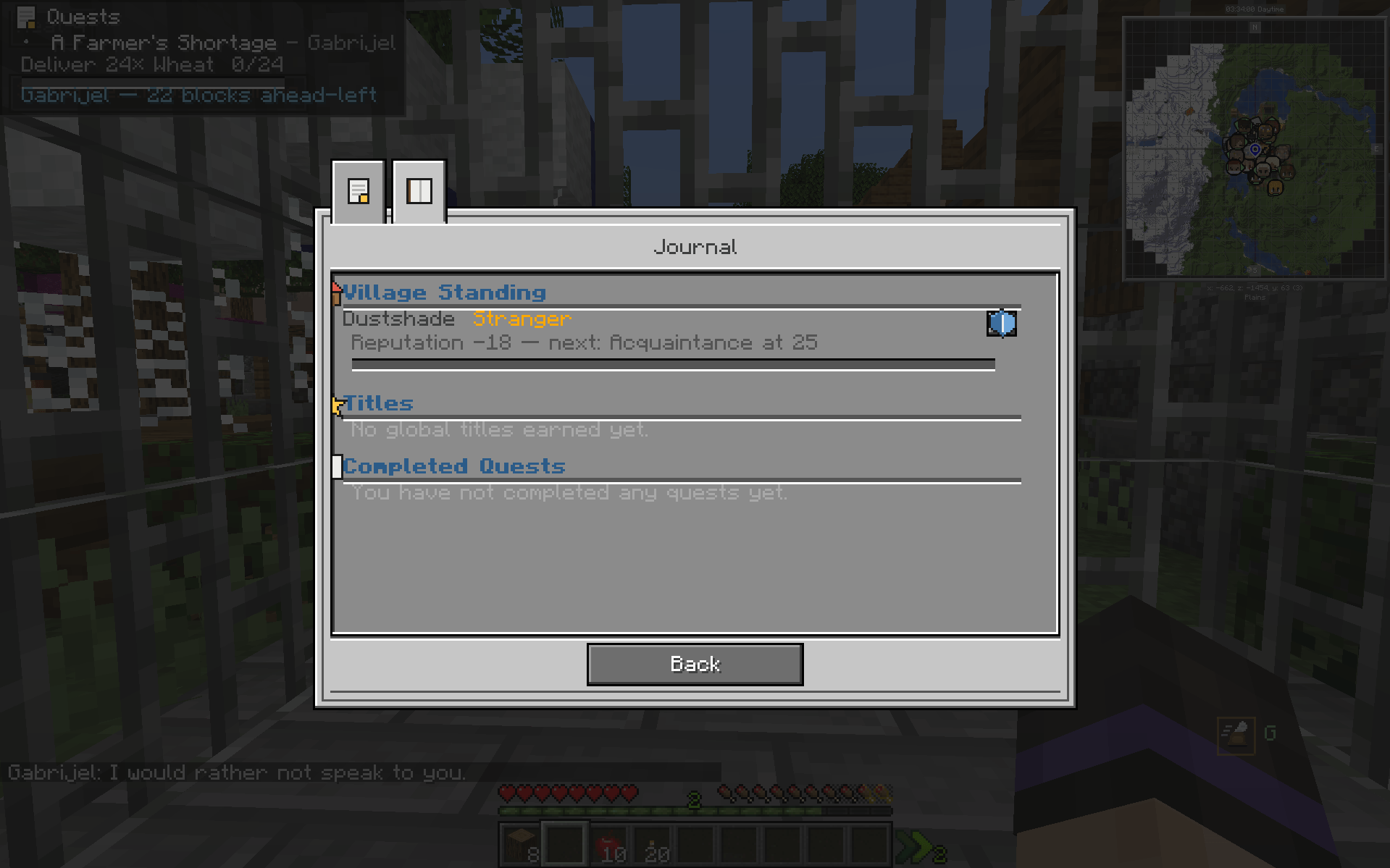 Journal Entries
Versions
Files
Relations
Project Relations
More like this
Similar Mods
Suggestions use data such as tags, dependencies, dependents, descriptions, titles, and more to rank how much they overlap with this mod.
On ModDex
Community snapshot
By the numbers
Statistics
Want to reach Minecraft players?
We're looking for a server hosting partner to feature here and other parts of the site. Interested? Send us a message!
Get in touchGet it on
Available Platforms
On ModDex
Community snapshot
By the numbers