Community listing page, reviews here may not be monitored by the author.
Mixed Slabs - pandorical

No reviews yet
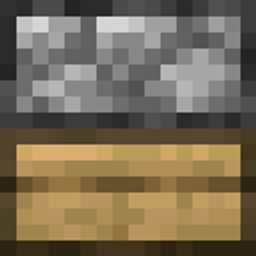
Two different slabs in one block space
Community voices
Reviews
No reviews yet. Be the first to review this project!
Get it on
Available Platforms
About
Project Details
For authors
Embed Badge
If you're the author of this project, you can embed a live badge anywhere that supports HTML or Markdown. It updates automatically whenever ratings change.
Use HTML for any page that supports it, or Markdown for README files and Markdown-based descriptions.
Identifiers
Platform IDs
Resources
External Links
About
Description
Place any slab onto any other slab's empty half. Vanilla does this already when both are the same block and calls the result a double slab; when they differ it gives up and puts the new slab in the next space along. This catches that second case and puts them in the same block.
Which half the new slab lands in is decided exactly the way vanilla decides it — from the face you clicked and how high up you clicked it — so the two behave identically and the answer never depends on which of them handled the click. Sneaking still means "ignore the block, use what is in my hand".
Break it and you get both slabs back, each as breaking that slab on its own would give it: a grass slab half comes back as a dirt slab unless the tool has Silk Touch.
Four blocks
There are four: mixed_slab, mixed_dirt_slab, mixed_topper_slab and mixed_signal_slab, split
by what is in the top half. That is not a stylistic division. A tag belongs to a block and not to
a state, so "this surface is dirt, plants may be placed on it" cannot be said about some states of
one block — splitting on the surface says it about all the states of one of them, and
mixed_dirt_slab sits in #minecraft:dirt. A thing resting on a slab is drawn where the lower half
ends rather than where the upper half begins, which is a different model for the same top half, so
it gets mixed_topper_slab; a redstone component carries an on/off bit the others have no use for,
so it gets mixed_signal_slab.
The four share every possible bottom half and divide the top halves between them, so together they hold exactly the combinations a single block would. The split costs no extra states at all.
Resting on a slab
Floor boards from wood-floor, torches, soul torches and carpets can be placed on a slab and share its block instead of spending the one above. A torch on a slab gives off a torch's light. Water can fill what a board or a carpet leaves empty; a torch on a slab is never waterlogged, because water destroys one.
Hitting what stands on a slab — a torch, a lever, anything in this section or the next — knocks just that off, at its own speed, and leaves the slab. It drops as it would anywhere else.
Redstone on a step
Pressure plates, buttons, levers and redstone torches sit on a slab and share its block instead of spending the one above. They work: a plate you stand on, a lever you flip, a button that springs back, a torch that inverts what it is standing on.
The components are not reimplemented. Everything a signal is read through — whether the block is a source, what it puts out and how strongly — is answered by building the real component's own state and asking it, the same way hardness and sound already are. Only the writing is ours: when the bit flips. That is a few lines per component rather than a system, and it is where the fidelity comes from.
With lever-torch and player-detector installed, a lever torch and a player detector ride along the same way, and the detector still notices only players.
One bit is the whole test. A plate, a lever, a button and a torch each store a single boolean. A repeater's delay, a comparator's mode, a weighted plate's sixteen power levels and redstone dust's connection shape cannot be carried, and are not here.
Candles ride along on the same terms. A candle placed on a slab shares its block, and its one bit is whether it is lit: flint and steel or a fire charge lights it, an empty hand puts it out, and it gives off a lit candle's light. What it gives up is the count - vanilla stacks up to four in a block, and there is no room here to say how many - so a candle on a slab is one candle, in any of the seventeen colours. It cannot be waterlogged either; the block that carries a bit has no room for water. And it does not flicker: the flame's dancing particle is a client-side animation tied to the vanilla candle block, so a lit candle on a slab glows and lights the room, and holds still.
Floor switches have no facing. A lever powers the same whichever way it points, so facing is cosmetic — and paying four times the states for it costs more than the orientation is worth.
The rule
A mixed slab is a full-height block whose surface material is its top half.
Ask it about material and it answers from a half. Nothing should read a slab type off one or offset a plant onto one — a plant standing on a mixed slab stands at full height, which is why vanilla plants are right for it and dirt-slab's half-height plant variants are not.
Its shape is whatever the two halves add up to. For two ordinary slabs that is a full cube. For a fence post slab — which fills a half of the block but only a narrow post inside it — it is not, and collision, culling and light all follow the real shape rather than a cube that isn't there.
What other mods see
A mixed slab is its own block, so every "what block is this?" in the game sees a mixed slab and not
the two slabs inside it. MixedSlabsApi is how a mod finds out — a small static surface over plain
vanilla types, reached by reflection so nothing has to depend on this mod:
isMixedSlab(state)halves(state)/topHalf(state)/bottomHalf(state)withTopHalf(state, block)— resurfacing, for grass creeping on or a shovel making a path. May hand back a state of the other block, since which one holds a combination depends on its top.
Wired up so far:
- conductive-copper — a cut copper slab inside a mixed slab still conducts. One copper half is enough: the metal is there, and asking for both would make a copper-and-oak step a wall the signal dies at.
- dirt-slab — grass spreads onto a mixed slab with dirt on top (only the top half changes, and
only if it really is dirt); a shovel makes a path of the surface; a hoe loosens coarse dirt to
dirt. Vanilla plants can be placed on any
mixed_dirt_slab.
Not covered
- Grass on a mixed slab does not spread outward, and does not die in the dark. Mixed slabs do not random-tick. Grass reaching one is a destination, not a source.
- Snow does not whiten a grass surface — there is no room for a
snowystate. - Farmland cannot be mixed at all, deliberately. Its behaviour lives in a moisture level a mixed slab has no room for, so one that looked like farmland could never be farmed; refusing is the honest answer.
- Sneaking with a shovel does not halve one. It is a full block; there is no half to take.
How it works
A position holds one block state, and one block state cannot name two materials. So a mixed slab is a block of its own whose state says which slab is in each half:
- 147 slabs, vanilla plus the suite's own, and 93 things that rest on one: 42 boards, torches and carpets, and 51 redstone components and candles. That is 147 × 240 = 35,280 combinations, and 70,560 states across the four blocks, since each also carries one more bit (waterlogged, or on/off for the redstone one).
- The blockstates are multipart, which is what makes that tractable. Each half's model is selected by its own property independently, so each file needs one case per thing per half (two for a redstone component, on and off) — 879 across the four — rather than one per combination.
- The slab models are vanilla's own, or the sibling mod's. Only the vanilla things that rest on a slab get a model generated here, their own model lifted onto the halfway line. The geometry is not duplicated per state: a multipart state holds references to already-baked sub-models.
The win is that vanilla does the drawing. Lighting, ambient occlusion, face culling and break particles are the real ones rather than an imitation, and there is no client-side rendering code to go wrong. The cost is paid once at startup and never again per tick.
Everything the block does defers to whichever half is being asked about:
- Hardness is the harder half's, so pairing stone with oak is not a way to mine stone cheaply.
- Drops are judged per half — mixing stone into oak does not let you collect stone by hand, and does not cost you the oak for want of a pickaxe.
- Sound comes from the top half, the one you are standing on.
Pandorical
Mixed Slabs registers the mixed slab block and its half-models through Pandorical's content sync, and tints a grass half through Pandorical's block tints.
The Pandorical mod must be installed client-side to see a mixed slab drawn as its two halves. Without it the mod still works server-side, but a connecting client sees an untextured block. Block Tip, if installed, names both halves when you look at one.
Screenshots
Gallery
Versions
Files
Relations
Project Relations
More like this
Similar Mods
Suggestions use data such as tags, dependencies, dependents, descriptions, titles, and more to rank how much they overlap with this mod.
On ModDex
Community snapshot
By the numbers
Statistics
Want to reach Minecraft players?
We're looking for a server hosting partner to feature here and other parts of the site. Interested? Send us a message!
Get in touchGet it on
Available Platforms
On ModDex
Community snapshot
By the numbers
Statistics
Resources