
Community listing page, reviews may not be monitored by the author.
Pathbound: World Difficulty

No reviews yet
Pick a world difficulty once on first join: Classic or Trial. Each path grants its own stages, datapacks and commands, all set by config.

Community voices
Reviews
No reviews yet. Be the first to review this project!
Get it on
Available Platforms
About
Project Details
For authors
Embed Badge
If you're the author of this project, you can embed a live badge anywhere that supports HTML or Markdown. It updates automatically whenever ratings change.
Use HTML for any page that supports it, or Markdown for README files and Markdown-based descriptions.
Identifiers
Platform IDs
Resources
External Links
About
Description

When a new world is created, its host picks a difficulty on a dedicated screen: Classic or Trial. The choice is stored in the world and cannot be changed from the game. Pathbound then applies it for everyone: player stages, datapacks, commands. Modpacks decide what each path actually means.
Everything is data. You can rename the difficulties, add your own, give them recipes and quests, and restyle the whole screen without writing a line of Java.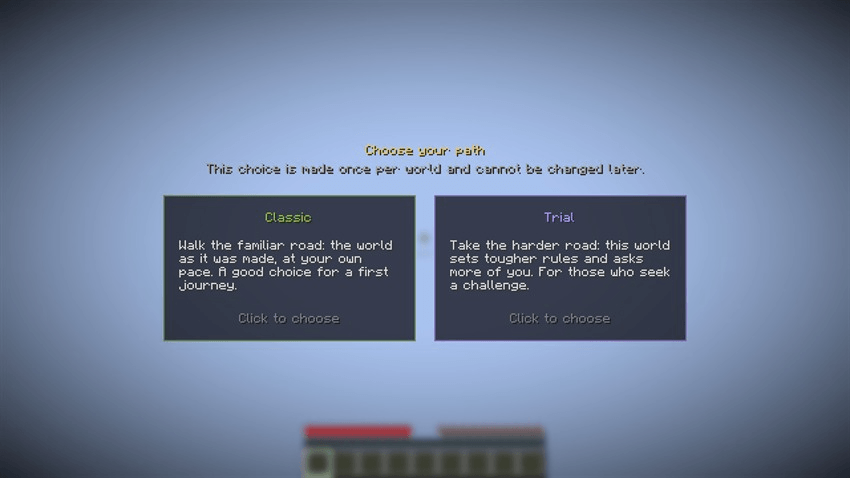 Pathbound out of the box: Classic and Trial.
What it does
- A one-time choice. The world host (or an operator on a server) sees the chooser on first join. Esc does not close it. Other players see a "the host is choosing" notice and can keep playing.
- Player stages. Every difficulty grants its own stages (player tags, the same stages KubeJS and FTB Quests read) and removes the stages of the others. Quests, recipes and scripts can react to them.
- Datapacks per difficulty. A difficulty can switch datapacks on: different recipes, loot or worldgen data for Trial worlds only. Packs can ship them in
config/pathbound/datapacks/, no extra jar needed. - Commands on choice. Run any server commands once when a difficulty is picked (gamerules,
/difficulty, scoreboard, functions). - Fully restylable screen. Card size and layout, colours, background, frame sprites (nine-slice, animated), item or texture icons, drawn title images per language, sounds and animations, all from a resource pack.
- KubeJS recipes per difficulty (optional). Write
PathboundEvents.recipes('trial', e => ...)instead ofServerEvents.recipesand those recipes exist only in Trial worlds: add, remove or replace anything, per difficulty. - KubeJS support (optional). Add or change difficulties from scripts, refuse a choice, react after it, read and set the difficulty.
- Server friendly.
defaultModein the server config picks a difficulty for new worlds automatically and skips the screen. - Any language. Names, descriptions and title images can be set per language (
en_us,de_de,pt_br...), and the screen texts come from ordinary lang files, so you can translate everything yourself.
Commands: /pathbound mode, /pathbound mode set <id|none>, /pathbound choose (show the screen again), /pathbound list. Changing the difficulty needs operator rights or the singleplayer world owner (cheats not required).
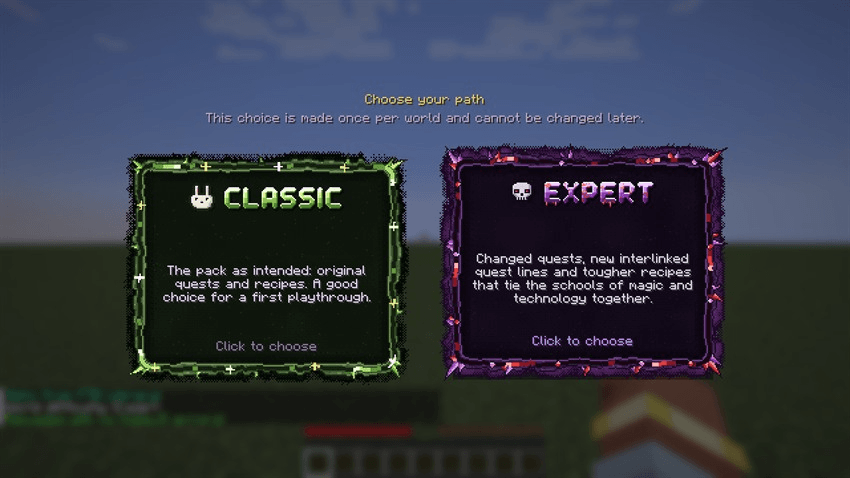
Example: Thaumaturge Renaissance (custom version)
This is a customised setup from the Thaumaturge Renaissance modpack, not what Pathbound looks like by default. The frames, drawn titles and the rabbit and skull icons belong to the pack and are not included in the mod.
What the pack does with Pathbound:
Custom version: animated pixel-art frames, drawn titles, icons and a hover glow from the pack's resources.
- renames the two paths to Classic and Expert and writes its own descriptions;
- gives each one a stage (
trq_normal/trq_hard): FTB Quests shows Expert-only quest lines only in Expert worlds;- turns on an Expert recipe datapack from
config/pathbound/datapacks/trq_hardin Expert worlds only;- replaces the plain cards with its own frames, titles and icons through
kubejs/assets.
All of it is config and resources. The pack has no code of its own for this.Make your own difficulties: a mini guide
1. Open the config. Start a world once, then open config/pathbound/difficulties.json. Each entry is one card:
{
  "id": "trial",
  "name": { "en_us": "Trial", "de_de": "Prüfung" },
  "description": "Tougher recipes and no keepInventory.",
  "color": "#B48CFF",
  "icon": "minecraft:wither_skeleton_skull",
  "order": 1,
  "stages": ["mypack_trial"],
  "datapacks": ["config:trial_recipes"],
  "commands": ["gamerule keepInventory false"]
}
2. Rename or recolour. Change name, description (plain text, or one text per language like {"en_us": "...", "de_de": "..."}) and color. icon takes an item id or a texture.
3. Add or remove a difficulty. Copy an entry and give it a new id (lowercase letters, digits, _). Delete an entry to remove it. order sets the card order. "selectable": false hides a card but keeps the difficulty for commands.
4. Give it recipes or loot. Put a normal datapack (a folder with pack.mcmeta, or a .zip) into config/pathbound/datapacks/ and list it as "config:<name>" in datapacks. Pathbound enables it only in worlds with that difficulty.
5. Or give it recipes with KubeJS. In any file in kubejs/server_scripts/, use PathboundEvents.recipes instead of ServerEvents.recipes. Inside it works exactly the same, but only in worlds with that difficulty:
PathboundEvents.recipes('trial', e => {
  e.remove({ output: 'minecraft:torch' })
  e.shaped('2x minecraft:torch', ['C', 'S'], { C: '#minecraft:coals', S: 'minecraft:stick' })
  e.replaceInput({ output: 'minecraft:anvil' }, 'minecraft:iron_block', 'minecraft:netherite_ingot')
})

PathboundEvents.recipes('classic', e => {
  e.shapeless('minecraft:bundle', ['minecraft:leather', 'minecraft:string'])
})
Pathbound reloads the recipes by itself when a difficulty is chosen and when a world opens. Recipes in plain ServerEvents.recipes keep working for every difficulty.
6. Hook up quests and scripts. Use the difficulty's stage, for example a stage task mypack_trial in FTB Quests (it reads stages through KubeJS and FTB XMod Compat), or player.stages.has('mypack_trial') in KubeJS.
7. Run commands. Add them to commands. They run once, as the server, right after the datapacks and recipes reload.
8. Restyle the screen (optional). In a resource pack (or kubejs/assets/) add:
- assets/pathbound/chooser/layout.json for card size, padding, colours, background, sounds and animations;
- frame sprites
assets/<yourpack>/textures/gui/sprites/<path>.png(plus_hoveredand_selected), then set"frame": "<yourpack>:<path>"on a difficulty; "banner"on a difficulty for a drawn title image, one per language if you like.
9. Apply and test. Restart the world (or the server), then run /pathbound choose to see the screen again. /pathbound list shows what was loaded. For servers, set defaultMode = "trial" in config/pathbound-server.toml to skip the screen.
The full reference (every field, layout keys, animations, KubeJS events) is in the README on GitHub.
Screenshots
Gallery
Versions
Files
Relations
Project Relations
More like this
Similar Mods
Suggestions use data such as tags, dependencies, dependents, descriptions, titles, and more to rank how much they overlap with this mod.
On ModDex
Community snapshot
By the numbers
Statistics

Get it on
Available Platforms
On ModDex
Community snapshot
By the numbers
Statistics
Resources