Community listing page, reviews may not be monitored by the author.
Pane


No reviews yet
A GUI library for Fabric: overlay tool windows over the running game, modal screens, 21 widgets, two-way data binding, and CSS-like theming, rendered entirely through Minecraft's own pipeline. No natives, no conflicts.

Community voices
Reviews
No reviews yet. Be the first to review this project!
Get it on
Available Platforms
Compatibility
Supported Environments
Required on the client. Installing it on the server adds functionality.
About
Project Details
For authors
Embed Badge
If you're the author of this project, you can embed a live badge anywhere that supports HTML or Markdown. It updates automatically whenever ratings change.
Use HTML for any page that supports it, or Markdown for README files and Markdown-based descriptions.
Identifiers
Platform IDs
About
Description
Pane
A GUI library for Fabric mods that feels like building for the web, rendered entirely through Minecraft's own pipeline.
Most Minecraft UI is written against the vanilla screen API: verbose, version-fragile, and modal-only. The alternatives bring native baggage: bundled renderers, platform jars, cursor fights with other mods. Pane takes a third path: a modern retained component tree, flex layout, two-way data binding and CSS-style theming, drawn with nothing but the same DrawContext the game itself uses. No natives. No renderer. Nothing to conflict with.
Pane was built to power Luminary's editor (three tool windows, a keyframe timeline and a gobo designer, running live in a 150-mod pack next to Axiom and Flashback). It's the library I wanted to exist, extracted and made public.
Two ways to show UI
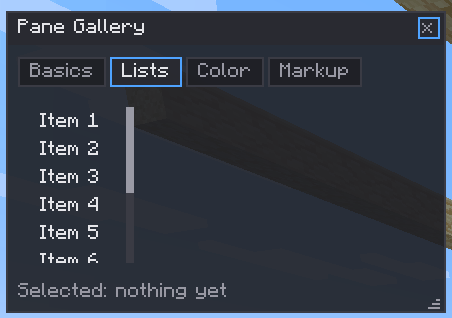
Overlay windows float over the game while it keeps running. Draggable, resizable from every edge, body scrolling, hardware resize cursors. One key frees the mouse; clicking the world puts you back in the game. This is the mode that makes editor-style tools possible.
Screens are classic modal menus built from the same widgets, hosted in a vanilla Screen. They pause-behave, tab-complete and close exactly like any other menu, because they are one.
Widgets that cover real tools
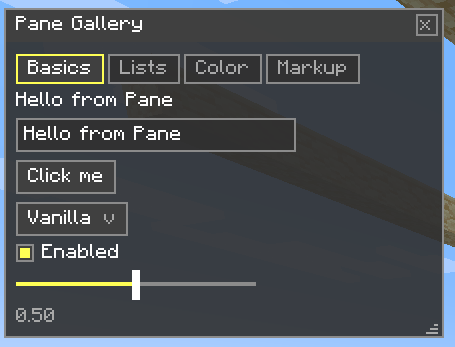
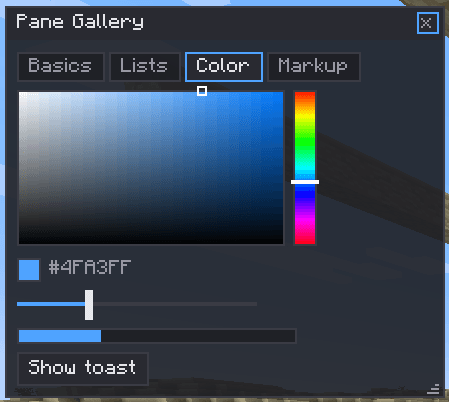
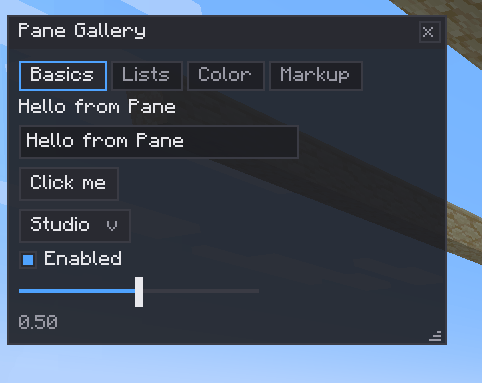
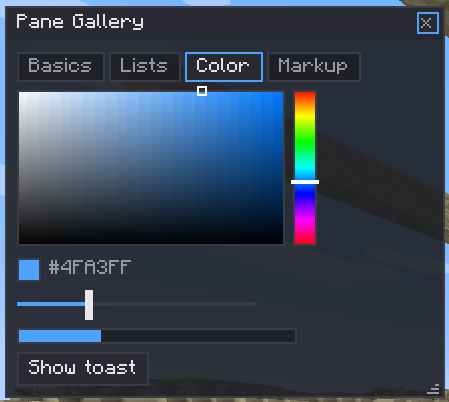
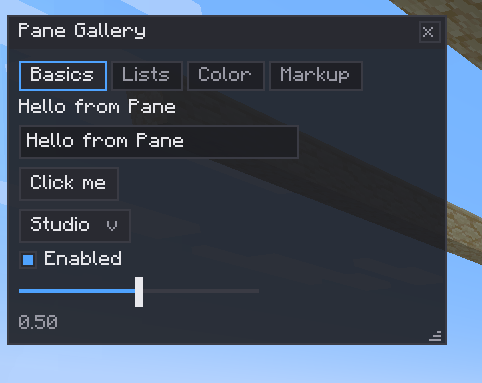
Buttons, checkboxes, sliders, dropdowns, text fields, number fields you can drag to nudge, color pickers, progress bars, tabs, scroll containers, tables, multi-select list views with drag-reorder, keybind capture fields, right-click context menus, confirm dialogs, toasts. Twenty-one widgets, one factory pattern:
Window win = Window.of("My Tool").at(40, 40);
win.add(Label.of("Target"));
win.add(TextInput.of(name));
win.add(Slider.of(speed, 0f, 2f));
win.add(Button.of("Apply").onClick(() -> apply()));
PaneOverlay.addWindow(win);
Data binding, not callbacks everywhere
One primitive, State<T>, connects widgets to your data in both directions. Bind the same state to a slider and a number field and they stay in step for free.
State<Float> radius = State.of(16f);
Slider.of(radius, 0f, 256f);
NumberField.of(radius, 0f, 256f);
radius.onChange(v -> sendToServer(v));
Author in markup, restyle in CSS
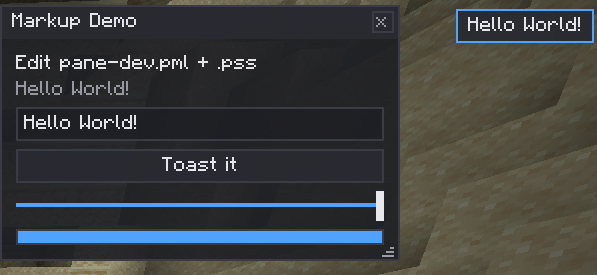
Big layouts can be written declaratively in PML, and styled with PSS: selectors, specificity, #AARRGGBB colors, the things your hands already know.
button   { bg: #292A31; padding: 3; }
.warn    { fg: #FF5555; }
#saveBtn { border-color: #4FA3FF; }
Themes
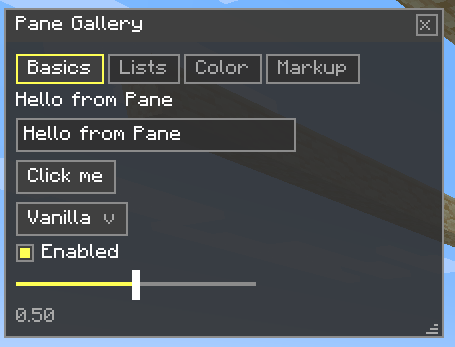
Eight tokens drive every widget. Three built-ins ship with it: Studio (dark), Paper (light), and Vanilla (blends with the game's own menus). A custom theme is one record away, and the dark/light toggle is a single call.
Headless by design
The core and every widget have zero Minecraft imports. The entire widget layer compiles and its test suite runs on a bare JVM, which is also why the same widgets ship unchanged across Minecraft versions; only a thin runtime layer differs per version.
Get it: Modrinth (soon) · Learn it: the Pane wiki·
Pane
Pane is a GUI library for Fabric and NeoForge. I built it because I needed proper tool windows for my lighting editor and nothing out there did what I wanted without dragging in native libraries or fighting whatever other UI mods were installed. Pane draws everything through Minecraft's own DrawContext, so there's nothing to conflict with. It runs daily in a 150-mod pack next to Axiom, Flashback, Sodium and Iris without issues.
What it does
There are two ways to put UI on screen.
Overlay windows float over the game while it keeps running. They drag by the title bar, resize from any edge, and scroll when the content doesn't fit. Press a key (default P) to free the mouse, click the world to go back to playing. This is the mode built for editor-style tools.
Screens are normal modal menus made from the same widgets, hosted in a vanilla Screen, so they open, close and pause exactly like any other menu in the game.
Widgets
Buttons, checkboxes, sliders, dropdowns, text fields with copy and paste, number fields you can drag to nudge, color pickers, progress bars, tabs, scroll containers, tables, list views with multi-select and drag reorder, keybind capture, right-click context menus, confirm dialogs and toasts. 21 in total, all created the same way:
Window win = Window.of("My Tool").at(40, 40);
win.add(Label.of("Target"));
win.add(TextInput.of(name));
win.add(Slider.of(speed, 0f, 2f));
win.add(Button.of("Apply").onClick(() -> apply()));
PaneOverlay.addWindow(win);
Data binding
Widgets bind to State<T> objects. The widget writes into the state, your code reads it, and setting it from your code updates the widget. Bind one state to a slider and a number field and they stay in sync on their own:
State<Float> radius = State.of(16f);
Slider.of(radius, 0f, 256f);
NumberField.of(radius, 0f, 256f);
radius.onChange(v -> sendToServer(v));
Markup and styling
If you'd rather not build big layouts in Java, there's PML for structure and PSS for styling. PSS works like CSS: type, class and id selectors with normal specificity, and you can reload a sheet at runtime to restyle without recompiling.
button   { bg: #292A31; padding: 3; }
.warn    { fg: #FF5555; }
#saveBtn { border-color: #4FA3FF; }
Themes
Every widget paints from a set of eight color tokens. Three themes ship with the mod: Studio (dark, the default), Paper (light) and Vanilla (matches the game's own menus). A custom theme is just a record with your own colors in it.
Defaults
Window dragging, resizing, screen clamping, resize cursors and scroll-on-overflow are all on out of the box. If another mod frees the cursor (Flashback's replay editor, Axiom), Pane windows stay clickable and clicks anywhere else still go to that mod. Each one has a switch if you don't want it, like .draggable(false) or PaneOverlay.setCursorShapes(false).
For developers
Add the jar to your dev environment and depend on pane in your fabric.mod.json or neoforge.mods.toml:
repositories {
    exclusiveContent {
        forRepository { maven { url = "https://api.modrinth.com/maven" } }
        filter { includeGroup "maven.modrinth" }
    }
}

dependencies {
    modImplementation "maven.modrinth:pane:<version>"   // e.g. 0.4.0+1.21.11-fabric
    // add `include` in front to bundle Pane inside your jar, so players
    // don't install it separately:
    // include modImplementation("maven.modrinth:pane:<version>")
}
The API is the same on both loaders, so switching doesn't touch your code.
Docs (getting started, widget catalog, binding, PML/PSS reference) are on the Pane wiki.
Pane powers the whole editor in Luminary, my scenic lighting tool: three tool windows, a keyframe timeline and a painting canvas, all running live over the game. That's where it gets tested.
Screenshots
Gallery
-
 Pane5.png Pane5.png
 -
 Pane4.png Pane4.png
 -
 Pane3.png Pane3.png
 -
 Pane2.png Pane2.png
 -
 Pane1.png Pane1.png

Versions
Files
Relations
Project Relations
More like this
Similar Mods
Suggestions use data such as tags, dependencies, dependents, descriptions, titles, and more to rank how much they overlap with this mod.
On ModDex
Community snapshot
By the numbers
Statistics
 (opens in a new tab)
Get it on
Available Platforms
On ModDex
Community snapshot
By the numbers