Community listing page, reviews here may not be monitored by the author.
Talking Villagers

No reviews yet
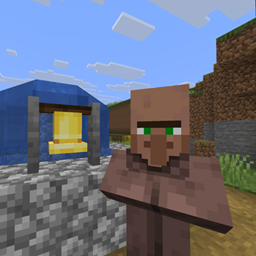
A server-side Fabric mod that gives Minecraft villagers names, personalities, families and politics — and lets you actually talk to them, in your own words, using a language model you run yourself.
Community voices
Reviews
No reviews yet. Be the first to review this project!
Get it on
Available Platforms
About
Project Details
For authors
Embed Badge
If you're the author of this project, you can embed a live badge anywhere that supports HTML or Markdown. It updates automatically whenever ratings change.
Use HTML for any page that supports it, or Markdown for README files and Markdown-based descriptions.
Identifiers
Platform IDs
Resources
External Links
About
Description
Talking Villagers
Villagers with names, personalities, families and politics — and you can actually talk to them, in your own words.
Every villager gets a name, a gender, an orientation and one of the 16 MBTI personality types. They form opinions about you and about each other, fall in love, marry, have children, grieve, gossip, complain about the food, and elect a mayor. Sneak-click one and type — they answer you in character, using a language model running on your own machine.
Nothing is sent to any external service. Speech is generated locally by Ollama. No API key, no account, no cloud, no cost. If Ollama is slow or missing, villagers simply go quiet — the server never blocks waiting on it.
Vanilla clients can join
This is a server-side mod. Everything it does is expressed through mechanisms a vanilla client already understands — entity names, floating text, particles, titles, the action bar, written books and chat.
Install it on your server and every player can join with an unmodded client. Nobody needs to download anything. It works in singleplayer too.
What it adds
Real conversations
- Sneak + right-click any villager with an empty hand to start talking. Type normally — your chat goes to them, not to the server.
- Replies float above their head, appear in your chat, or both (your choice).
- They know who they are, who you are, how they feel about you, what happened in the village today, and what people have been saying.
- The model judges how kindly you spoke. Compliments and offers of help warm a villager to you; insults and threats cost you far more, and they remember it.
- Conversations end when you say goodbye, walk too far away, or go quiet for 30 seconds.
Relationships that matter mechanically
- Every villager keeps a −100…+100 opinion of each person they know, moved by trading, gifts, being hit, watching a neighbour be killed, being cured of zombification, and by how you speak to them.
- That meter feeds vanilla trade pricing — being liked genuinely makes trading cheaper.
- A villager who hates you enough refuses to open a trade at all.
Villages that run themselves
- A settlement forms around a bell, names itself, and elects one of its own residents as mayor. Kill the mayor and the village holds a new election.
- Villagers need a bed and a workstation. Two nights with nowhere to sleep and they give up and leave.
- Farmers, fishermen, butchers and shepherds feed the population. If the farms cannot keep up, the village goes hungry.
- Unmet needs become standing complaints — and complaints that persist cost the mayor standing with every adult resident. Including you, if you are the mayor.
- Villages notice raids and remember how they went.
Families
- Courtship, engagement, weddings (with fireworks), births, and visible grief when someone dies.
- Children inherit their father's surname and are born into a real family tree.
Gossip
- Each village invents a handful of fresh topics per day, and residents bring them up when they stop to talk to one another.
- Pairs of villagers hold their own conversations, and how it goes nudges both their opinions — announced with happy or angry particles.
Two written books
- Villager Autobiography — sneak-click a villager holding a book. Who they are, their family, and everyone they know sorted by how they feel about them.
- Village Directory — sneak-click a village bell holding a book. Population, trades, food, mood, recent events and current complaints.
Both work with a plain book or one the mod already wrote (it rewrites it, so a record is never stuck stale).
Become mayor yourself
Read the sitting mayor's book while standing in their village and you are offered [Take over as mayor]. Take the office and the Village Directory gives you [Rename village]. Those two buttons are the mod's only interactive controls — and the village's complaints become your problem.
Setup
1. Install the mod
Drop talkingvillagers-1.0.0.jar into the mods folder alongside Fabric API. Server only — or your own mods folder if you are playing singleplayer.
2. Install Ollama
Download it from ollama.com/download.
On Linux:
curl -fsSL https://ollama.com/install.sh | sh3. Pull a model
A 3B model is what this mod is tuned for — small, fast, and enough to hold a character:
ollama pull llama3.2:3bAny model you have pulled will work. See what you already have with ollama list — the model setting in the config must match a name from that list exactly, including the tag after the colon.
4. Make sure Ollama is running
It usually starts with your computer and listens on port 11434. If not, run ollama serve. Check it with:
curl http://localhost:11434A working server answers Ollama is running.
5. Start the server
That's it. If Ollama is on the same machine as the Minecraft server, the defaults already work — there is nothing to configure. The config file is written to config/talkingvillagers.toml on first run, and the server log tells you whether Ollama could be reached.
Ollama on a different machine?
Ollama refuses outside connections until told otherwise. On the machine running Ollama:
- Set the environment variable
OLLAMA_HOST=0.0.0.0 - Restart Ollama
- Allow port 11434 through its firewall
- In
config/talkingvillagers.toml, pointbase_urlat it — e.g.base_url = "http://192.168.1.50:11434"
Screenshots
Gallery
Versions
Files
Relations
Project Relations
More like this
Similar Mods
Suggestions use data such as tags, dependencies, dependents, descriptions, titles, and more to rank how much they overlap with this mod.
On ModDex
Community snapshot
By the numbers
Statistics
Want to reach Minecraft players?
We're looking for a server hosting partner to feature here and other parts of the site. Interested? Send us a message!
Get in touchGet it on
Available Platforms
On ModDex
Community snapshot
By the numbers
Statistics
Resources