
Community listing page, reviews here may not be monitored by the author.
Entity Detective

No reviews yet
A server-side Fabric mod that gives admins commands to find, count, profile and locate entities across all dimensions

Community voices
Reviews
No reviews yet. Be the first to review this project!
Get it on
Available Platforms
Compatibility
Supported Environments
Runs entirely on the server. Also works in singleplayer.
About
Project Details
For authors
Embed Badge
If you're the author of this project, you can embed a live badge anywhere that supports HTML or Markdown. It updates automatically whenever ratings change.
Use HTML for any page that supports it, or Markdown for README files and Markdown-based descriptions.
Identifiers
Platform IDs
Resources
External Links
About
Description
Entity Detective
Entity Detective is a server-side Fabric mod built for one job: find entity-related lag fast. One command tells you which entity types are costing the most MSPT, where lazy mobs are silently accumulating, and where persistent creatures will never despawn — across every loaded dimension at once, no client mod needed. Works in singleplayer without enabling cheats.
What it does
- Hotspot scan — Run a 20-tick sample across all dimensions and get back the top-5 most expensive entity types ranked by MSPT, with no arguments needed — a fast first pass when you don't know where to look.
- Lazy mob detection — Pinpoint mobs stranded in chunks with no player within 128 blocks — the exact threshold Minecraft uses for despawn checks — where the server will never clean them up naturally
- Persistent mob detection — Find name-tagged mobs, item-holders, leashed animals, and vehicle riders that will never despawn even when they do tick.
- MSPT profiling — Measure how many milliseconds per tick any entity type is consuming, or profile every type at once sorted by cost, or just examine every entity inside a variable chunk range
- Chunk loader detection — Server load is often caused by chunk loaders. Find them fast. List all active portal chunk loaders (paired OW ↔ Nether) and ender pearl stasis chambers across every dimension.
- Block entity ticking audit — Use
--ticking-onlyto find which block entities in a large farm actually ticked during an observation window, and--debugto see per-position tick counts instead of aggregate MSPT. - Player profiling (
nark) — Measure the MSPT cost of all entity types in the 21×21 chunk range surrounding any online player, to find what's expensive near their location.
Quality of life features
- Per-dimension summaries — See every entity type sorted by count, one block per dimension, across overworld, nether, and end simultaneously
- Clickable teleport links — Every chunk header and individual entity line is clickable in chat and pastes
/tp <playername> x y zdirectly to the chunk centre or exact entity location - Live mob cap — Check current vs. maximum entities per category with colour-coded saturation so you can spot mob cap pressure at a glance
- Command alias — Available as both
/entitydetectiveand/ed
Command structure
/entitydetective
├── mob <category>
│   │   category: monster | creature | ambient | axolotls | water_creature | water_ambient
│   │   (bare)              — Type-count summary per dimension
│   │   --lazy-only         — Type-count table, non-persistent mobs in lazy chunks
│   │   --persistent [subtype]  — Type-count table, persistent mobs only
│   │       subtype: all | name-tagged | holding-item | structure-spawn | in-vehicle | leashed | custom
│   │   --world <dim>       — Scope to overworld | nether | end
│   │   --range <chunks>    — Scope to (2N+1)×(2N+1) chunk square (0 = single chunk)
│   │   --detail            — Expand to chunk-grouped entity list with clickable /tp links
│   └── cap                 — Live mob cap (current vs max, colour-coded)
│
├── entity
│   │   (bare)              — Summary of all entity types by count, per dimension
│   │   --lazy-only         — Type-count table, non-persistent entities in lazy chunks
│   │   --persistent        — Type-count table, persistent entities only
│   │   --world <dim>       — Scope to a specific dimension
│   │   --detail            — Expand to chunk-grouped entity list with clickable /tp links
│   ├── --range <chunks>    — Instant census of every entity type within range (0 = single chunk; no tick window)
│   ├── locate <type>       — Locate any entity type (tab-complete from live world, substring match)
│   │       --lazy-only, --world <dim>, --range <chunks>, --detail
│   │       --ticking-only  (block entities only) — filter to positions that actually ticked
│   ├── profile <type> [ticks]
│   │       Measure MSPT cost over a tick window (default 100 ticks / 5 s; max 6 000 ticks / 5 min)
│   │       --world <dim>, --range <chunks>
│   │       --debug         (block entities only) — per-position tick counts instead of aggregate MSPT
│   └── profile all [ticks]
│           Profile every entity type simultaneously, sorted by MSPT cost descending
│           (bare): all dimensions | --world <dim>: one dimension | --range <chunks>: local
│
└── item
    │   (bare)              — Dropped item summary per dimension, colour-coded by severity
    │   --lazy-only         — Type-count table, lazy chunks only
    │   --world <dim>       — Scope to a specific dimension
    │   --range <chunks>    — Scope to chunk square around your position
    │   --detail            — Expand to chunk-grouped item list with clickable /tp links
    └── locate <item_id>
            Find chunks with a specific item type (tab-complete, substring match)
            --lazy-only, --world <dim>, --range <chunks>, --detail

chunks                      — Detect active chunk loaders across all dimensions
    ├── loaders             — Portal loaders only (paired OW ↔ Nether lines)
    └── stasis              — Ender pearl stasis chambers only
        Coordinates are clickable /tp when you're in the matching dimension

hotspot                     — Top-5 entity hotspot scan (20-tick sample, all dimensions)

nark <player>               — Profile all entity types in the 21×21 chunk range around an online player
--detail must always be the last flag. --range and --world are mutually exclusive. Use /ed as a shorthand alias for /entitydetective.
Why lazy and persistent mobs matter
Lazy mobs are non-persistent mobs in chunks with no player within 128 blocks — the exact threshold Minecraft's despawn logic uses. Because those chunks never tick entities, the normal despawn check never runs. Mobs accumulate there indefinitely. Use
--lazy-onlyto get a type-count table of what's building up, then add--detailfor chunk-grouped clickable/tplinks to teleport directly to the problem.
Persistent mobs are flagged by the game engine to never despawn, even in fully-ticking chunks. This includes name-tagged mobs, any mob that has picked up a dropped item off the ground, leashed animals, and mobs riding vehicles. Because they never despawn, they accumulate over time and increase the server's tick cost. Use
--persistentto see where they are building up, and--persistent <subtype>to narrow to a specific cause.
Sample output
/entitydetective mob monster --lazy-only (type-count table)
-- lazy monster [overworld]: 45 entities --
  minecraft:zombie      28
  minecraft:skeleton    12
  minecraft:creeper      5
Total: 45 entities across 3 types
/entitydetective mob monster --lazy-only --detail (chunk-grouped, clickable)
-- monster [overworld] (lazy, --detail): 45 entities in 2 chunks --
  Chunk (12, -4)  ×  31  →  /tp @s 192 ~ -64
    [196, 63, -61]  —  minecraft:zombie
    [191, 64, -68]  —  minecraft:skeleton "Bob"  (name tagged)
    ...
/entitydetective entity profile all --range 10
-- Base Profile: 10-chunk range (100 ticks) --
    3.636mspt  TOTAL ×102
    1.779mspt  avg:  0.040ms  piglin ×44
    1.188mspt  avg:  0.043ms  hoglin ×28
    0.402mspt  avg:  0.040ms  strider ×10
    3.636mspt  TOTAL ×102
/entitydetective item (severity-coloured)
-- Item Types [overworld]: 2 847 items --
    2 130 items  (142 entities)  minecraft:cobblestone   ← red
      480 items  ( 48 entities)  minecraft:gravel        ← yellow
       12 items  (  4 entities)  minecraft:diamond       ← green
No client mod required · Works cross-dimension · Singleplayer compatible · Respects LuckPerms
Singleplayer world owner has full access without enabling cheats. On servers, requires op level 2 or the entitydetective.command LuckPerms node.
Releases · Source · License: MIT
Screenshots
Gallery
-
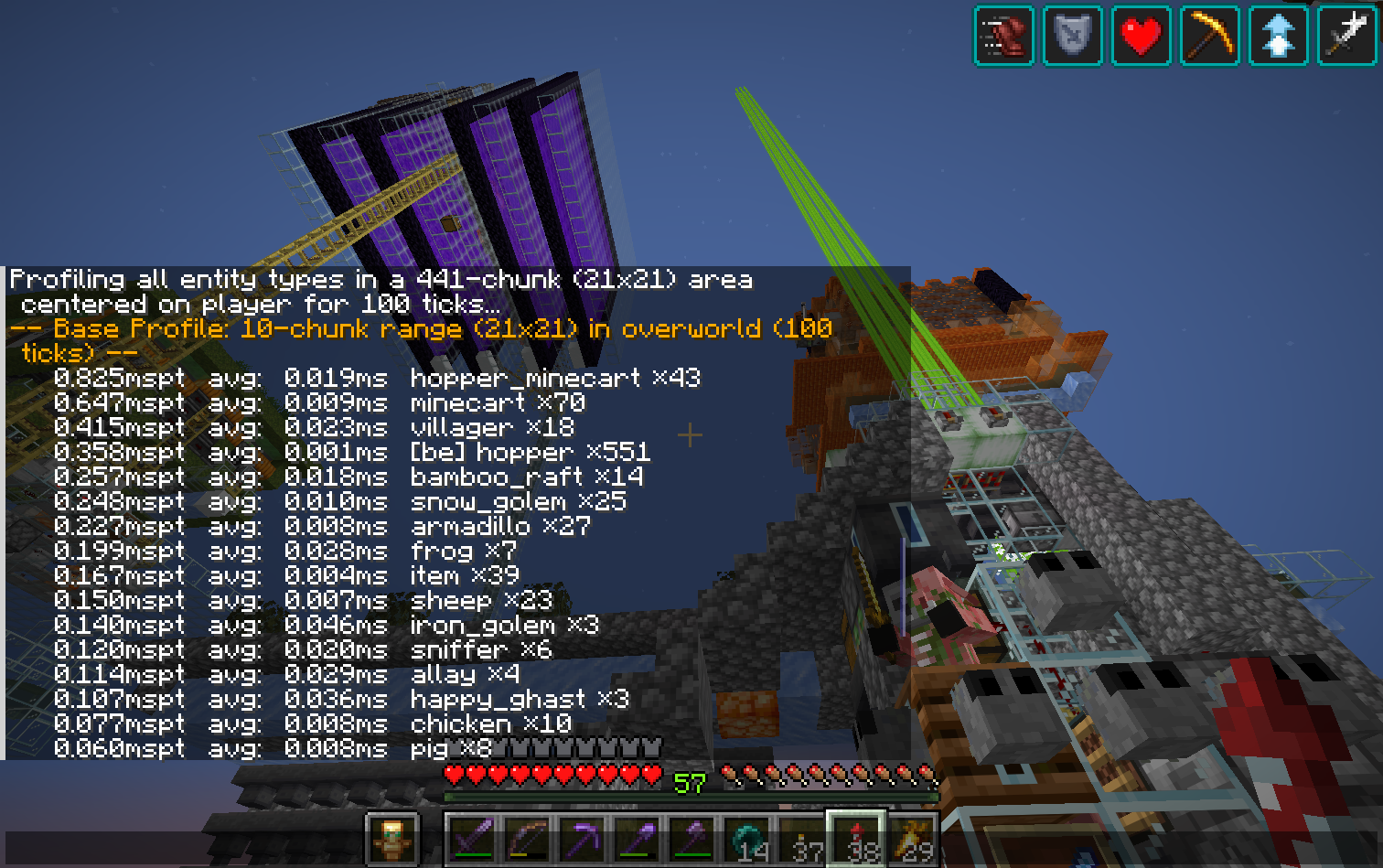 Range Scoped Profile
 -
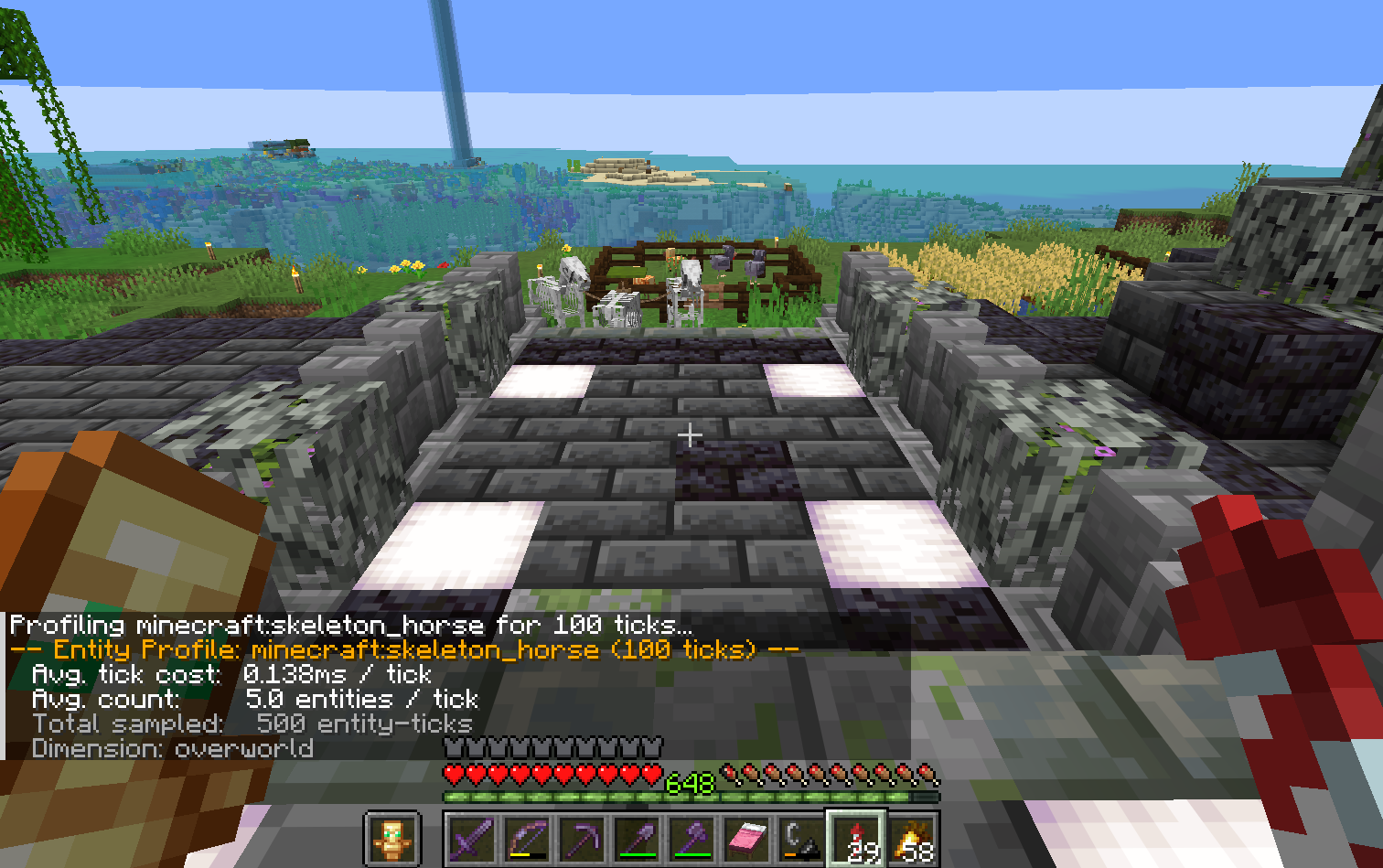 Entity Profiling
 -
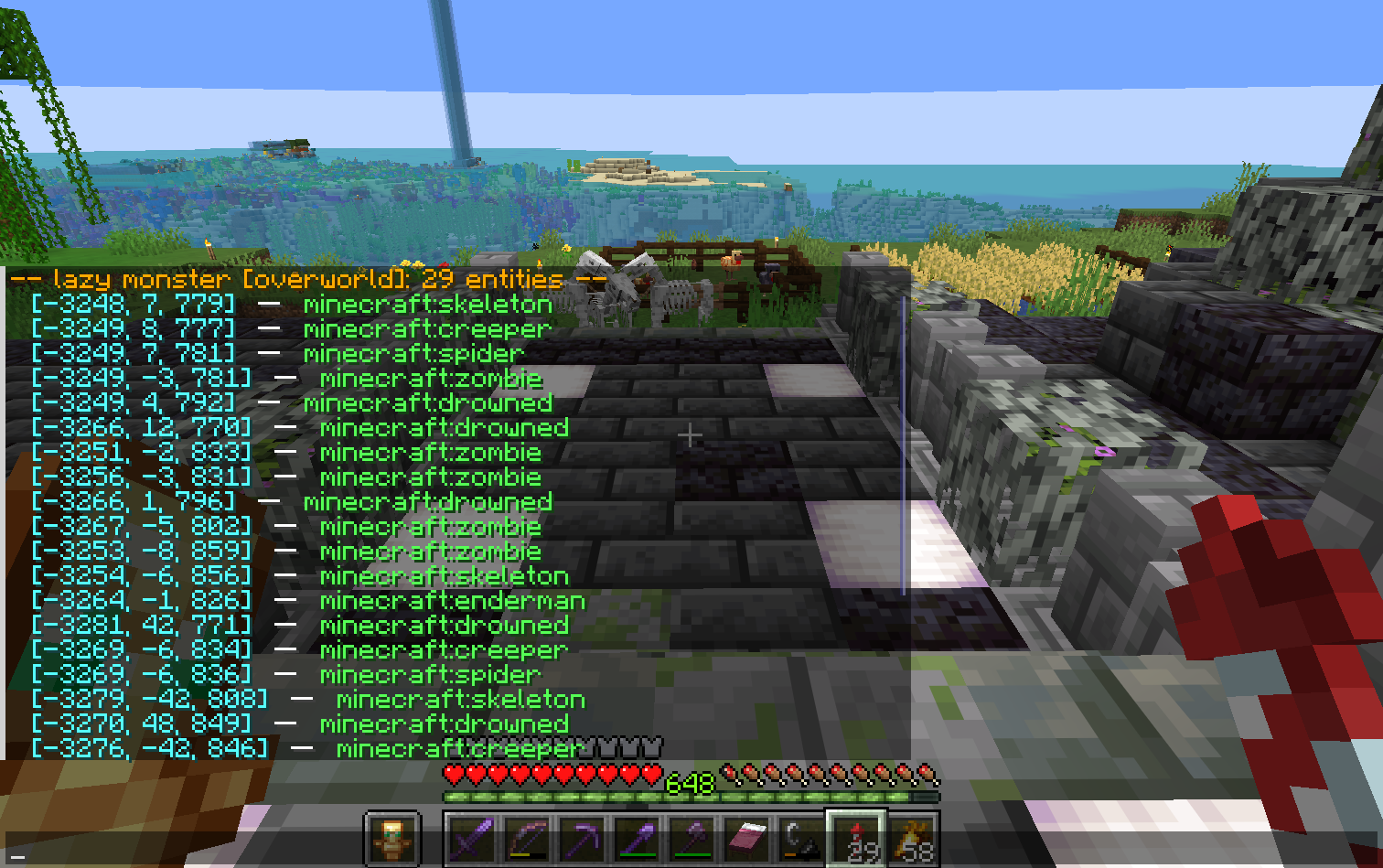 Lazy Loaded Mobs Find mobs that impact mobcap because lazy-loaded
 -
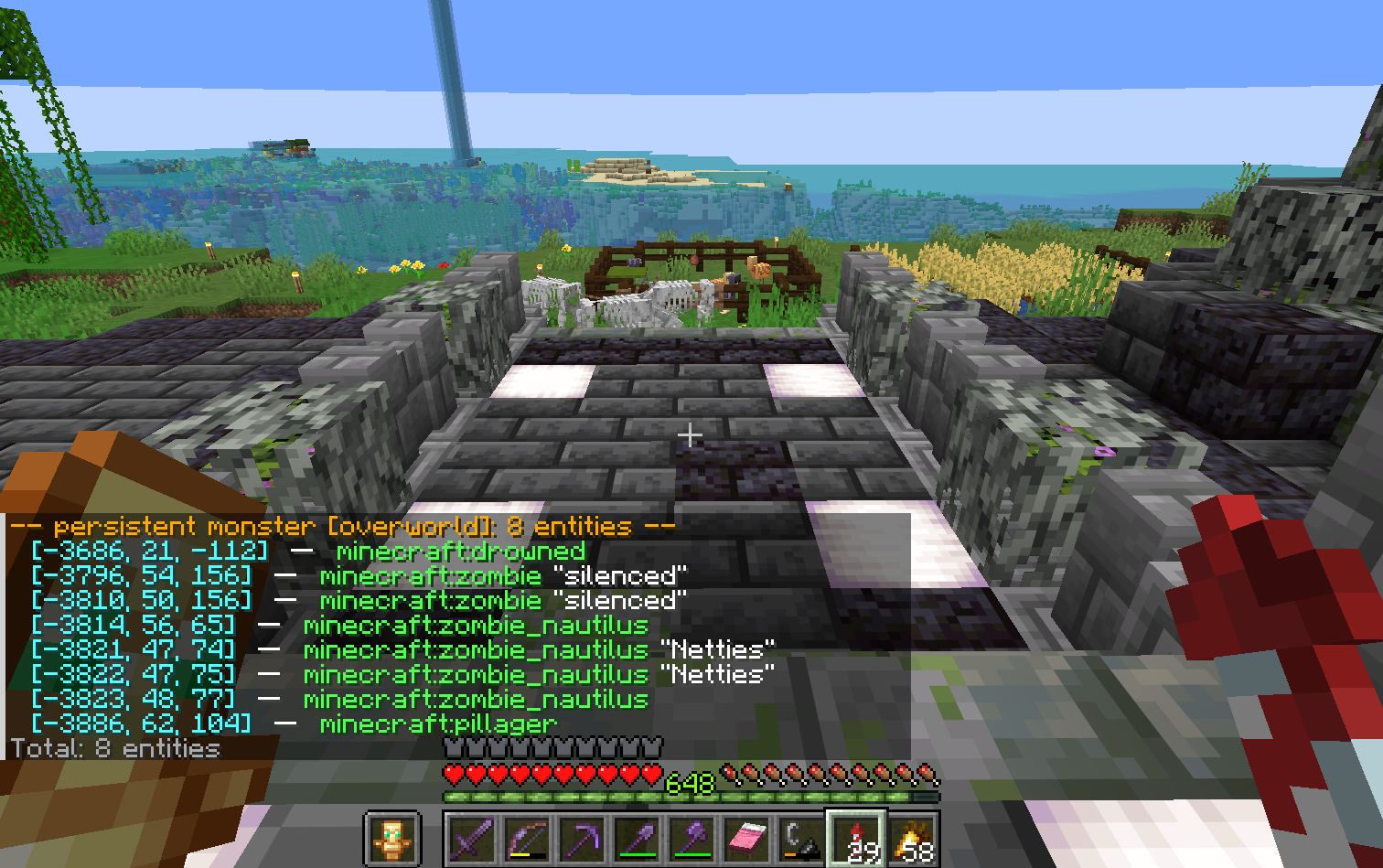 Find Persistent Mobs Name tagged, in boats or carts or on leads
Versions
Files
Relations
Project Relations
More like this
Similar Mods
Suggestions use data such as tags, dependencies, dependents, descriptions, titles, and more to rank how much they overlap with this mod.
On ModDex
Community snapshot
By the numbers
Statistics

 (opens in a new tab)
Get it on
Available Platforms
On ModDex
Community snapshot
By the numbers
Statistics
Resources